

Tracking the power behind the Internet Computer: NNS governance, voting blocs, whale influence & verified exchange flows. On-chain facts, not narratives
web3.0
Joined July 2026
- Tweets272
- Following32
- Followers541
- Likes634




Yesterday the network burned 2,497.99 ICP into cycles, 2.7 times a median day. One address, in one transaction of 1,238.70 ICP, was half of it.
That is the third time this month, and the pattern is the finding.
19 October, 7,236 ICP burned, two accounts in six transactions were 84%.
26 October, 4,574 ICP burned, one account in one transaction was 66%.
28 October, 2,498 ICP burned, one account in one transaction was 50%.
Now look at what the crowd paid on those three days: 1,143 ICP, 1,574 ICP, 1,259 ICP. Hundreds of payers, almost no variation. The entire difference between a 7,236 day and a 2,498 day is the lump sitting on top of it.
And the two lumps of this week are not even the same kind of thing. One is a single budget funded by one sender since 2021. Yesterday’s comes through an account fed by more than two hundred distinct senders, a shared payment path rather than one party. On a daily burn chart they look identical.
Here is the part that matters for anyone reading daily burn as demand.
27 October executed 612.0M messages, the most in sixty days. It burned 1,346.78 ICP, an ordinary day. Yesterday executed fewer messages and burned nearly twice as much.
A burn is a purchase of cycles. The compute it pays for can be spent weeks later. So the burn chart measures the buying decisions of a handful of conduits, and the message count measures the work. Two different measurements, and they should never be drawn as one trend.
Measured, not modelled.
The ICPulse founder list is close to full. 100 seats, price locked for the life of the account. icpulse.io
#ICP #InternetComputer #Cycles #Tokenomics #OnChain #DFINITY


The Internet Computer executed 612.0M messages yesterday and the number is being read as more traffic. It is more than that, and the interesting part is in a ratio nobody is quoting.
Against the prior 30-day average:
Messages executed, up 35.3%
Cycles burned, up 23.7%, now at a 60-day maximum
Blocks produced, down 10.0%
So the chain is not producing more blocks. It is producing fewer. Divide the two series and you get the actual change:
29.9 messages per block last month. 45.0 now. Up 50%.
The same consensus throughput is carrying half again as much executed work.
Cost per message barely moved, 9.84M cycles to 9.00M. That matters, because a new cheap workload would have cut that number hard. This is the same kind of work and there is simply more of it.
It is also not money moving. The ledger recorded 31,390 transactions, an ordinary day.
One honest note on method. These daily points are samples, not daily averages, so we read the trend and never a single day as a fact. The ratio climbs across the whole fortnight: 37.7 on 15 October, 38.6 on the 23rd, 42.8 on the 27th, 45.0 now.
What we cannot tell you yet is whether this is new canisters or existing ones working harder. We started collecting both numbers together on 25 October for exactly this question, and we will publish the answer when the series is long enough to mean something.
Measured, not modelled.
The ICPulse founder list is close to full. 100 seats, price locked for the life of the account. icpulse.io
#ICP #InternetComputer #Cycles #OnChain #Scalability #DFINITY


Yesterday the Internet Computer burned 4,573.65 ICP into cycles. That is the fifth largest day in the last 90, and 5.3 times the median day of 867.35.
Then we pulled every burn transaction of the day and the shape changed.
1,715 burn transactions. 697 distinct payers. And one address, in a single transaction of exactly 3,000.00 ICP, was 65.6% of the entire day.
Take that one transaction out and the day burns 1,573.65 ICP, which ranks 30th of 90. An ordinary day with one purchase sitting on top of it.
The address is not new to us. It is one of the accounts through which ICP is converted into cycles on this network, running since 31 May 2021, funded by a single sender, and nothing has ever been transferred out of it. A round 3,000 in one transaction is a compute budget being topped up, not metered consumption.
So this is not someone converting a holding. It is the network’s cycle minting path running, and the same account burned 8,485 ICP in August and 13,200 in September, the only two complete months in our window.
We are not naming who stands behind it. The ledger shows events, not owners, and the chain ends at a funding account whose customers exist in its own records.
One more number from the same rows, going the other way. Fee-paying transfers averaged 14,069 per day in August and 37,128 in October, 2.6 times more, while the daily burn stayed flat month over month. Transfers and compute are two different activities and right now they are moving apart.
Measured, not modelled.
The ICPulse founder list is close to full. 100 seats, price locked for the life of the account. icpulse.io
#ICP #InternetComputer #Cycles #Tokenomics #OnChain #DFINITY

We like it!

🌊 One chain is a waterfall. Another is a single drop
Same week, same crypto, and a 290x gap in real transactions per second
This is what actual onchain traffic looks like when you can see it
📊 chainspect.app/dashboard?ran…
ICPulse retweeted

Tomorrow, Dominic Williams (@dominic_w) will present “Sovereign cloud for the AI era” at @DubaiAIFest on 27 October 2026, 3:10 pm GST (12:10 pm CET) on the Innovation Stage.
With Open Cloud, you create a cloud engine from nodes you choose by operator, country, datacenter, and hardware class. The Internet Computer combines them into one platform that keeps running when some nodes fail.
Choose where your cloud runs: opencloud dot org

A chart going around shows zero in the “2 years and above” dissolving row, and the thread is reading it as conviction.
It is not. No neuron on the Internet Computer can hold more than 2 years of dissolve delay.
We sorted the entire neuron index by remaining delay and read the ceiling directly:
Maximum delay, whole index: 63,115,200 seconds. Exactly 730.5 days.
37,609 neurons sit on that exact value, to the second.
The longest dissolving neuron sits just underneath it, at 23.9982 months.
That is a cap, not a coincidence. Mission70 proposed cutting the maximum from 8 years to 2, with a one time migration capping every existing neuron. The chain matches the design.
So the zero is a value the protocol makes impossible. It says nothing about what holders believe.
Two things the chart does not show you.
The largest dissolving band is 18 to 24 months: 21,795,029 ICP across 1,532 neurons. That is 14,226 ICP per neuron, an order of magnitude above every other band. It is the shape a cap migration leaves behind.
And 44,016,245 ICP across 372,673 neurons is already dissolved. Disbursable now, no waiting period, no column anywhere on that chart. 15.3% of all staked ICP.
Measured, not modelled. We do not claim any of it will be sold.
Core ICP data is free on ICPulse, forever. What a founder seat buys is the head start: live whale flows, full history, and an alert the moment a large transfer moves.
100 seats. The founding price never rises while the subscription stays active.
icpulse.io/#founders
#ICP #InternetComputer #NNS #Staking #OnChainData


The new $ICP dashboard is 🔥 🔥 🔥 🔥 🔥 🔥 🔥 🔥 🔥
Notice how the two year gang has zero dissolve?
So bullish it's not even a debate.
Lock tf in and ignore the noise!

On 24 October the Internet Computer burned 2,196.03 ICP buying cycles.
For scale, an ordinary day earlier this month ran between 500 and 800 ICP. We know because we pulled every burn transaction of those days one at a time.
The rest of the day’s burn was 2.62 ICP in transaction fees. At a flat 0.0001 ICP per transfer that is 26,200 fee-paying transfers, which sits correctly under the 27,017 ledger transactions recorded for the same day, the difference being mints and burns, which pay no fee.
So for every 1 ICP destroyed by moving tokens around, 838 ICP were destroyed buying compute.
That ratio is the thing worth sitting with. The supply pressure on this network does not come from people transacting. It comes from people running software.
Total burn covered 96% of the day’s issuance. Minted 2,290.8, burned 2,198.6, net +92.2 ICP. A rounding error from break-even.
It also lines up with what we measured this week. Messages executed are up 29% against the previous month and cycles burned are up 27.8%. This is the same growth, counted in ICP instead of in messages.
Not claimed: whether these 2,196 ICP came from many buyers or a few large ones. On 19 October we checked and found two accounts behind 84% of that day. We have not run that check on 24 October.
Core ICP data is free on ICPulse, forever. What a founder seat buys is the head start: live whale flows, full history, and an alert the moment a large transfer moves.
100 seats. The founding price never rises while the subscription stays active.
icpulse.io/#founders
24h ending 25 Oct 00:00 UTC
Source: ledger-api.internetcomputer.…
#ICP #InternetComputer #Tokenomics #OnChainData

Two days ago we reported messages on the Internet Computer up 29% and said we could not tell where. Now we can.
We pulled the message rate for all 42 subnets, 45 days each, and compared 13 September to 12 October against 13 to 24 October.
36 of the 42 subnets rose. The median subnet is up 68.7%.
The biggest single contributor accounts for 13.7% of the increase. The top ten account for half of it, which means the other half is spread across everything else. Six subnets fell, the worst by 12 messages per second.
The two largest subnets barely moved. Together they carry 38% of all messages on the network and they grew 7.2% and 2.9%. The increase is in the middle and the tail, where eight subnets at least tripled from a small base, one of them by a factor of 5.5.
Split by subnet type, one group stands out. The eleven verified application subnets more than doubled, up 127.4%. They held 7.5% of network messages before and delivered 30.8% of the growth.
The three system subnets, which include the NNS, rose 11.3%. This is not governance traffic.
So it is not one application and not one workload. It is most of the network moving at once.
What we still cannot tell you is whether that is new canisters being deployed or existing ones getting busier. Message counts carry no canister identity, and until today nobody was storing canister counts per subnet over time. We now are, daily, from the same call that reports the message rate so the two are always comparable. Ask us again in two weeks and that will be a measurement instead of a question.
We built ICPulse to answer one question: when something large moves on the ICP ledger, who moved it and where did it go. The indexer reads the ledger every 60 seconds and tells us before anyone writes about it.
We are opening the first 100 subscriptions as founder seats. Those names hold the founding price for as long as they stay subscribed.
icpulse.io/#founders
#ICP #InternetComputer #OnChainData

ICPulse retweeted

Internet Computer flips Solana to become crypto's fastest chain.
Despite @Solana holding the top spot for several weeks, @dfinity was the fastest chain in crypto over the past week, recording some 2,323 tx/s.
$ICP's figure sat well ahead of $SOL's for the period, which saw only 1,896 tx/s.
The data comes from @chainspect_app's scalability dashboard.


Messages executed on the Internet Computer are up 29% against the previous month. We checked whether that is real.
Comparing the same daily series across two windows, 13 September to 12 October against 13 to 23 October:
messages per second 4,579 to 5,912, up 29.1%
cycles per second 46.39B to 59.31B, up 27.8%
cycles per message 10.13M to 10.03M, down 1.0%
That last line is the one that matters. If this were a change in how things are counted, the cost per message would have moved. It did not. The network is executing more work and the work is being paid for in cycles.
It is also not a spike. The rate stepped up around 13 October and has held for eleven days.
One number does not fit the others. Block production fell 11.7% over the same period, from 184.8 to 163.1 per second. More messages, fewer blocks. Each block now carries about 36 messages where it carried 25 a month ago, a 46% rise in density.
We do not know what is generating the extra load, and the network level series carries no subnet breakdown, so we cannot yet say where it sits. A message is a unit of execution, not a user and not a dollar. What we can say is that the increase shows up in three independent series at once.
The founder list is at 60 of 100. Those names get the first 100 subscriptions, at a price that never rises while the subscription stays active. icpulse.io
Source: ic-api.internetcomputer.org, message execution rate, block rate and cycle burn rate.
#ICP #InternetComputer #OnChainData

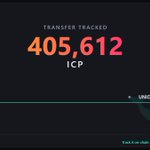
405,612.4784 ICP left Binance this morning at 08:46:23 UTC.
Five seconds later, at 08:46:28, the receiving account got a second transfer. 0.0001 ICP, the smallest amount the ledger allows, from an address that is not Binance.
That address begins 220c and ends 5a5. The real Binance address begins 220c and ends 5a5.
This is address poisoning. The dust buys the attacker one row in your transaction history, sitting next to the real one and looking almost the same. It costs 0.0001 ICP. It pays off the day you scroll back, copy what you think is the exchange address, and send.
The account that received the 405,612 had four transactions in its entire history before today. We are not naming it and we are not saying what the money is for.
We have seen this timing before. In August we measured the same thing landing seven seconds after a real transfer. Today it was five. Whoever runs this is watching the ledger and reacting, not drizzling at random.
If you move size, type the address or use a saved contact. Do not copy from your history.
The first 100 ICPulse subscriptions are founder seats, at a price that stays locked for as long as the subscription is active. Join the founder list at icpulse.io.
Source: the ledger, every transaction of the receiving account.
#ICP #InternetComputer #Security #OnChainData

112,732.77 ICP were minted on 21 October, the day after a 51,464.93 day. We traced both.
They are not the same event repeated. They are opposites.
On 20 October, 44 addresses were minted inside three seconds, all carrying one shared memo. Thirty-three minutes later, in the same second, every one of them sent its entire balance to a single collector. Each address now holds exactly two transactions.
On 21 October, 34 addresses were minted across twelve hours and twenty minutes, each with its own memo, each its own operation. Together 88,530.96 ICP, 78.5% of the day.
The amounts are what stands out. All 34 land between 2,493.79 and 2,674.78 ICP. A spread of 181 ICP on a median of 2,624. Thirty-four separate events, hours apart, within 7% of each other.
And then nothing happened. All 34 addresses hold exactly one transaction. Not one has moved. At the time we checked, the youngest had been sitting for 9 hours and the oldest for 22.
Not claimed: who controls these addresses, whether they belong to one party, or what the ICP is for. Identical structure is not ownership. We have refused stronger patterns than this one.
What we will do is look again in a few days. Whether 88,531 ICP stays still is a fact, and it will be measurable.
The first 100 ICPulse subscriptions are founder seats, at a price that stays locked for as long as the subscription is active. Join the founder list at icpulse.io.
Source: ledger-api.internetcomputer.…, every mint of both days and every transaction of all 34 recipients.
#ICP #InternetComputer #OnChainData #Tokenomics

Railway disclosed this week that an unauthorized third party may have reached customer environment variables, and for some of them obtained the decrypted contents. API keys, database credentials, registry credentials. They describe it as part of a series of attacks on platform companies aimed at reaching AI inference providers further upstream.
That is not a story about one company. It is a property of the architecture, and Railway is simply the one that disclosed it this week.
A normal web application cannot hold its own secrets. It runs on a machine it does not own, so its keys sit in the platform’s key store, and that store becomes the most valuable target in the system. Every customer’s secret in one place, protected by the platform’s discipline rather than by yours. Vercel, Render, Heroku, Railway: different companies, same shape.
A canister on the Internet Computer moves that problem somewhere else.
Its code and its state live on the subnet, not inside a hosting account. There is no deploy dashboard that holds the keys to it.
It has no private key of its own to steal. A canister signs with threshold cryptography split across the nodes of its subnet, so no single machine ever holds the whole key.
Who may upgrade it is a controller, and that controller can be a DAO. Changing the code becomes a vote with a public record instead of a password someone can phish.
What this does not solve, and we will not pretend otherwise: a canister that calls a third party API still needs that third party’s key, and that key sits in canister state. Controller keys can still be lost or stolen. The Internet Computer takes the platform operator out of the trust chain. It does not take key management off your desk.
The difference is that there is no longer a single store holding everyone’s secrets at once.
The first 100 ICPulse subscriptions are founder seats, at a price that stays locked for as long as the subscription is active. Join the founder list at icpulse.io.
#ICP #InternetComputer #Security #Web3job
51,464.9 ICP were minted on 20 October, seven times the day before. We traced every one of them.
36,366.49 of that total was minted in three seconds, between 11:43:43 and 11:43:46 UTC, across 44 separate addresses. All 44 mints carry the identical memo, a unix timestamp two seconds before the first block. One memo means one operation.
Then every one of those 44 addresses did the same thing. At 12:16:28 UTC, the same second for all of them, each sent its entire balance to a single collector. The money existed at those addresses for 33 minutes.
It closes exactly:
minted 36,366.4850 ICP
swept 36,366.4806 ICP
fees 0.0044 ICP, which is 44 transfers at the flat 0.0001
Nothing was held back. Every one of the 44 addresses now holds exactly two transactions and will almost certainly never be used again.
We have seen this before. In August we measured the same structure at the same collector: 23 addresses on one timestamp, largest 1,933.14 ICP, smallest 193.84. Yesterday it was 44 addresses, largest 2,131.75, smallest 194.90. The same distribution, twice the size.
Not claimed: who controls these addresses, whether they belong to one party, or why. Identical structure is not ownership.
The rest of 20 October was an ordinary day.
This is what ICPulse does every day. The first 100 subscriptions are founder seats, at a price that stays locked for as long as the subscription is active. Join the founder list at icpulse.io and we will tell you the day they open.
Source: ledger-api.internetcomputer.…, every mint of the day and every transaction of all 44 recipients.
#ICP #InternetComputer #OnChainData #Tokenomics

82 crypto projects are reported to have shut down this year. That is a good moment to ask what actually keeps a network alive, and then to measure it.
On the Internet Computer the answer sits on chain: people pay, continuously, to run software on it.
18 October was an ordinary day. 644 separate burns, 792.37 ICP destroyed to buy compute. 19 October was not ordinary: 7,236.29 ICP in 660 burns from 402 paying addresses. We checked every transaction of both days.
One shared payment path we have been tracking since August has carried 133,642 ICP into cycles from 201 separate paying senders. Measured to the end of August, and not one month at zero since November 2024.
The infrastructure gets paid too. Node provider rewards are denominated in XDR and settle on a monthly schedule, by protocol, not by anyone’s budget meeting.
None of that is a roadmap or a promise. It is a ledger.
DFINITY built this network and remains its largest contributor. The network itself is governed by the NNS, which is why those payments keep clearing regardless of how any single company’s quarter goes.
This is what ICPulse does every day. The first 100 subscriptions are founder seats, at a price that stays locked for as long as the subscription is active. Join the founder list at icpulse.io and we will tell you the day they open.
Source: ledger-api.internetcomputer.…, metrics-api.internetcomputer…, and our own measurements.
#ICP #InternetComputer #DFINITY #OnChainData


ICPulse retweeted

We're about to switch the ICP Dashboard to a new version: every number is read straight from the chain, and the dashboard itself is served from a canister. internet-computer:native
Like it? Don't? Found a bug/issue? Tell me below 👇
g3psz-xyaaa-aaaam-ajeza-cai.…
ICP closed 19 October with 7,236.29 ICP burned, nine times the day before. We pulled every burn transaction of that day to see what happened.
The day was not busier. 660 burns from 402 paying addresses, and 400 of those addresses come to 1,142.50 ICP between them. That is an ordinary day.
Six transactions are 84% of the total, and they come from two accounts that hold nothing. Each receives ICP, burns it seconds later, and is then sent a zero value notification. This is the network’s cycle minting path.
5,000.00 ICP in five identical 1,000 ICP tranches, 11:54 to 13:35 UTC
1,093.79 ICP in one transaction at 05:33 UTC
We have been measuring the second of the two since August. Its funding account collects from 201 separate paying senders, so one large burn there is many parties buying compute through a shared path.
None of this ICP was sold. It was spent on compute, and it no longer exists.
Not claimed: who operates either account, what the cycles will run, or whether the five tranches came from one party.
This is the kind of work ICPulse does every day. We are opening 100 founder seats, at a price that stays locked for as long as the subscription is active. Join the waitlist at icpulse.io and we will tell you the moment they open.
Source: every burn transaction of the closed UTC day, ledger-api.internetcomputer.…. The total reconciles with our published Net Emission figure to the cent.
#ICP #InternetComputer #Tokenomics #OnChainData

ICP closed 19 October slightly inflationary.
Minted 7,395.3 ICP
Burned 7,243.0 ICP
Net +152.3 ICP
Burn covered 97.9% of the day’s mint. Cycles took 7,236.3 ICP of that. The remaining 6.68 ICP is transaction fees, which at a flat 0.0001 ICP per transfer is 66,800 fee-paying transfers.
For scale: on 16 October the network burned 1,963 ICP. Three days later it burned 7,243, close to four times as much, while mint rose with it.
24h ending 20 Oct 00:00 UTC
Source: ledger-api.internetcomputer.…
#ICP #InternetComputer #Tokenomics #OnChainData

ICP closed 16 October deflationary.
Minted 1,951.4 ICP
Burned 1,963.1 ICP
Net -11.7 ICP
Almost all of the burn is cycles: 1,958.1 ICP bought compute. The other 4.97 ICP is transaction fees. At a flat 0.0001 ICP per transfer, that is 49,700 fee-paying transfers on the day.
The margin is 11.7 ICP. The network destroyed slightly more than it issued.
24h ending 17 Oct 00:00 UTC
Source: ledger-api.internetcomputer.…
#ICP #InternetComputer #Tokenomics #Deflation #OnChainData
