

I invest in Tech Early in NVIDIA and Tesla -- bought it way before it was cool. Firm Intel bull—betting big as Lip‑Bu Tan steers Intel’s comeback 🚀
Joined November 2025
- Tweets2.6K
- Following137
- Followers1.5K
- Likes7.5K




Pinned Tweet
$INTC I know we are all very hurt and emotionally involved in the company. But let’s take a step back. My personal take after digging deeper into the details:
@intel at $65 is honestly criminal. This feels like a massive overreaction, and I believe Intel could rebound at least 15% over the next three months.
But!
@LipBuTan1 needs to rebuild the investment thesis and give investors a compelling reason to believe in Intel again. I expect the next earnings report to bring a clearer picture, potentially with revised numbers and much stronger guidance for Q1 2027.
My take: Don’t rush to sell Intel. I’d wait at least until the next earnings report to see how management addresses the concerns and what the outlook looks like before making a decision.
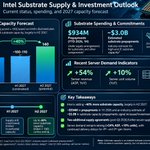
$INTC We are all disappointed that Intel cannot fully meet server CPU demand in H1 2027. However, there are several levers Intel can pull: reallocating substrate capacity to less demanding CPU lines, such as 5th Gen Xeons; improving substrate packaging yields; and, finally, raising prices to maximize revenue from the available supply given the exceptionally strong demand.
Importantly, some of the additional substrates could arrive earlier than anticipated, as Intel works with suppliers to accelerate delivery timelines while consistently seeking additional capacity.
H2 2027 will be the major turning point.
Intel CFO Dave Zinsner said:
“We’ve talked about putting 40% more capacity in substrates, but a lot of that doesn’t hit us until the back half of the year.”
With 40% more substrate capacity secured, the potential for earlier deliveries, improving yields, and strong Xeon demand, could Intel potentially double its server CPU revenue as supply constraints ease?
I believe that, starting in Q3, Intel will have significantly more capacity to sell and could therefore potentially double its server CPU revenue in the second half of 2027.
@LipBuTan1 @dzinsner

$INTC is a fundamentally stronger company today than it was in 2022, yet the market still appears to be significantly undervaluing its long-term potential.
I believe Intel deserves to trade well above $100 per share.
2027 could be the year Intel experiences a meaningful valuation rerating.
There are several catalysts that could drive this transformation:
1. Intel 18A and Intel 3
These technologies have the potential to become the workhorses of Intel Foundry, driving manufacturing scale, improving yields, and strengthening Intel’s competitive position for its own products.
2. CPU supply constraints
The ongoing demand for CPUs and industry supply constraints could give Intel greater pricing power, stronger margins, and meaningful revenue growth.
3. 14A, ASICs and advanced packaging
These businesses could open entirely new markets and customers. Advanced packaging and custom silicon represent significant opportunities, with the potential to become meaningful revenue contributors over time.
4. AI inference GPUs
Intel has an opportunity to participate in the rapidly expanding AI inference market. This could become another meaningful growth engine that the market is currently overlooking.
Let’s talk valuation.
Based on an assumed $60 billion in annual revenue, Intel trades at approximately 5.3× price-to-sales.
What if Intel received the same sales multiples as its semiconductor peers?
Company multiple
Intel implied share price
Valued like NVIDIA: 14.2× $159
Valued like AMD: 18.4× $206
Valued like ARM: 36.5× $409
And before someone brings up free cash flow…
Yes, Intel will likely remain under significant free cash flow pressure as it invests heavily in capital expenditure, particularly in advanced packaging capacity and 14A development to serve EXTERNAL customers!
Intel will return to sustained free cash flow generation. And when its foundry, packaging and product businesses reach scale, the potential for meaningful profitability could be substantial.
Intel is massively undervalued at these levels and the rerating to the upside will be fast
🤖 Made with AI

$INTC Intel’s ASIC business an other growth opportunity underrated by analysts consensus.
While investors focus heavily on CPUs and GPUs, Intel is quietly expanding its custom silicon business, designing purpose-built chips for customers with specific computing, networking and AI workloads.
1. ASIC business growth is accelerating
Intel management reported on its Q3 2026 earnings call that purpose-built silicon revenue increased:
• More than 50% quarter over quarter.
• More than 2× year over year.
CEO Lip-Bu Tan has also described the business as having tripled over the past three years, with the ambition to triple again over the coming years.
This is significant because custom ASIC programs can generate recurring revenue as customer-specific chips move from design into volume production.
2. How big is the opportunity?
Intel CEO Lip-Bu Tan has described the potential addressable market for purpose-built silicon as:
“Potentially it’s over $100 billion TAM market.”
Management has also discussed an approximately $2B annualized revenue run rate for the business, with a future $4B run-rate ambition.
3. Who are Intel’s existing ASIC customers?
• Fortinet ($FTNT): A named custom-silicon collaboration. Intel is working with Fortinet on its next-generation Security Processor 6 (SP6), designed for FortiGate security appliances.
• Major cloud customers: Intel has discussed purpose-built silicon and networking opportunities with hyperscale customers. Not all customer identities have been disclosed.
The opportunity is particularly interesting because custom chips are designed around individual customers’ workloads rather than being generic processors.
4. Who could become future ASIC customers?
Potential targets include:
• AWS — custom cloud infrastructure and AI silicon.
• Google — custom AI accelerators.
• Microsoft — Azure infrastructure and AI chips.
• Meta — AI inference and recommendation workloads.
• OpenAI — specialized AI computing.
• Anthropic — AI inference infrastructure.
• Networking and cybersecurity companies developing their own specialized processors.
These are potential customers, NOT confirmed Intel ASIC contracts.
5. Why could Intel benefit?
Hyperscalers and AI companies increasingly want chips optimized for their own workloads.
Custom ASICs can offer:
• Better power efficiency for specific workloads.
• Lower operating costs at scale.
• Greater control over chip architecture.
• Less dependence on general-purpose accelerators.
• More differentiated hardware for cloud and AI services.
🤖 Made with AI


IntelBull retweeted

🚨 @ElonMusk ON WHY THERE'S NO AI DEMAND PROBLEM:
"We've actually tried to offload some of our inference compute to other cloud providers so that we can use more compute for training, and we get the Cheese Shop Sketch"
He says no one has any chips left to rent:
"We'll ask them, 'What about some GB300s?' 'Nope, don't have any of those.' 'What about some TPUs?' 'Nope.' 'How about some H100s?' And they're like, 'Well, we might have some overseas somewhere.' And then they'll come back and say, 'Nope, we don't have that either'"
And says demand isn't the issue:
"I don't think we're gonna have a demand issue here"

IntelBull retweeted

The sad irony of this is:
- the Leeds data centre is estimated to create 1,000+ jobs across the region
- its water needs are roughly equivalent to 5 moderately busy car washes
- and... it will use rainwater gathering, so a decent chunk of water needs are covered anyway
Objecting to it essentially makes the region poorer, for no real gain.


IntelBull retweeted

Super intelligence leads to abundance

SpaceX’s Arizona data center, per a county supervisor: “We could be reducing property taxes across the board in Cochise County, the entire county, by 20%”
Frank Antenori, whose district includes the site, brought up the county’s tax math during a live Q&A:
“Here’s just something to just chew on. Arizona has an expenditure limit requirement that is placed on counties. If we exceed that expenditure, we have to rebate back to the taxpayers a certain amount.”
“So, if we’re receiving revenue in from SpaceX, by law, we have to offset that to the taxpayers. We have the potential to reduce, based on the projected revenue they’re creating, as much as 20%.”
“Let me just say it again. We could be reducing property taxes across the board in Cochise County, the entire county, by 20% to offset for the revenue here, because we can’t spend all that money. So, we have to give that money back to the taxpayers. The law says we have to.”
“So, you could see a potential significant impact to local property taxes. What that is, I don’t know. We’re going to have to do the math on it. But the law, if we have this large increase in property tax revenue, we have to balance those rates. So that will reduce dramatically the property tax burden of every resident in the county.”
“The construction sales tax, which also is the TPT, the transaction privilege tax, the retail tax, and the jail excise tax. So that will be part of the construction tax. We could literally use that money to pay the jail off in 2 to 3 years, as opposed to the 13 to 20 years.”
“So this could be a revenue to eliminate the half-cent sales tax in 2 to 3 years. We can get rid of that half-cent sales tax.”
IntelBull retweeted

先购入天量的看跌期权,然后在周末释放Jensen的桃色丑闻进行发酵,一切看起来都那么的理所当然,充满着操纵与欺骗。

$10,400,000 of $NVDA $120 puts were just purchased at $1.04 per contract.
Expiring Dec 18, 2026.
IntelBull retweeted

People are confusing political theater and emotion with how the real world works.
The demand for super intelligence is only increasing and we don’t yet have at scale humanoid bots, self driving cars globally, AI in mfg, massive disease discovery , and even close to full AI penetration in business or personal agents scaled which will increase demand maybe millions of times where we are today.
Supply will eventually meet that demand whether it is built in the US, other foreign countries, and in space. The US controls their own destiny. We can choose to be AI sovereign, on the cutting edge, create the most amount of jobs/wealth, and be as secure as possible - making deals that greatly net benefit local communities too. We still have the opportunity to have our cake and eat it too… Or we can fall into a mob driven psyop used as a political wedge to help get one party elected. My gut tells me deals will get made.
But to be clear, the AI hyperscalers / cloud companies do not need US soil to build AI infrastructure. I think they prefer to have it in the US but these are highly resourced global companies who will go where is needed to fulfill demand. My other guess is the exec branch will start allocating significant amounts of federal land if local communities make themselves a bottleneck.
If you take one thing away from this post, just know AI infrastructure will get built to meet demand wherever in the world or universe is required. Taking the results of a midterm election in one country (that was mostly expected to be split gov outcome) and applying it to the demand/supply for super intelligence is literally absurd.

There is no fact-based argument for a reduction of data center build out due to an already expected split government midterm result or the state voting initiatives.
1. If a local/state gov doesn’t want to make a deal, the cloud/hyperscaler will move to one who will . This isn’t binary, most locals are making deals. The builds over the next 1-1.5yrs are already permitted.
2. If the US as a whole rejects enough land mass where the demand for AI factories cannot be fulfilled in the US, those AI factories will move offshore repeating the prior 3 decades of globalization and hollowing out of our middle class. It was dumb back then and even dumber now given the geopolitical national security implications of AI sovereignty…
@HalftimeReport @TheJudgeCNBC
.@sama @DarioAmodei maybe saying to millions of Americans that AI will come for your job over and over again wasn’t a good idea after all…
2
13
949
IntelBull retweeted

Crazy week. Fought the good fight for what we believe to be true. Innovation does not stop and AI is the growth engine of the U.S. and the world. Long American Exceptionalism. ❤️🇺🇸


Previously, the doom-and-gloom narrative was dominated by the Iran war, inflation, debt, and bond yields. Now, the focus has shifted to the data centre moratorium. Honestly, fear sells.
Don’t let them scare you out of your positions! Everything will be fine. Stay long. The average bear market lasts around nine months. Go outside and tune out the news for a while.
A bubble driven purely by speculation wouldn’t have a forward P/E of less than 20. If these doom-and-gloom commentators are truly right, the entire market will tank and the economy will slide into a recession. Many people will lose their jobs, including the very same people calling the AI buildout a bubble.
Don’t let a few short sellers and their sponsored FUD destroy your hope for a better future.
Chip demand is running at roughly 4:1 relative to supply (So there is a lot of room). Most of these chips are already paid for and on take or pay contracts) Regardless of what happens in the market, chip capacity remains heavily constrained, with orders and supply commitments extending well into the future
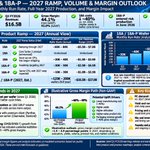
$INTC — 18A is shaping up to be a huge success for Intel.
CEO Lip-Bu Tan confirmed the manufacturing ramp is progressing in both Oregon and Arizona:
“The ramp of the 18A in both Oregon and Arizona, including Fab 62, our second high-volume 18A fab.”
He also confirmed Clearwater Forest is already shipping for revenue, while Diamond Rapids, Intel’s first 18A-P server product, is on track to ramp in 2027.
And the manufacturing improvements are becoming increasingly important.
Intel CFO Dave Zinsner said on the Q3 earnings call:
“Intel 18A costs have declined approximately 40% since Q1, reflecting continued yield and cycle time improvements.”
The manufacturing economics are moving in the right direction:
• Higher yields = more usable chips per wafer.
• Better cycle times = faster production and improved throughput.
• Higher factory utilization = fixed costs spread across more output.
• A richer mix of premium client and Xeon server CPUs = potential margin expansion.
Management reported that 18A yields improved at a double-digit rate, while wafer output on Intel 18A and Intel 3 exceeded expectations.
Intel also reported:
• 18A output approximately 25% above target.
• More than 50% quarter-over-quarter output growth.
Now combine improving yields, falling manufacturing costs, expanding factory capacity in Arizona and Oregon, and the upcoming 18A-P product ramp.
This is how Intel can build a much stronger manufacturing business and improve margins.
The 2027 opportunity is getting increasingly interesting. Intel is trading at bargain prices based on the work accomplished on the manufacturing side.
Wafer-start projections based on @Alex_Intel_ Intel and analyst estimates, not official Intel guidance.
🤖 Made with AI

IntelBull retweeted

If Texas or other states don’t want the economic benefits of data centers, Alabama will gladly take the business.
alreporter.com/2026/10/16/op…

$INTC Intel 2027 external packaging revenue is not accounted for by analysts forecast. Packaging is high margin business that saw multiple price increases as the bottleneck deepened.
Experts believe Intel could generate $3B–$5B in annual packaging revenue as external customer programs scale in 2027.
For context, estimates put TSMC’s packaging-related revenue in the $11B–$18B range in 2026.
AI chip demand is surging, and advanced packaging remains a critical bottleneck. Intel could capitalize without requiring customers to move wafer fabrication away from TSMC or Samsung.
Intel CEO Lip-Bu Tan said on the latest earnings call:
“Both continue to see significant external customer traction as well.”
He was referring to Intel’s EMIB and EMIB-T advanced packaging technologies. Tan also said Intel is adding capacity in New Mexico and Malaysia to support customer ramps in 2027.
Even a handful of major AI packaging wins could unlock billions in annual revenue for Intel.
🤖 Made with AI

There is more than $750 billion in compute backlog waiting to be monetized. Do you really think these companies don’t want to turn that demand into revenue?
The demand is there. Customers are waiting for compute capacity. Every day that capacity cannot be delivered is revenue that cannot yet be captured.
This is the opportunity the market seems to be missing: the bottleneck is not necessarily demand — it is the ability to supply enough compute to meet it.
And if America makes it too difficult or expensive to bring that capacity online, companies will build elsewhere. It’s a big world 🌍. Capital and future projects can move to countries with cheaper power, faster permitting, and better economics.
The irony is that the Trump administration wants AI infrastructure built in America to create jobs, drive economic growth, and secure US technological leadership.
But you cannot expect to capture the economic benefits of the AI boom while making it harder to deliver the compute customers are demanding.
Every project that moves overseas means potentially lost jobs, supplier revenue, tax receipts, and strategic advantage.
America, stop shooting yourselves in the foot. 🇺🇸
Build the capacity. Deliver the compute. Monetize the demand.
$INTC $AMD $NVDA $TSM
1
9
1,061
IntelBull retweeted

$INTC 8 years ago:
• $55/share
• Primarily an x86 CPU & PC business with no external foundry business or outside backing & no meaningful AI growth engine
$INTC today:
• $55/share
• A centerpiece of America's push for domestic advanced chipmaking backed by U.S. government & $NVDA with Data Center & AI revenue just posting its strongest growth in 15 years
Same price. Very different business.

Intel GPU D-Series: A New AI Inference Opportunity for $INTC that could bring billions of revenue as early as next year for Intel that is not accounted for by analyst forecast.
Google is already estimated by analyst to bring $40 billion in revenue in 2027 through its AI TPUs sales to external customers.
The broader AI inference market is projected to reach $421.8 billion by 2033. Could this be Intel's opportunity to capture a meaningful share of one of AI's fastest growing markets?
Every ChatGPT response, AI generated image, coding assistant and AI agent requires inference computing. As adoption grows, the opportunity is to deliver more tokens at a lower cost.
Intel designed this GPU specifically for memory intensive inference workloads, prioritizing memory capacity, bandwidth and power efficiency.
Key specifications:
• Up to 480GB LPDDR5X memory
• 1.5 TB/s memory bandwidth
• 1.3 PFLOPS FP8 compute
• 350W power envelope with air cooling
It is designed to support models up to 300 billion parameters on a single card.
On Intel's Q3 earnings call, Lip-Bu Tan said:
"Early feedback is encouraging. Performance is tracking well." He added that customer engagements are progressing towards firm commitments.
🤖 Made with AI
