
Lead Strategist @1of10media Book a call: https://teapawt.net/t.co/uNr8tOqalC
Wales, United Kingdom
Joined September 2013
- Tweets10.6K
- Following311
- Followers10.7K
- Likes16.2K



Insane

I pushed Opus 5.5 to make the whole planet Earth look photorealistic at night with no loading time between day/night cycles
Here I'm still in Paris in that video and.. Yeah, really happy with the result! It looks pretty cool I think!
But I want to 100x everything.. So now I'm thinking about moving the project to Unreal Engine because I'm starting to feel limited by the browser
One issue is that I'm rebuilding the lighting system, shaders, collisions, etc. myself, and I don't have access to NVIDIA tools like DLSS.
On the other hand, Unreal Engine has Nanite, makes better use of my GPU and also has many other useful tools
I could probably rebuild a smaller version of all that, but I feel like it'd be a waste of time and tokens?
Let's see! :)
Proud enough to say I'm better than 99% of people at YouTube
Humble enough to admit there are people better than me
It might be a bit too apparant that I don't post ai slop tweets, actually

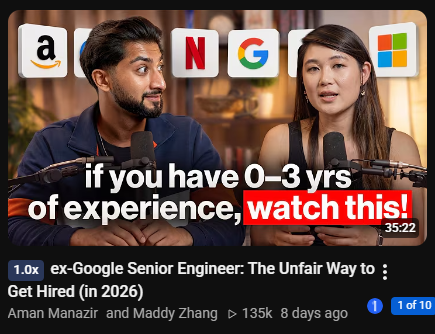
Some things to think about when packaging your next video:
1. are you the expert in the topic?
2. do you have an angle nobody else in your niche has? 3. do you solve a specific problem/pain point in your video?
4. do you have an authoritative position considering the information you will be giving?
If so, communicate this in the packaging rather than relying on a person to click and find out in the video!
This can either be in the title or thumbnail!



JD retweeted

"Outlier theory is dead"
Well, explain THIS then...
We found a doctor's creatine video that did 4x his channel average.
A clear sign that there was serious interest in the topic.
So we took that proven demand and developed a new angle around an experiment:
"I Took 5x The Recommended Creatine For 7 Days. Here's What Happened."
Then we focused on the thumbnail.
The biggest decision? Writing "25g/day" in the powder instead of "Creatine".
"Creatine" tells you what the video is about immediately. But "25g/day" written in questionable white powder? 25g/day of what?
You're forcing people to take the extra 1-2 seconds to pay attention to the title. And since the video idea was based on a proven interest topic and the proven "I did X so you don't have to" format, it worked.
Built the final thumbnail in 1of10's thumbnail generator with a few specific design choices:
- Dark wood floor so the white powder pops
- Dark clothes so nothing pulls your eyes away from the text
- Brighter wall so there's enough contrast for his face to stand out
The result? 351K views in the first 10 days, 637K in the first month. A 1 of 10 for his channel, and 4.2x outlier.
So tell me again how outlier theory doesn't work...


JD retweeted
two of my favorite thumbnails i ever worked on - both inspired from outside of YouTube
i wanted to capture the same raw intensity i always felt watching these scenes in the anime and loved this top down composition.
the result?
almost 8 million views combined, across 2 videos in completely different niches.


Channels I’ve seen blow up weren’t even run by the most talented creators
They were run by the ones who actually enjoy the process - giving out their insight, discovering their audience, learning how to improve their content
A lot of creators forget that you need to enjoy the process to grow on YouTube. It'll never be sustainable otherwise and so your efforts were worth nothing
"The person who loves walking will always go further than the person who loves the destination"
Don't just create content to chase a bag. Create content for a positive impact on the people watching it


Goated analysis broken down simply

They're willing to pay for advice, so we're giving it for free.
A few hours ago, I was tagged in a message asking for advice about their YouTube channel. The hosts of a YouTube channel called “The Adventure Crews” would go to ask for more information about how to solve their retention curve.
First, we took a look at the message they sent. The first thing that the host shared was some data from their last video.
73% of their viewers are 45+
Roughly 75% male / 25% female
7:01 average view duration on their latest video
32.7% average percentage viewed
But there's something else they share right after this, which is the problem they are struggling to solve.
They say “We're losing more than HALF of our viewers in the first 60 seconds. Our retention drops from roughly 93% to 49% in that first minute. And here's what's interesting: Once viewers make it through our intro, the retention curve levels out pretty consistently across our videos. We just need to figure out how to get more of them past that first minute.”
So, let's solve this for them.
First, let's look at the data they shared and add some nuance to understand which metrics are actually useful.
The first piece of data is their demographics. Knowing that the majority of their audience is over 45 years old, with a split favoring males, is useful information when figuring out why certain things are working and why not. However, it doesn't necessarily solve our problem, so we're putting this information to the side for the actual analysis.
Next, we have their average view duration and average percentage viewed. Their AVD and APV. The problem with these metrics is that they're heavily influenced by selection bias. We don't know who YouTube showed the video to, whether these were colder audiences, or how the audience differs from their other videos. On top of that, AVD is influenced by video length, making comparisons even more difficult.
So while these numbers tell us something about viewer behavior, they don't necessarily tell us whether the video performed well or not. There are simply too many factors influencing them, so let's put these metrics to the side as well.
And this brings us to their actual problem: losing more than half their viewers in the first 60 seconds.
The same reasoning applies here. What matters isn't the actual percentage, but the behavior of the retention chart, which isn't something they shared.
I don't really care what percentage we start with and end up with after 60 seconds. What I care about is: what were the moments where we lost people, and what were the moments where people kept on watching?
Now, the intro isn't just about engagement. It's also the second decision point viewers use to decide whether they want to watch the video.
In this case, it seems like YouTube is serving the video to people who are likely to click, but many of them are making their decision during the intro rather than before clicking. This could explain why the initial drop looks so aggressive.
Later in their message, they ask whether the issue is storytelling, pacing, the way they're opening the video, or something they're completely overlooking.
So, after looking at the first 60 seconds of their video, here are the five things I've noticed.
1. Make sure the intro follows a logical structure.
Right now, we're giving the viewer a lot of information, but it's not presented in a logical order. We're jumping between teaser clips, context, narration, and different statements without really connecting them. This makes it difficult for the viewer to understand what we're trying to communicate. I would focus on restructuring the intro so that every piece of information builds on what we've previously established.
2. Make sure the visuals and narration support each other.
There are several moments where the visuals don't really connect with what we're saying. For example, we're showing lobster fishing while talking about spending 48 hours on the island. We're also including statements from locals that don't necessarily add anything to the context we've already provided. I would make sure that every visual and statement has a clear purpose and helps the viewer understand the story.
3. Start the story closer to where the actual experience begins.
After the intro, we're spending quite some time sitting in a car, talking about the island and explaining how we're getting there. The problem is that the story starts way too early. I would consider opening the actual video when we're standing in front of the boat or arriving at the isolated island. This immediately puts the viewer closer to the experience we're promising, rather than making them sit through information that isn't necessarily important.
4. Be more selective about the information we're giving the viewer.
We're spending quite some time explaining how to get to the island, the different transportation options, and when the ferry operates. But we should ask ourselves whether the viewer actually needs this information to follow the story. Just because something happened during the experience doesn't mean we need to include it. I would focus on information that helps establish the situation.
5. Create more tension and make the tone match the experience.
I think one of the biggest problems with the first minute is that everything feels extremely happy. We're presenting this remote, isolated island as somewhere difficult to live, but the music, narration, and overall presentation don't really communicate that. Everything feels quite relaxed. I would focus on creating more tension, emphasizing the isolation, and making the viewer curious about what we're going to discover. We need to establish why this experience is interesting and give the viewer something to look forward to.


4. Knowing your audience Not just “who your current audience is” but who are the new people we're trying to reach? What are they worried about? What would make them stop scrolling. Every idea we did had to answer one question: why would our viewer care about this? If we couldn’t answer it, the idea didn’t get made.


JD retweeted

@TeamYouTube Hi, I’m Justin Dorff. My fitness channel (@JustinDorff) (100k+ subs) has been entirely demonetized.
I’m concerned that YouTube's automated moderation systems may be incorrectly flagging my content, and I'm hoping someone can help.
I create videos documenting my personal experiences testing popular diets, health trends, and wellness products.
Recently, several of my videos were removed for allegedly violating YouTube's harmful behavior and eating disorder policies.
Every removal notification explicitly stated that my channel had received no strike and wasn't being penalized.
Yet my entire channel has now been demonetized and removed from the YouTube Partner Program.
I believe my content is being misclassified. My videos document personal experiments for entertainment and education. They do not promote eating disorders or encourage harmful behavior.
What I don't understand is why my channel has lost monetization when the videos identified as violations have already been permanently removed, and each removal notification assured me that my channel wasn't receiving a strike or penalty.
I'm respectfully requesting a manual review of my channel and the decisions that led to its demonetization.
I'd sincerely appreciate your help getting this resolved.