
Vancouver policy lawyer, past Deputy Minister, CEO, UBC law prof., Bank of Canada director. Quora rated him most viewed writer in climatology.
VANCOUVER BC
Joined September 2013
- Tweets25.5K
- Following709
- Followers877
- Likes2.9K




Jim Matkin retweeted

Most climate change debate today treats atmospheric CO₂ as a threat, and modern temperatures as a dangerous anomaly.
But a far more resilent Earth emerges once you step back into deep geological time and see basic plant biology. CO₂ is still the foundational carbon source of all terrestrial life, on a planet still locked in a long-term ice age.
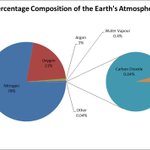
CO₂ comprises roughly 0.04% of Earth's atmosphere. It's not a toxic pollutant though, it's a vital trace gas. Through photosynthesis, plants draw in CO₂ and water to build carbohydrates and release the oxygen every animal and human depends on. Higher atmospheric CO₂ directly stimulates plant growth, improves water-use efficiency in crops and lifts global agricultural yields.
NASA's satellite observations confirm that rising CO₂ over recent decades has driven record global greening. This resulted in expanding leaf cover over arid and temperate regions - an area twice the continental United States.
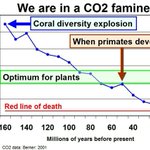
Viewed across geological time, CO₂ levels are unusually 'low' - not dangerously high. Throughout the Phanerozoic Eon spanning 539 million years, atmospheric CO₂ was routinely several times higher. Before the first vascular plants colonised the land in the Cambrian, CO₂ sat between 4,000 and 7,000 ppm while marine biodiversity was ready to explode.
Over hundreds of millions of years, rock weathering and carbon burial steadily drew that carbon down. By the time of the Last Glacial Maximum 20,000 years ago, CO₂ had fallen to roughly 180 ppm — close to the 150 ppm threshold below which many land plants cannot survive. The modern rise above 400 ppm is a bounceback from historic depletion, not an unprecedented spike.
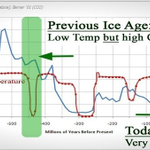
Earth's temperature tells a similar story when placed in a broader context. Our planet is still in the Late Cenozoic Ice Age, which began 34 million years ago, when permanent ice sheets formed on Antarctica. More specifically, we live in the Quaternary glaciation (begun 2.58 million years ago), experiencing a temporary warm interglacial — the Holocene — between major glacial advances.
Across hundreds of millions of years, Earth's average temperature has frequently been far warmer than today, by as much as 9°C during prolonged greenhouse eras when polar ice caps did not exist.
During the most recent Eemian interglacial 125,000 years ago, temperatures ran roughly 2°C warmer than today. This warming was driven primarily by natural orbital shifts, solar variations and ocean circulation, not from rising CO₂.
If natural or human-driven processes warm the planet further within today's Holocene interglacial, the geological record points to ecological expansion rather than biological collapse.
These are not a crisis. Warmer temperatures paired with higher CO₂ reduce cold-weather deaths. They lengthen the growing seasons and push arable land and forests northward into the vast empty expanses of the Siberian taiga and boreal belt.
This extends a miraculous planetary greening, which is already well underway.

Jim Matkin retweeted

It’s the same everywhere this green idiocy has taken hold.


Sverige har lyckats med något historiskt. På bara några år har vi förvandlat ett land med nästan gratis, stabil el till ett land där folk får ångest varje gång de öppnar sin elräkning. Det är en bedrift som få länder matchar.
Förklaringen är enkel och elegant: de rödgröna stängde kärnkraftverk som producerade el dygnet runt, året om, och ersatte dem med vindkraftverk som producerar el när det blåser lagom mycket. När det inte blåser importerar vi istället el från kolkraftverk i Tyskland eller gas från länder vi helst inte vill nämna. Resultatet? Rekordhöga priser i södra Sverige och politiker som förklarar att det här är precis så det var tänkt.
När elräkningen landar på 12 000 kronor i januari får man höra att det är Putins fel. Eller klimatets. Eller marknadens. Aldrig att det kan ha något att göra med att man medvetet monterat ner den enda energikälla som faktiskt levererar planerbar el i stor skala.
Nej, lösningen är mer av samma: fler vindkraftverk till havs, fler solpaneler som inte ger något i december, och fler utredningar om hur man ska kompensera hushållen för den politik man just genomfört.
Samtidigt exporterar Sverige el till kontinenten när det blåser bra, för att sedan köpa tillbaka dyr el när det är kallt och vindstilla. Det kallas ”europeisk solidaritet”. Svenska villaägare kallar det något annat när de sitter i mörkret med vinterjackan på och funderar på om det är värt att sätta på ugnen.
Det vackraste är ändå retoriken. Man talar om ”grön omställning” medan elpriset gör att folk tvingas elda med ved eller stänga av elementen. Man talar om ”framtidens energi” medan industrierna hotar att flytta. Och när någon påpekar att Norge och Finland har lägre priser tack vare mer kärnkraft, blir svaret att Sverige är mer progressivt.
Så nästa gång elräkningen kommer: tänk inte på den stängda reaktorn i Barsebäck eller Ringhals. Tänk på de vackra vindkraftverken som just nu står stilla. Det är framsteg. Det är moral. Och det är, enligt de ansvariga, det enda ansvarsfulla valet.

Jim Matkin retweeted

Sverige har lyckats med något historiskt. På bara några år har vi förvandlat ett land med nästan gratis, stabil el till ett land där folk får ångest varje gång de öppnar sin elräkning. Det är en bedrift som få länder matchar.
Förklaringen är enkel och elegant: de rödgröna stängde kärnkraftverk som producerade el dygnet runt, året om, och ersatte dem med vindkraftverk som producerar el när det blåser lagom mycket. När det inte blåser importerar vi istället el från kolkraftverk i Tyskland eller gas från länder vi helst inte vill nämna. Resultatet? Rekordhöga priser i södra Sverige och politiker som förklarar att det här är precis så det var tänkt.
När elräkningen landar på 12 000 kronor i januari får man höra att det är Putins fel. Eller klimatets. Eller marknadens. Aldrig att det kan ha något att göra med att man medvetet monterat ner den enda energikälla som faktiskt levererar planerbar el i stor skala.
Nej, lösningen är mer av samma: fler vindkraftverk till havs, fler solpaneler som inte ger något i december, och fler utredningar om hur man ska kompensera hushållen för den politik man just genomfört.
Samtidigt exporterar Sverige el till kontinenten när det blåser bra, för att sedan köpa tillbaka dyr el när det är kallt och vindstilla. Det kallas ”europeisk solidaritet”. Svenska villaägare kallar det något annat när de sitter i mörkret med vinterjackan på och funderar på om det är värt att sätta på ugnen.
Det vackraste är ändå retoriken. Man talar om ”grön omställning” medan elpriset gör att folk tvingas elda med ved eller stänga av elementen. Man talar om ”framtidens energi” medan industrierna hotar att flytta. Och när någon påpekar att Norge och Finland har lägre priser tack vare mer kärnkraft, blir svaret att Sverige är mer progressivt.
Så nästa gång elräkningen kommer: tänk inte på den stängda reaktorn i Barsebäck eller Ringhals. Tänk på de vackra vindkraftverken som just nu står stilla. Det är framsteg. Det är moral. Och det är, enligt de ansvariga, det enda ansvarsfulla valet.


Jim Matkin retweeted

THE ONE THING NEARLY EVERY CLIMATE SCIENTIST GETS WRONG
There is a number at the center of climate science. Everyone fights about it. The IPCC says it is going up because of CO2. The skeptics say it is going up because of the sun, or clouds, or ocean cycles, or pressure. Nikolov and Zeller say pressure explains it entirely.
They are all wrong.
Not about the cause. About the number.
The number has no physical meaning.
Global Mean Surface Temperature. GMST. Global temperature anomaly. Whatever you call it. It is not a physical quantity. It is an arithmetic average of readings whose average has no physical meaning. The result is a number. The number does not measure anything in the physical world.
This is not an opinion. It is a proven theorem. An absolute, eternal mathematical truth. The proof is at papers.jcohler.com/ptt.
The Math That Nobody Reads
Temperature is an intensive property. The sum of intensive properties across a system has no physical meaning. The arithmetic mean of intensive properties across a non-equilibrium system has no physical meaning. The operations run. The results mean nothing.
Mass adds. Volume adds. Energy adds. These are extensive. You can sum them across a planet and get a meaningful total.
Temperature does not. Pressure does not. Density does not. Take the arithmetic mean of the temperature in Riyadh and the temperature in Antarctica. You get a number. There is no body, no system, no region whose temperature that number represents. The averaging operation ran. The result has no physical meaning.
This is first-year thermodynamics. It is not controversial. It is not debatable. It is not a "climate" question at all. It is pure math applied to a defined physical property.
Yet every climate paper, every IPCC report, every skeptic rebuttal, every "warmest year on record" headline treats this number as if it were a temperature. They attach units of Kelvin or Celsius to it. They compute trends in it. They attribute causes to it. They build entire theories to explain its behavior.
They are explaining a ghost.
THE NIKOLOV-ZELLER GARBAGE
Nikolov and Zeller are a useful case because they are wrong three times. Their mechanism is physical nonsense. Their fit is to a quantity with no physical meaning. Their planetary data is not data. Three independent kills.
Their "Unified Theory of Climate" derives planetary surface temperature from atmospheric pressure and solar insolation. They fit it across Venus, Earth, Mars, Titan, Triton. They present the fit as proof that CO2 does nothing and that pressure explains everything. A fit proves nothing. A fit is coefficients chosen to minimize residuals against a chosen functional form across a chosen sample. It is a statistical operation. Causation is not among its outputs.
Kill one: the mechanism is physical nonsense.
Pressure does not create temperature. Compression work raises temperature during compression. Once compression stops, no further heating occurs. A static atmosphere in hydrostatic equilibrium is not being compressed. It is sitting there. Its weight on the surface is a force. Force is not heat.
The lapse rate they lean on exists because convective motion carries parcels through pressure gradients, doing work on them as they descend and extracting work from them as they rise. That is dynamics. It is not a steady-state pressure-driven heating of the surface. Removing the solar input shuts the whole thing down. The atmosphere does not maintain surface temperature by its weight.
Their equation gives pressure the role of a heat source. Thermodynamics does not. The first law is explicit about what adds energy to a system and what does not. Static pressure is not on the list. The mechanism they propose contradicts the energy accounting that any undergraduate physics student learns in the first semester.
Kill two: the quantity they fit to has no physical meaning.
The quantity on the left side of their equation is physically meaningless.
The "mean surface temperature of Venus" is not a temperature. The "mean surface temperature of Mars" is not a temperature. Neither is Earth's. Each of these numbers is an arithmetic mean of readings taken across wildly non-equilibrium systems with enormous spatial gradients. None of them has a thermodynamic meaning. All of them are physically meaningless.
Their equation predicts a physically meaningless quantity from real inputs. Regress a manufactured number against pressure and insolation across a small sample of bodies and you can find coefficients that work. You could do the same with any smoothly varying planetary summary statistic. Shoe size would give you coefficients too, if shoe size varied smoothly across the sample. Fitting is not evidence of mechanism. It never has been.
This is not a critique of their arithmetic. The arithmetic ran. It is a critique of what they fit, and what a fit means. They built a theory on a quantity that is physically meaningless, and claimed a statistical operation as proof. Neither move is valid.
Kill three: the planetary data is not data.
Four of their five bodies have no meaningful surface temperature measurements. Venus: a handful of Soviet Venera landers between 1970 and 1982, each surviving minutes to two hours at a single low-latitude daytime point. No night-side surface data exists. Mars: a dozen landers and rovers, most within about 25 degrees of the equator, none in the southern mid-to-high latitudes. Titan: Huygens landed once in 2005. Triton: never landed. One Voyager flyby in 1989.
The numbers Nikolov and Zeller use for the "mean surface temperature" of these bodies are model outputs. Radiative-transfer models, atmospheric circulation models, extrapolations from sparse point samples under modeling assumptions. The regression fits their equation to other people's model outputs and calls the result validation. It is not validation. It is one model agreeing with another model, nothing more.
The IPCC does the same thing with CO2 as the regressor instead of pressure. Same errors. Different villain.
WHY EVERYONE DOES THIS
Most scientists have never faced the math. They were taught GMST as a given. They inherited it from their advisors, who inherited it from theirs. It is the water they swim in. Nobody asks whether the water is real.
Ask any climate scientist, warmist or skeptic, to defend the physical meaning of GMST from first principles. Watch what happens. They will reach for "well, it correlates with" or "it is a useful proxy for" or "it is standard practice." None of these is a defense. Correlation is not physical meaning. Utility is not physical meaning. Convention is not physics.
The honest answer is that they have never thought about it. The dishonest answer is that they have thought about it and chose to proceed anyway because their careers depend on the number being real.
Both answers end at the same place. GMST is treated as a physical quantity by people who cannot demonstrate that it is one. Because it is not one. It is physically meaningless.
WHAT IS ACTUALLY TRUE
Temperature exists. It exists at a point, at an instant, in a system near local equilibrium. You can measure the temperature of a thermometer bulb. You can measure the temperature of a cubic meter of air if the gradients across it are small enough. You cannot measure the temperature of a planet because a planet is not a system in equilibrium.
Energy exists. The energy content of the Earth system is a real extensive quantity. It can in principle be measured. It is not what GMST measures. GMST is an area-weighted arithmetic mean that blends near-surface air temperature over land and sea ice with sea-surface temperature over ice-free ocean. It is not energy. It is not proportional to energy. The relationship between GMST changes and actual energy changes is not even monotonic in general.
Local climate exists. The climate of Boston is a real thing. The climate of the Sahara is a real thing. These are statistical descriptions of local physical systems that are coherent enough to describe. Adding them produces a number. The number has no physical meaning. There is no "global climate" that the number refers to.
The honest science is local, physical, and heterogeneous. The dishonest science is global, statistical, and homogenized. The entire climate debate, warmist and skeptic alike, is conducted in the dishonest frame.
THE ONLY WAY OUT
Stop defending the number.
Stop attacking the number.
Stop explaining the number.
The number has no physical meaning.
Argue about energy if you want to argue about energy. Argue about local climates if you want to argue about local climates. Argue about CO2 physics at the molecular level if you want to argue about CO2 physics. All of these are real arguments about real quantities.
GMST is not. Neither is global temperature anomaly. Neither is any other area-weighted arithmetic mean of intensive surface readings. These are physically meaningless numbers. Building a science on them is building a science on nothing.
The IPCC built on nothing. Nikolov and Zeller built on nothing. Most scientists built on nothing. They are all defending different causes for the same physically meaningless effect.
There is only one truth here. It is in the math. The math has been proven. It is not debatable. It is not controversial within thermodynamics. It is only controversial within climate science, and only because climate science has refused to read it.
papers.jcohler.com/ptt
Read it. Face it.
Stop defending a meaningless number.




Jim Matkin retweeted

With EU tariffs based on ESG,
Him and his corrupt corporate partners
can profit from every transaction in the chain
EU charges Canadian companies - their EU partners profit
Canadian taxpayers pay for the corporate relief to the Canadian companies - their banks profit
The companies then spend that money on the ESG compliance being forced by him and the EU - their corporations profit
It’s win-win-win economics for the Liberanos

Jim Matkin retweeted

Hold on a second. Canadians have been told, for months, that a key tenet in the Prime Minister's whole trade strategy is "walk away from Washington, pivot to Europe". Now we find out his own officials told him in December 2025 that the pivot runs straight into a wall?
The EU's carbon tariff hits Canadian steel, iron and aluminum, the same metals already hit by U.S. tariffs. And even though, with great fanfare, the Prime Minister is forging ahead with some kind of "associate membership" for Canada in the EU, an exemption is "not currently possible." In other words, he sat on that detail for 10 months, until an access to information request forced it out days before he hosts the Canada-EU Summit.
So the plan is: turn down the August terms that were agreed then disagreed to in three days with the U.S., tell workers Europe is the answer, and quietly know Europe is putting up its own border charge. According to the @CBCNews report, that charge is close to $900M a year in exposure in Newfoundland and Labrador, $792M in Quebec, and adds up to $150 more per tonne of steel by 2034.
And recall that he weakened the carbon price in his Alberta deal while knowing that, with it, he made an EU exemption even harder to get.
What kind of diversification is it if you're trading one tariff wall for two and hoping nobody reads the memo?


Jim Matkin retweeted
The oceans - not human industrial activity - are the regulatory engine that maintains global climate stability.
Earth, by all physical metrics, should be renamed Ocean. We inhabit an ocean world where deep waters cover 72% of the globe to an average depth of 2.3 miles. Land comprises a mere 28% of the planet's surface, and all human infrastructure combined occupies just 1% to 3% of that remaining land.
Crucially, the oceans hold 86% of the surface carbon reservoir and absorb over 90% of retained thermal energy, while the atmosphere holds just a fraction of a percent of each.
Because of this vast oceanic thermal capacity, Earth’s climate is buffered within longer-term geological regimes. Currently, our planet remains bound to the Late Cenozoic Ice Age, with an average global temperature of roughly 15°C. This is well below (at least 10°C lower) the long-term planetary average of 24°C seen throughout most of biological history.
Carbon dioxide was not the primary driver of these macro-level shifts. The current ice age structure began 34 million years ago with the thermal isolation and glaciation of Antarctica, later intensified by the closure of the Isthmus of Panama and orbital Milankovitch cycles.
The modern world emerged during the current 2.58-million-year Quaternary Glaciation. This is a sequence of 100,000-year long glacial cycles, periodically paused by brief, roughly 15,000-year warm interglacials. All human civilisation, agriculture and technological progress has unfolded within the latest of these: the Holocene interglacial, which began 11,700 years ago.
Measuring current conditions against these geological baselines reveals a very different picture than the skewed narrative of a runaway warming crisis. Roughly 10% of Earth's land area remains permanently capped by glacial ice (15 million square kilometers) - nearly a third of its extent during the Last Glacial Maximum peak 20,000 years ago.
The vast majority of this ice resides in Antarctica, the largest and thickest ice sheet on the planet, extending up to 4.8 kilometers deep and holding 90% of global ice volume.
The Earth has a built-in natural stability, which has guided the planet throughout the entire rise of life on land.

Jim Matkin retweeted
The sheer scale of China's coal infrastructure remains unmatched anywhere in the world.
China operates over half of the world's total coal power capacity, boasting roughly 1,200 to 1,270 GW of operational capacity spread across more than 2,600 active coal generating units.
The massive hypocrisy of this reality cannot escape anyone. While Western nations aggressively retire aging hydrocarbon assets, new coal-fired power plants entering operation in China have hit sustained multi-year highs.
Beijing is adding tens of gigawatts a year to shore up baseload reliability and energy security, even as its renewable energy rollout breaks all records. China remains on track to permit and build the equivalent of two new coal power plants every week.
By contrast, mid-sized developed nations maintain a fraction of that footprint. Australia, for instance, operates just 18 major coal-fired power stations. Yet all these Western economies are in retreat - all grappling with soaring energy costs while their heavy industries face systemic paralysis.
Globally, the picture is one of stark geographic divergence. Worldwide operational coal capacity sits above 2,000 GW, with China, India and the United States accounting for roughly 75% of the total.
Hundreds of new gigawatts are under construction or in development worldwide, heavily concentrated in developing Asia where industrial energy demand growth continues to outpace even rapid clean energy additions.
The central challenge facing modern energy policy isn't just the rise of alternatives, but the persistent reliance on coal for system stability.
This leaves major Western economies walking an increasingly precarious tightrope between rapid green expansion and the cold reality of keeping the lights on.

Jim Matkin retweeted

Je parle souvent de La Route de la servitude de Friedrich Hayek. Je vais être direct : pour moi, quiconque lit ce livre en étant sain d'esprit et n'en ressort pas libéral et profondément anti-étatiste est soit fou, soit stupide, soit corrompu. Soit les trois à la fois.
Voici pourquoi. Masterclass.
D'abord, l'homme.
Friedrich Hayek naît à Vienne en 1899, dans un empire qui se croit éternel. À 18 ans, il est sur le front italien. Quand il rentre, l'empire n'existe plus. Il voit l'Autriche sombrer dans l'hyperinflation, les économies d'une vie effacées en quelques mois.
Il devient l'élève de Ludwig von Mises, celui qui avait démontré qu'un planificateur sans prix libres navigue à l'aveugle. En 1931, il part enseigner à Londres et devient le grand rival intellectuel de Keynes. En 1938, il voit son pays natal avalé par Hitler sous les acclamations de la foule. Il prend la nationalité britannique.
C'est là, en pleine guerre, entre 1940 et 1943, qu'il écrit son livre. Pas contre les nazis : tout le monde l'était déjà. Contre quelque chose de bien plus dérangeant. Il voit les élites anglaises, les meilleurs esprits, les gens les mieux intentionnés, reprendre exactement les idées qui avaient mené l'Allemagne au désastre. Planification, direction de l'économie, organisation « scientifique » de la société.
Il dédie le livre « aux socialistes de tous les partis ». Tout est dit.
Trois éditeurs américains le refusent. Il sort en 1944, s'épuise en quelques semaines, puis le Reader's Digest le condense pour des millions de lecteurs. Keynes lui-même, son grand adversaire, lui écrit qu'il en approuve moralement et philosophiquement presque chaque ligne. Trente ans plus tard, Hayek reçoit le prix Nobel. Thatcher relit le livre en 1974 et change la trajectoire de l'Angleterre.
Le titre, d'ailleurs, est un hommage à un Français : Tocqueville, qui avait vu venir le despotisme doux.
Maintenant, ce que dit le livre. En clair.
Première idée : personne ne sait assez pour planifier.
La connaissance qui fait tourner une économie n'est dans aucun bureau. Elle est éparpillée dans des millions de têtes : l'agriculteur qui sait quand sa terre est prête, le commerçant qui sent son quartier changer, l'artisan qui connaît son fournisseur. Le prix libre est le seul système capable de rassembler tout ça en un signal. Remplacez les prix par un plan, et vous remplacez le savoir de millions de gens par l'ignorance de quelques-uns.
Deuxième idée : contrôler l'économie, c'est contrôler la vie.
On croit que l'économie est un domaine à part, matériel, secondaire. Faux. Celui qui contrôle les moyens contrôle les fins. S'il décide de ce que vous pouvez produire, acheter, chauffer, cultiver, il décide de la façon dont vous vivez. Il n'y a pas de liberté politique sans liberté économique.
Troisième idée : une démocratie ne peut pas se mettre d'accord sur un plan.
Tout le monde veut « un plan ». Personne ne veut le même. Le Parlement débat, tergiverse, se divise. L'impatience monte, et on finit par dire : laissons faire les experts. On délègue à des agences, des commissions, des autorités « indépendantes ». La démocratie ne meurt pas d'un coup d'État. Elle se dessaisit elle-même, par lassitude.
Quatrième idée : l'État de droit contre l'arbitraire.
Dans un pays libre, l'État fixe des règles générales, connues à l'avance, les mêmes pour tous, comme le code de la route. Vous savez à quoi vous attendre et vous construisez votre vie autour. Dans un pays planifié, l'État décide au cas par cas : qui a droit à quoi, quel secteur survit, quelle région est sacrifiée. Ce n'est plus la loi qui gouverne, c'est la volonté de quelqu'un.
Cinquième idée, la plus terrible : pourquoi les pires arrivent au sommet.
C'est le chapitre que tout le monde devrait lire. Quand le plan échoue, et il échoue toujours, il faut contraindre. Il faut des gens prêts à faire ce que les gens honnêtes refusent de faire. Le système ne promeut pas les meilleurs, il sélectionne ceux qui n'ont pas de scrupules. Et pour souder une majorité autour du plan, rien ne marche mieux qu'un ennemi commun : le riche, l'étranger, le récalcitrant.
Sixième idée : la fin de la vérité.
Un plan a besoin que tout le monde y croie. Alors l'information devient un instrument. Ce qui sert le plan est vrai, ce qui le gêne devient de la « désinformation ». La propagande n'est pas un accident du dirigisme. C'est une nécessité.
Et la leçon centrale, celle qui glace le sang : ceux qui ouvrent la route ne sont pas des monstres. Ce sont des gens sincères, cultivés, bien intentionnés. Ils veulent la justice, la sécurité, le progrès. Ils ne voient pas où mène le chemin. Les monstres arrivent après, quand le terrain est prêt.
Ce livre est une bouteille à la mer. Hayek nous a laissé le mode d'emploi pour reconnaître la pente avant qu'elle devienne un précipice.
Et que fait l'Europe ? Elle rejoue le livre, chapitre par chapitre.
Les règles générales remplacées par des milliers de normes au cas par cas. Des décisions qui pèsent sur nos vies prises par une Commission que personne n'a élue et que personne ne peut renvoyer. Des plans à vingt-cinq ans pour l'énergie, l'agriculture, l'industrie, l'automobile, comme si quelqu'un à Bruxelles savait mieux que 450 millions d'Européens ce qu'il faudra produire en 2050. Et quand ça échoue, on ne remet jamais le plan en cause. On ajoute une couche : une taxe, une interdiction, un régulateur.
Le plus cruel, c'est l'ironie. En 1939, Hayek défendait l'idée d'une fédération européenne. Mais une fédération où ni le centre ni les États ne pourraient diriger l'économie. Une union pour libérer les échanges, pas pour piloter les vies. Nos européistes ont gardé le mot « fédération » et jeté tout le reste. Ils ont construit exactement ce contre quoi il nous mettait en garde.
Ils avaient le livre à portée de main. Ils refont les mêmes erreurs, avec les mêmes bonnes intentions et le même mépris pour ceux qui doutent.
Je ne crois pas que l'histoire se répète à l'identique. Je crois qu'elle rime. Au XXe siècle, la route de la servitude a mené au pire : des tyrans fous, des peuples broyés, des dizaines de millions de morts. Ceux qui avaient ouvert la route n'avaient jamais voulu ça.
J'espère que, pour une fois dans l'histoire, nous saurons nous arrêter avant. Que nous n'attendrons pas le tyran pour comprendre où menait le chemin.
Hayek nous a tout dit il y a quatre-vingts ans. La seule question est de savoir si nous saurons le lire à temps.
Lisez La Route de la servitude. Puis offrez-le à quelqu'un que vous aimez.


Christine Lagarde publie son autobiographie le 4 février 2027. Titre : « Lady First ».
Pile au moment où elle s'apprête à quitter la BCE avant la fin de son mandat.
Officiellement, c'est pour laisser Macron choisir son successeur. Et la rumeur l'envoie à la tête de Davos.
Un livre-portrait, une sortie anticipée, une présidentielle trois mois plus tard. Vous croyez aux coïncidences ?
On va essayer de vous la vendre. Pour comprendre ce qu'on va vous vendre, il faut d'abord comprendre ce qu'est le mondialisme.
Le mot est tellement utilisé qu'il ne veut plus rien dire. Reprenons.
Le mondialisme, ce n'est pas le commerce international. Des pays libres qui échangent des biens, c'est le marché. Le mondialisme, c'est l'inverse : l'idée que les grandes décisions (monnaie, énergie, frontières, normes, dépenses) doivent remonter toujours plus haut, vers des instances que personne n'a élues et que personne ne peut révoquer.
Ce projet a un nom. C'est un projet de planification centrale. C'est un projet communiste.
Pas le communisme du drapeau rouge et du kolkhoze. C'est le communisme des comités, des normes, des « trajectoires », des objectifs fixés d'en haut pour 450 millions de personnes.
Mises l'a démontré dès 1920 : sans prix libres, un planificateur ne peut pas calculer. Aussi intelligent soit-il, il navigue à l'aveugle.
Hayek a enfoncé le clou en 1945. Le savoir qui fait tourner une économie est dispersé dans des millions de têtes : entrepreneurs, agriculteurs, artisans, ingénieurs. Aucun bureau ne peut le centraliser. Ceux qui prétendent le faire ne planifient pas l'économie, ils la détruisent.
Dans La Route de la servitude, il décrit la suite. Quand le plan échoue, on ne remet jamais le plan en cause. On accuse le peuple, on serre la vis, on retire des libertés. C'est mécanique : plus le centre est loin, plus il doit contraindre.
Le Gosplan avait ses plans quinquennaux. Nous avons des « Green Deal », des « Pactes » et des « Agendas 2030 ». C'est la même logique, avec un meilleur marketing.
Ce projet n'est pas un fantasme, il est écrit noir sur blanc. Jacques Attali, l'ancien conseiller de Mitterrand, plaide ouvertement pour un gouvernement mondial.
Lisez « Demain, qui gouvernera le monde ? ». Il ne s'en cache pas. C'est la matrice intellectuelle de toute une génération de dirigeants français.
Attal. Philippe. Glucksmann. Lagarde.
Les étiquettes changent, la direction reste la même : toujours plus de pouvoir loin de vous, toujours moins de pouvoir chez vous.
Lagarde en est l'incarnation parfaite : Bercy, le FMI, la BCE, et peut-être Davos.
Jamais élue au suffrage universel à une fonction exécutive, toujours aux commandes. Le récit est déjà prêt : la femme des premières fois, la compétente, la rassurante, celle « au-dessus des partis ». La candidate idéale d'un système qui n'a plus de candidat.
Ne vous faites pas avoir.
Place au Brivadamus.
Si l'extrême centre rafle encore 2027, ce seront les dernières vraies élections de ce pays.
On ne supprimera pas le vote, mais il ne décidera plus de rien, parce que tout ce qui compte aura été transféré plus haut. Vous voterez encore, comme on vote dans ces pays où le résultat ne change rien.
Ce sera 1984 avec un label RSE. Et l'Europe, la vraie, celle des nations, des peuples et des cultures, ne s'en relèvera pas.
2027 n'est pas une élection comme les autres.
C'est la dernière sortie avant l'autoroute.
Brivadamus a parlé.

Jim Matkin retweeted

𝗚𝗲𝗿𝗺𝗮𝗻𝘆’𝘀 𝗚𝗿𝗲𝗲𝗻 𝗘𝗻𝗲𝗿𝗴𝘆 𝗧𝗿𝗮𝗻𝘀𝗶𝘁𝗶𝗼𝗻 𝗕𝗲𝗰𝗼𝗺𝗶𝗻𝗴 𝗜𝗻𝗰𝗿𝗲𝗮𝘀𝗶𝗻𝗴𝗹𝘆 𝗘𝘅𝗽𝗲𝗻𝘀𝗶𝘃𝗲…𝗔𝗻𝗼𝘁𝗵𝗲𝗿 𝟲 𝗧𝗿𝗶𝗹𝗹𝗶𝗼𝗻 𝗘𝘂𝗿𝗼𝘀❗
Germany is on the hook for another 6 trillion euros to push through its green energy transition by 2045.
That's hundreds of billions every year for grids and infrastructure.
The grid overhaul alone will drive fees through the roof.
Factories are already getting bailed out by the government just to stay.
Read the full article:
wattsupwiththat.com/2026/10/…

Jim Matkin retweeted

En janvier 1972, une erreur de planning a placé Vesna Vulović, une hôtesse de l'air de 22 ans, sur un vol qu'elle n'était absolument pas censée assurer. Une collègue portant le même prénom avait été affectée à cette liaison, mais l'erreur passa inaperçue ; et Vesna, toujours aussi décontractée, se présenta simplement au travail et embarqua.
Quarante-cinq minutes après le décollage du vol JAT 367 depuis Copenhague, une bombe dissimulée dans une mallette explosa dans la soute à bagages avant de l'appareil. L'avion ne se contenta pas de perdre de l'altitude ; il se disloqua instantanément à 33 330 pieds (environ 10 160 mètres) au-dessus des montagnes gelées de Tchécoslovaquie.
Alors que tous les autres passagers et membres d'équipage furent projetés dans le vide, Vesna, elle, ne le fut pas.
Elle se trouvait dans la section arrière de l'appareil au moment de l'explosion. Un chariot de service la percuta violemment, la plaquant contre le fuselage. Ce hasard physique lui sauva probablement la vie. Tandis que les autres chutaient à travers les nuages, elle demeura piégée à l'intérieur d'un tube de métal en train de se désagréger, en état de chute libre totale.
La queue de l'avion plongea sur plus de six miles (environ 10 kilomètres). Elle percuta en biais le flanc escarpé et enneigé d'une montagne ; les arbres et l'épaisse couche de neige amortirent l'impact juste assez pour empêcher le fuselage d'être totalement pulvérisé.
Dans l'obscurité de l'épave, au milieu du silence de la forêt, quelque chose bougea.
Elle hurlait.
Un habitant du coin, nommé Bruno Honke — un ancien infirmier militaire ayant servi durant la Seconde Guerre mondiale — fut le premier à l'entendre. Il se fraya un chemin à travers la neige et les débris pour découvrir une jeune femme vivante au milieu d'une épave à laquelle nul être humain n'était censé survivre.
Ses blessures étaient catastrophiques : crâne fracturé, trois vertèbres brisées et les deux jambes fracassées. Les médecins conseillèrent à sa famille de se préparer au pire, convaincus que, même si elle survivait, elle ne marcherait plus jamais.
Ils ne connaissaient pas Vesna Vulović.
Après seize mois d'opérations chirurgicales et d'une rééducation acharnée, elle sortit de l'hôpital, marchant sur ses deux jambes. Le personnel médical, qui avait un jour douté qu'elle puisse même respirer sans assistance, la regarda s'éloigner dans un silence stupéfait.
Elle finit par reprendre son travail au sein de la même compagnie aérienne et, fait remarquable, ne développa jamais la moindre peur de l'avion. Elle devint une héroïne nationale en Yougoslavie et détient toujours le record du monde Guinness de la chute la plus haute survécue sans parachute. Le quiproquo qui l'a placée à bord de ce vol aurait pu mettre un terme à son histoire avant même qu'elle ne commence véritablement. Au lieu de cela, il a offert au monde l'une des histoires de survie les plus incroyables jamais relatées.
Certaines personnes n'en ont tout simplement pas encore fini.fr.wikipedia.org/wiki/Vesna_…

Jim Matkin retweeted

If you’re not already following Moose on the Loose you should.
He is exposing Mark Carney MASSIVE SCAMS on Canadians in real time.

Jim Matkin retweeted
The Club of Rome was founded in the late 1960s by a core of disenchanted scientists, rich industrialists and bureaucrats.
They were the embryo of today's familiar climate activism aims, blaming unchecked population growth, industrial expansion and resource consumption for an impending collapse of civilisation within a century.
Their 1972 report, The Limits to Growth, popularised the concept of finite planetary boundaries and the perceived necessity of global growth management. This same core ideology drives the supranational climate agenda today.
In 1951, the UN incorporated the World Meteorological Organization, and in 1988 it created the Intergovernmental Panel on Climate Change. These twin agencies became the chief architects of an ongoing environmental crisis narrative. Both operate with explicit political mandates: providing governments with curated scientific rationale to justify top-down climate mandates.
The underlying aim was always to frame human development - driven by energy use and population - as an existential threat. While IPCC assessment reports themselves were often selectively edited, UN leadership routinely amplified only the most radical, worst-case projections, distilling complex data into slogans of 'global boiling' or a 'code red for humanity'.
The result has been a feedback loop of escalating rhetoric, artificial urgency and public hysteria - language not supported even by the underlying technical documents. Meanwhile, dissent was quietly neutralised; scientific careers were bypassed, funding diverted and academic tenure denied to those who questioned this orthodoxy.
The core scientific claim relies on the premise that human emissions - roughly 3 to 4% of the total annual carbon flux - are overwhelming a naturally stable cycle. Yet Earth has experienced multiple sustained warm periods throughout the current Holocene interglacial; temperatures were 1 to 2°C warmer than today during the Holocene Climatic Optimum 8,000 to 5,000 years ago.
The previous warm interglacial period, the Eemian, was 2°C warmer than today; African megafauna lived in the Thames Valley. CO₂ played no part.
Furthermore, satellite observations confirm the planet has greened dramatically since the 1980s, expanding leaf-area index by an area equivalent to twice the continental United States - primarily driven by CO₂ fertilisation (NASA 2016, 2019; Zhu et al, Chen et al).
While adding atmospheric CO₂ produces warming, it does so on a diminishing logarithmic scale. The critical debate, therefore, has never been basic physics, but rather the magnitude of warming, the balance of real-world harms, and whether the mandated policy remedies are worse than the disease.
After four decades of warning and trillions of dollars in subsidies, wind and solar still supply only about 6% of global primary energy, while dense hydrocarbon fuels generate 82% (Statistical Review of World Energy 2024).
Western economies have been rushed into rapid, capital-intensive energy transitions for which grid infrastructure was never designed, driving systemic price spikes and manufacturing off-shoring. Strategic dominance over supply chains has shifted, with China now manufacturing over 90% of the world’s solar panels and wind turbines.
Meanwhile, annual COP summits have evolved into the world’s most extravagant traveling public relations circus - generating an estimated 100,000 tonnes of CO₂ at COP26 alone from fleets of private jets and five-star accommodations - to broker sweeping pledges that developing nations have little capacity or intention to fulfill.
That the climate debate touches on legitimate environmental questions is to be expected. But the overarching policy response has been shaped from its genesis by the same impulse that birthed the Club of Rome: restrict energy use, limit economic growth, and dilute national sovereignty.

Jim Matkin retweeted

🔥 EUROPAS ENERGIKRISE ER SELVSKABT!
Vi har i Europa ført en energipolitik, der er så kortsigtet og ideologisk, at man næsten skulle tro, det var løgn!
Nu stiger gaspriserne igen, og regningen lander hos europæiske familier og virksomheder.
Men lad os nu være ærlige: Vi har i vid udstrækning selv skabt problemerne!
I årtier har europæiske politikere truffet den ene energipolitiske beslutning efter den anden, der har gjort vores energiforsyning dyrere og mere sårbar.
🔴 Tyskland lukkede sine atomkraftværker, selvom de kunne levere enorme mængder stabil og CO₂-fattig elektricitet.
🔴 Europa gjorde sig dybt afhængigt af russisk gas, samtidig med at vi reducerede vores egne muligheder for energiproduktion.
🔴 Vi har investeret massivt i vind og sol, men uden at sikre tilstrækkelig stabil energiproduktion, lagring og infrastruktur, når vinden ikke blæser, og solen ikke skinner.
🔴 Vi har gjort energi til et politisk prestigeprojekt, hvor symbolpolitik og nationale særinteresser alt for ofte har vejet tungere end forsyningssikkerhed og konkurrenceevne.
Imens kan amerikanske og kinesiske virksomheder ofte producere med langt billigere energi.
Det er økonomisk meningsløst og udgør også en sikkerhedsrisiko på sigt for os.
Vi er i fuld gang med at eksportere vores industri, arbejdspladser og velstand til andre dele af verden.
Og det mest absurde?
Vi risikerer at flytte produktionen til lande med mindre klimavenlig energiproduktion. Dermed kan vi ende med både at blive fattigere og skade klimaet.
Vi skal have atomkraft tilbage på den europæiske dagsorden, sikre teknologineutral konkurrence og skabe rammerne for rigelig, billig og stabil energi. Vi har allerede spildt fem år siden den russiske invasion af Ukraine
For billig og stabil energi er ikke en luksus. Det er selve fundamentet for et velstående industrisamfund!
Europa mangler ikke ressourcer, viden eller teknologi.
Vi mangler den rigtige politik, som tager udgangspunkt i at velstand skal skabes, før den kan fordeles! 🇩🇰🇪🇺
Herunder prisen på gas, som har en kæmpe betydning for elprisen grundet marginalprissystemet.

Jim Matkin retweeted

This is eye-opening. Europe’s share of global tech R&D has collapsed from 23% in 2005 to just 8% today, while the US has climbed to 62% and China has risen from near zero to 15%. South Korea now outspends Germany, France, the UK, and Italy combined in tech R&D. Yep, you read that right.
This is the predictable result of policy choices that systematically favor control and redistribution over growth. Layered regulation, data rules, AI restrictions, labor rigidities, and precautionary frameworks, raises the cost and slows the pace of turning ideas into products, forcing companies to spend scarce resources on compliance rather than experimentation. High taxation and expansive redistributive systems extract capital that would otherwise fund private R&D and risk-taking, while shrinking the after-tax reward for building something new and scaling it. The broader left-leaning mindset that prioritizes equality of outcome over dynamism treats entrepreneurial success as something to be managed, taxed, or shared rather than unleashed and rewarded.
Places that protect the returns to innovation and keep barriers low continue to pull ahead, attracting talent and capital that Europe increasingly loses. Europe’s relative decline is the cumulative outcome of treating dynamism as a problem to be regulated rather than the engine of prosperity. Without a shift toward lighter rules, lower burdens on enterprise, and greater tolerance for unequal outcomes from unequal effort, the gap will keep widening, and Europe will become an open-air museum for wealthy Americans and Asians.

Jim Matkin retweeted

From 2015 to 2024, Canada's real GDP per person grew just 1.4%. That ranked 37th of 38 OECD countries.
Only Luxembourg did worse.
The economy got bigger. Canadians didn't get richer. Most of the growth came from more people, not more output per person.
Ten years, side by side:
🇮🇪 Ireland +41.7%
🇵🇱 Poland +40.1%
🇺🇸 U.S. +18.2%
🌍 OECD average +13.6%
🇬🇧 U.K. +5.5%
🇩🇪 Germany +4.4%
🇨🇦 Canada +1.4%
Same resources. Same workers. Same giant market next door.
What changed was Ottawa: weak business investment, slow permits, and provinces still putting up trade barriers against each other.
The guy who helped write the Liberal economic plan is now running it.
Bigger isn't better if your slice keeps shrinking, eh? 🇨🇦

Jim Matkin retweeted
The climate crisis agenda was built upon a predicted global warming scenario, now widely recognised as 'implausible'.
The Earth is not facing runaway warming.
First introduced in 2011 to guide policy, this extreme high-emissions projection - known as RCP8.5 (and later SSP5-8.5) - predicted a 5.5°C temperature rise by 2100. This misleading scenario was used to create subsequent dramatic news headlines for over a decade.
With the retirement of the extreme 5°C baseline ahead of the 7th Assessment Report (AR7), the ceiling for high-emissions projections has dropped significantly. The IPCC’s high-end baselines have been downgraded towards a 3.3°C ceiling - but even this appears to be implausible.
The flaws in this runaway warming scenario lies in the record of Earth's long climate history. The world exists within a long-term ice age regime that has spanned 34 million years. Current temperatures are actually 9°C 'colder' than the planet's 24°C average across the past 485 million years (Judd et al., Science 2024).
The current average temperature stands at approximately 15°C. This already low ceiling reflects a modest increase of up to 1.4°C over the past 250 years since the start of the Industrial Revolution. It also shows that increases in CO₂ do not automatically trigger runaway temperatures.
Earth’s climate system is amazingly complex, and is driven by multiple interacting variables. The principal driver of our current ice age cycle lies in orbital anomalies known as Milankovitch cycles, while global surface temperatures remain a composite of distinct regional dynamics.
Far from causing ecological collapse, the atmospheric CO₂ rise of just over 100 ppm has actually driven a substantial expansion of global leaf area across previously sparse terrain. Certain crop yields have surged, a phenomenon confirmed worldwide via NASA satellite vegetation data.
At roughly 420 parts per million, CO₂ remains a trace gas - still among the lowest concentrations in geological history. The atmosphere is more than 99.9% nitrogen, oxygen, and argon, while atmospheric water vapor exceeds CO₂ concentrations many times over.
A deceptive, anthropogenic CO₂-driven warming narrative had been heavily promoted by the United Nations and it's agencies, the World Meteorological Organization and the IPCC. This served as the foundational justification for Net Zero mandates.
In practice, it forced the premature dismantling of reliable hydrocarbon energy infrastructure across most Western nations. The downstream result has been widespread economic decline and a historic transfer of industrial capacity to Beijing.
China now produces roughly 90% of the world's wind turbines, solar panels and critical processing components. Many consider this to be the greatest transfer of wealth in world history.
However, it also suggests the world faces a vast and unpredictable geopolitical shakeup.
