

Content in obscurity & cosseted by mild eccentricity. Objectivity is giving all a fair hearing. It does not equate to false moral equivalence. RT ≠ endorsement
Search and ye shall find
Joined March 2009
- Tweets26.9K
- Following637
- Followers3.6K
- Likes1.4K





Nikolai Holmov retweeted

We have functional morons in charge of this, the real estate bros at it again, who essentially are promoting a pro Russian strategy. The smartest thing for Europe and Ukraine to do is just ignore these two idiots. Smile and wave. Meanwhile, Ramp up all u got, in terms of military assistance, outside the US purview. Ie, act like the US doesn’t exist. (Hopefully Ratcliffe keeps the intel flowing. Somehow this continues. Don’t even count on that long term, of course, find other ways (the French, etc). And we r messing with Starlink again somehow. Horrible. Bottom line: The only hope for the US doing anything productive rest of Trump term is that a Democratic Congress can force through legislation - with a veto proof majority with some pro Ukraine Republicans - to better aid Ukraine, and that only comes after January 3. All the stuff now it’s just total nonsense. Embarrassing, historically so.

🚨Scoop: The U.S. has asked Russia to submit a new proposal for a future security agreement with Europe that includes Russian steps to ease tension with the continent, two sources with knowledge of the matter said. My story on @axios
axios.com/2026/11/11/russia-…

Nikolai Holmov retweeted

If true, Moscow's latest demands confirm that the Kremlin is not seeking a peace settlement. Rather, it is using the peace talks to pursue the Putin regime's oldest foreign policy ambition: the revision of Europe's security order.
Russia invaded Ukraine to stop its drift westward. It now uses the peace talks to roll back the alliance's eastern flank to lines that preceded the war that Russia started. Finland out of NATO, no bases in the Baltics – none of this has anything to do with achieving peace. It is a ransom note that holds Ukraine hostage while pointing a gun at Finland, Estonia, Latvia, and Lithuania.
And what does Moscow offer in return? Withdrawal of the nuclear weapons it announced – just before Finland joined NATO in 2023 – that it would station in Belarus. In other words, Russia proposes to undo its own escalation in exchange for permanent concessions from the alliance.
Here are the classic hallmarks of Russian revisionism: a power that feels perpetually threatened, but which only unthinkable concessions can reassure, and a pursuit of great power status that has long lacked the means to achieve it.

Nikolai Holmov retweeted

Valtioneuvosto teki tänään periaatepäätöksen Venäjän kansalaisten maahantulon rajoittamisesta. Venäläisten urheilijoiden maahantulo voi vaarantaa Suomen kansainväliset suhteet. Uudet rajoitukset koskevat urheilijoiden lisäksi muutakin lyhytaikaista työntekoa.
um.fi/ajankohtaista/-/asset_…

Nikolai Holmov retweeted

All of Russia’s neighbours have an interest in seeing Russia honour the treaties it has already signed. Yet Moscow has violated its commitments to Ukraine, including the 1997 Treaty on Friendship, Cooperation and Partnership and the 2003 Treaty on the Ukrainian–Russian State Border. Its credibility as a treaty partner is therefore severely compromised.
What guarantees would make another Russian promise credible? Follow that logic far enough and we would have to return to the Middle Ages: demand hostages as guarantees of compliance, their lives forfeit if Russia broke its word and attacked another neighbour.
Nobody intends to return to the Middle Ages to accommodate Russia’s inability to honour its commitments. Russia needs to start keeping its word - beginning with ending its war and withdrawing from Ukrainian territory.

Russian diplomats are pitching three options for a post-war European security architecture. The proposals, presented during Ukraine peace talks, range from Iran-style political agreements to bilateral pacts with "individual NATO member states." reuters.com/world/europe/rus…

Nikolai Holmov retweeted

There is no “land for peace” scenario in Russia’s war against Ukraine. Putin wants territory, but his goal is full control over Kyiv. Drawing Ukraine and the West into talks over territorial concessions will trap them in a cycle of ever more concessions, advancing his goal.
Nikolai Holmov retweeted

This opens up all sorts of possibilities and unintended outcomes…. A Herculean task even for very experienced diplomats and military experts. But the currents talks are not structured this way. A two days session can only get you a road map for further extensive talks. Hard.

President Trump is determined to bring an end to this horrible war, which has caused enormous loss of life, destruction, and suffering. We are working hard to find a negotiated solution that can deliver lasting peace and create the conditions for a sovereign, secure, and prosperous Ukraine within a more stable European security environment.
Before beginning the two days of trilateral talks with Ukraine and Russia in Abu Dhabi, @SEPeaceMissions and I will meet with our partners from Ukraine, the EU, NATO, Germany, France, the United Kingdom and Italy to continue the close consultation and coordination we have undertaken on European security and Ukraine’s postwar future over the past several weeks.
These will be the first trilateral talks since February. Building on our separate consultations with both sides, our objective is to bring Ukraine and Russia together to discuss directly their postwar security concerns, proposals, and potential solutions. We hope these discussions will identify areas of common ground, advance practical solutions, and build momentum toward the next phase of negotiations.
Ultimately, achieving a comprehensive and lasting settlement will also require direct engagement between Russia and our European partners on the broader security arrangements that affect them. We hope the discussions in Abu Dhabi will create the conditions for that engagement to begin in the near future, as part of a broader multilateral process.
Our work has focused on four interconnected priorities: ending the fighting, developing credible postwar security guarantees and arrangements that reduce the risk of renewed conflict, preparing a comprehensive economic and prosperity plan for Ukraine, and advancing humanitarian measures to alleviate suffering and address the human consequences of this war.
Together with Ukraine, the EU, and other European partners, we are working to address Ukraine’s substantial postwar fiscal and reconstruction needs, support critical infrastructure, attract private investment, and create the conditions for long-term economic growth and self-sufficiency.
We are also working with the parties on important humanitarian issues, including the return of prisoners and civilians, and practical measures to alleviate suffering and reduce the human cost of this conflict.
An important part of this process is encouraging all parties to begin thinking seriously about what comes after the war. By discussing postwar security, economic recovery, and the mechanisms needed to prevent future conflict, we hope to shift the focus from managing the war toward building the foundations for a durable peace.
The existing European security agreements and institutions provide an important foundation for this work. We want to build upon what has worked, identify where existing mechanisms have fallen short, and what practical improvements are needed to make them more effective in the future. Our discussions will focus on stronger consultation, reliable crisis communications, greater military transparency, and reciprocal measures to reduce escalation risks, while fully respecting the sovereignty and independent decision-making of every nation.
This is an extraordinarily difficult and complicated conflict. We recognize the difficult decisions ahead and are approaching these discussions with determination and realism. Our hope is to make meaningful progress, establish a practical pathway forward, and help create the conditions for a lasting peace.
Nikolai Holmov retweeted

He is insane

Readers added context they thought people might want to know
This screenshot is fabricated. Lead Stories reviewed Trump's Truth Social account and archive and found no matching post with this wording; a separate fact-check reached the same conclusion. leadstories.com/hoax-alert/202… europesays.com/people/293839/
Nikolai Holmov retweeted
Russians have a word for action performed for appearance rather than effect: показуха (pokazukha). It captures European leaders’ persistent habit of labelling Russian attacks – even industrial arson – on their soil as “hybrid.”
If Moscow now regards Europe rather than America as its principal adversary, that habit is becoming more dangerous. A determined foe will keep probing for credible response limits until it encounters one. Yet hybrid is too elastic a label to establish one.
Europe’s hybrid показуха must end. Retire this strategically vapid term.

For the first time since World War II, “Europe, rather than the United States, has become Russia’s principal geopolitical adversary,” writes Dmitry Adamsky.
foreignaffairs.com/russia/ho…

Nikolai Holmov retweeted

However, let's recognize @elonmusk's bravery. Meddling in Europen politics and attacking the EU itself when you want regulatory privileges and frequency permissions is a bold business strategy.

More reporting suggesting that Musk does indeed have his finger on Starshield's operability. Quite a lot of power for a ketamine-addicted trillionaire in bed with hostile foreign regimes. You might even say this endangers U.S. national security. wsj.com/world/trump-called-m…


Nikolai Holmov retweeted

If we cannot be 100% certain that a technology will be available when we need it most, we cannot trust it at all.
That’s how trust works. Either it’s absolute, or it doesn’t exist.
Nikolai Holmov retweeted

Russian savagery on full display. Only a total and utter idiot would trust their leadership, or feel they could exert influence over these barbarians.
I pray every day for a Ukrainian victory over evil on all fronts.

A Russian ballistic missile attack on Kyiv. Once again, no early warning from our partners. The main target was energy infrastructure, specifically CHPP-4. Unfortunately, it was hit. A residential building was also damaged, and rescuers are currently putting out a fire there. Our systems detected these missiles only when they were already virtually on approach to Kyiv. CHPP-4 is one of Kyiv’s key energy facilities.
According to our intelligence, the Russians are preparing further ballistic missile launches. The facts show that the Russians do not consider themselves bound by what the President of the United States said. Ukraine supported an energy ceasefire. Russia is targeting yet another power plant and the lives of our people.
And this is absolutely unjust: when they are destroying our energy infrastructure, and Ukraine is not even receiving early warnings about ballistic missile launches. It is important that the world does not stay silent about this. And it is important that the United States really see what is happening and who is responsible for this war continuing.
Please stay safe tonight and tomorrow. We are working to replenish our air defenses with anti-ballistic missiles.

Nikolai Holmov retweeted
Hey, @elonmusk, big man, are you playing politics with your products again?
As your European customers, we are watching you.

⚡️ 'This cannot be a coincidence' — Ukraine's Starlink access restricted without warning, Zelensky adviser says.
Ukraine relies on Starlink to operate its mid-strike drones in Russian-occupied Ukraine.
kyivindependent.com/this-can…

Nikolai Holmov retweeted

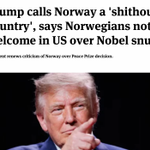
I am a member of the Norwegian Nobel Committee.
There are five of us. Five people, appointed by a parliament most of the planet could not find on a map, who decide, once a year, which human being the world has agreed to call good.
I know. I know. I think about it on the tram.
We meet in a building on Henrik Ibsens gate, a street named after a man who wrote almost exclusively about people discovering they are frauds, which nobody on the committee finds funny except me. There is a room with a long table and the portraits of the dead laureates looking down, Mandela, the Dalai Lama, a great many earnest men in spectacles, and one portrait we do not discuss, which is Kissinger, 1973, awarded while the bombs were still falling, after which two of our predecessors resigned and the satirist Tom Lehrer said political satire was now obsolete. We keep him on the wall. A reminder. Every family has the uncle.
It is October in Oslo, which means the sun gives up around four in the afternoon like a civil servant, and it rains the particular Norwegian rain that isn’t quite falling, just hanging there, judging you. I arrive with wet shoes. I always arrive with wet shoes. There is coffee, because this is Norway and there is always coffee, we drink more of it per person than almost anyone alive, and someone’s wife has sent kanelboller, the cinnamon buns, and we sit, five Norwegians, damp, caffeinated, sugared, and we decide the moral standing of the entire species.
Let me tell you how it actually works, because the world imagines a cathedral and it is, I promise you, a book club with a mandate.
287 nominations this year. 208 people, 79 organizations. Anyone can nominate, that’s the secret nobody understands: a professor, a parliamentarian, a former laureate, so the “nominee” list is meaningless, it’s a suggestion box, and every autumn some congressman nominates his own golden retriever and the press writes “SHORTLISTED.” Nobody is shortlisted. There is no short list the public ever sees. There is us, and the coffee, and the rain, and the portraits, and a Norwegian stubbornness that is older than the prize itself.
We read reports. The institute’s advisers write them, thick dull documents, and we argue. Our chairman told the BBC once that in the final meeting “there is a high temperature.” High temperature, for a Norwegian, means someone slightly raised an eyebrow and then apologized for it. We don’t do high temperature. We do a long silence, and then Kristin says “well,” and everyone knows exactly what “well” meant, and it’s settled. That’s our shouting. “Well.” You’d have to be raised here to hear the violence in it.
Now. This year. I will not say the name, because we never say the name, but you know the name.
A certain head of state wanted this prize the way a child wants a thing in a shop window, which is to say loudly, and in public, and with the full belief that wanting it was itself the argument. He said he deserved it. He said he’d ended eight wars, a number that grew most times he said it, like a fish. He had other heads of state phone us. Israel’s prime minister posted it on the internet, “Give him the Nobel.” The leaders of Cambodia and Pakistan announced they’d nominated him, as though announcing it were part of it, as though we tally mentions. A man flew around the globe collecting endorsements for a Norwegian committee the way you’d collect signatures for a petition to the council about a noisy dog.
And here, uff da, is the detail I treasure, the one that makes me smile into my coffee. The nomination deadline is the 31st of January. He took office on the 20th. So for all the phone calls, all the posts, all the gilded lobbying, the only nominations that could possibly count for this year’s prize were filed in the first eleven days of his term, before he had, by his own arithmetic, ended a single one of the eight wars. He campaigned all year for a prize whose window had shut while he was still hanging up his coat. We didn’t have to reject him. The calendar did. We just watched. Norwegians are very good at watching. We have long winters.
People think we sit there weighing his deeds. We don’t. That’s the thing I can’t make the world understand. We’re not grading his homework. We don’t owe anyone the prize for a ceasefire, however real, however loud the announcement. “He made peace” is not a sentence that ends in a medal, the way he believes it does, the way he believes every good thing ends in his name on it. The will of a dead Swede says the prize goes to whoever did the most for fraternity between nations. A dead Swede, I should add, who made his entire fortune inventing dynamite and selling arms, and spent his last years horrified at his own obituary, which called him a merchant of death, and so bought his way to immortality as a man of peace. The whole prize is one guilty arms dealer’s attempt to launder his name. We are, all of us, administering a dead man’s public relations. I find this clarifying. It keeps me humble. It should keep everyone humble, and it keeps, by my count, no one humble at all.
So who did we give it to?
An eighty-five-year-old woman. A judge. Born in Durban, under apartheid, granddaughter of a Tamil man who came to South Africa as indentured labor, a bus driver’s daughter from the poor Indian quarter, who became the first non-white woman to run a law practice in her province, who defended Mandela’s people when defending them was dangerous, who sat on the Rwanda tribunal and the court at the Hague, and who, at eighty-five, is right now a judge weighing whether a genocide is a genocide. When we told the world, our chairman said the rule of law “underpins the system we have set up to ensure peace,” and that “peace requires justice.” She wasn’t even in Oslo. She was in Nuremberg. In courtroom 600. The actual room where they tried the Nazis. You cannot stage that. God staged that, and God, it turns out, is a better satirist than any of us.
She did not phone us. She did not post. No prime minister demanded it for her on the internet. She had, as far as our deliberations are concerned, the one qualification the loud man could never manufacture, which is that she wanted the work and not the medal. The medal finds those people. It flees the ones who chase it. This is not a rule we wrote. It’s just the only pattern the hundred-odd years of our mistakes has ever shown.
The reaction from across the ocean was immediate. His spokesman posted that we “place politics over peace.” Ja. Perhaps. We’re five damp pensioners in a rainy city; of course it’s political, it was always political, it was political when we gave it to a sitting American president nine months into his first term for the promise of things he had not yet done, and we have been quietly embarrassed about that one for fifteen years, so believe me, we had a particular reason this year to prefer a woman with fifty years of verdicts behind her over a man with eight wars in front of him and a deadline already behind him.
Here is what he will never understand, the thing I’d tell him on the tram if he ever took one. We are the one prize he cannot buy, cannot post his way to, cannot have a friendly dictator phone in for him. Not because we’re incorruptible, nei, we’re as vain and wrong and human as the portraits on our wall. But because the entire point of the thing, the only power a small cold country’s book club has ever held, is that it goes to the person not performing the wanting. The moment you demand it, you’ve proven you don’t understand what it’s for, and proving that is itself the disqualification. He ran the most expensive campaign in the history of the prize and the campaign was the reason. He was never losing to Navi Pillay. He was losing to the concept.
It’s dark now. Four o’clock dark. The buns are gone. Kristin said “well” an hour ago and we all went home. I’m on the tram with my wet shoes, and somewhere across the water a very powerful man is explaining to a camera that the prize is rigged, that we’re corrupt, that he’ll win it next year, and he genuinely might, we’re only five idiots and we’ve been wrong before, Kissinger is still on the wall.
But not this year. This year an old woman in Nuremberg, in the room where the law once stared down the exact kind of man who thinks wanting a thing loudly enough should make it his, got a phone call she didn’t ask for.
That’s the job. We don’t reward the man who ends the war and announces it.
We reward the woman who spent fifty years deciding what a war was.
He’ll never see the difference. That’s rather the whole point of him.
Takk for i dag. I have to change trams.
Nikolai Holmov retweeted

This is the right thing what Ukraine should continue to do. World does not need Russian disel, it needs Western leaders who can make decisions and can make moraly right decisions.


Nikolai Holmov retweeted

“Unfortunate and short-sighted. Instead of lowering prices for Americans, the Trump Administration is further isolating the U.S. and making it harder to bring perpetrators of atrocities to justice for victims in places like Ukraine and Darfur.” -@SenatorShaheen

Breaking: The Trump administration has imposed new sanctions on the International Criminal Court, the latest effort to try to cripple it. The Nobel Peace Prize was just awarded to a former ICC judge. Many US allies are among the 125 court member states. nytimes.com/2026/10/09/us/po…

Nikolai Holmov retweeted
What?!?!?! The US punishes India for importing fuel from Russia and threatens 100% tariffs on other countries that do so. And then Trump blithely announces the US is doing the same?


