
Delving into QM, QFT, CM/QM, random fields/QFT. Refiguring renormalization.
New Haven, Connecticut
Joined May 2011
- Tweets9.6K
- Following420
- Followers1K
- Likes26.5K




Peter Warwick Morgan retweeted

BREAKING: The results for the advanced graduate level explainer videos are in. You won't want to miss these youtube.com/watch?v=KeDJYrag…
Peter Warwick Morgan retweeted

Here is my recent intro talk to masterclass on Koopman operator theory at the Isaac Newton Institute for Mathematical Sciences Cambridge, UK. youtube.com/watch?v=mTSDXDlY… The talk was a part of the programme On Operator Theory Methods in Dynamical Systems newton.ac.uk/event/omd/ thanks to the Institute and the organizers!


Peter Warwick Morgan retweeted

Theorists are like midfielders and experimentalists are like forwards. The art of a proposal, like a through ball, is to play it a little bit ahead of them into the open space, with the right direction and pace so that it matches their run and meets them at the right time.
Peter Warwick Morgan retweeted

Tolstoï ou Dostoïevski - George Steiner
youtube.com/watch?v=zBB2bWub…
Georges BORTOLI : "George Steiner, vous écrivez, dans votre livre, et c'est même la phrase choc qui apparaît sur la bande du livre, vous écrivez : 'Demandez à un homme s'il préfère Tolstoï ou Dostoïevski, vous connaîtrez le secret de son cœur.' Pourquoi faire de Tolstoï et de Dostoïevski ces cas limites, en quelque sorte, ces cas-tests ?"
George STEINER : "Il est des œuvres d'art qui nous forcent, en quelque sorte, à choisir, parce qu'elles vous prennent à la gorge pour ainsi dire, et elles disent : 'Voilà une vision du monde, de Dieu, de votre rôle dans le monde, choisissez entre nous. Nous avons des visions opposées, antagonistes.' Et pour moi ce sont là les deux géants du roman, qui est après tout la forme contemporaine par excellence, la forme qui a succédé au poème épique, au drame tragique. Nous sommes dans le siècle, si vous voulez, ou dans le second siècle du roman, et ce sont les deux grands maîtres de cette forme. Et quoique nous puissions les apprécier tous deux, je crois que chaque homme, en soi, choisit l'un plutôt que l'autre."
Georges BORTOLI : "C'est-à-dire, disons, peut-être pour simplifier les choses, le rationalisme, et puis d'autre part l'irrationnel ?"
George STEINER : "Dostoïevski, en somme, pour simplifier, dit au monde entier : 'Si vous voulez le royaume de la justice sur terre, le royaume de la raison, vous aboutissez par la ruine, par l'inhumain, par le monde concentrationnaire', qu'il a prévu dans Les Possédés et dans Les Frères Karamazov.
Et Tolstoï dit : 'Non, c'est ici qu'il faut bâtir le royaume de l'homme et de Dieu, et si vous vous esquivez en pensant au ciel, au transcendant, alors vous aboutirez par l'injustice.'
Et les deux solutions sont antagonistes et très ennemies, elles ne s'admettent pas également toutes deux. Et je crois, d'instinct, de raison, de sensibilité, nous choisissons."
Georges BORTOLI : "Pourquoi, plus précisément, avoir choisi deux Russes ?"
George STEINER : "Parce que je crois que dans le roman, ce sont les géants, les géants qui définissent les limites mêmes de cette forme. Il y a eu trois très grands moments dans notre littérature : le moment grec, les tragiques grecs; le moment shakespearien; et puis le moment russe. Des moments d'ailleurs très brefs, curieusement brefs, n'est-ce pas. Entre les débuts de Gogol et la fin de Tolstoï, 60 ans, 60 années fulgurantes, avec des chefs-d'œuvre presque tous les ans, comme sous Shakespeare, et 10 ou 12 très grands contemporains.
Ce sont, ces moments, des moments de crise, d'habitude, d'approche de révolution ou de chute de civilisation, où la littérature semble porter cette charge d'angoisse, de révolution. Les grandes questions que la philosophie pose d'une façon abstraite, elles vivent dans le mode littéraire. Et Tolstoï et Dostoïevski ont montré que le roman peut tenir tête à Sophocle, à Eschyle, à Shakespeare."
Georges BORTOLI : "Oui, mais tout de même, nous avons tendance à croire que le roman, le grand roman, est né et a vécu, aussi, ailleurs qu'en Russie, en France par exemple."
George STEINER : "Le roman français a pris la décision d'être entièrement un grand roman séculier. C'est-à-dire que lorsque Balzac crée son monde génial, c'est le monde de la bourgeoisie, du paysan, c'est ce monde sans Dieu. Il effleure le problème de Dieu, mais dans de très mauvais livres, dans Séraphîta, dans le Christ en Flandre. Chez Proust, il y a le refus, un refus de génie, si vous voulez, mais d'ouvrir les portes vers le ciel ou l'enfer. Imaginez Mitia Karamazov en chaussettes avec Dieu au plafond, hurlant avec son âme, ça ne va pas dans Proust. Ni les chaussettes sales, car il y a dans Proust de la saleté, mais jamais du mauvais goût, ni Dieu. Et pour simplifier naïvement, les chaussettes sales et la présence de Dieu vont ensemble. Elles vont ensemble dans Shakespeare, elles vont ensemble dans les grands poèmes épiques, et aussi dans le roman russe. Il est remarquable que le roman français ait produit Madame Bovary, Tolstoï répond par Anna Karénine. Le roman français produit Le Rouge et le Noir ou La Chartreuse de Parme, avec leur politique et leur Napoléon, Tolstoï répond par Guerre et Paix, et Dostoïevski par Les Possédés."
Georges BORTOLI : "Et qu'est-ce que vous pensez du roman français actuel ?"
George STEINER : "Eh bien, il est presque l'aboutissement de ce triomphe du style, de l'autonomie de la cadence et du langage sur le contenu humain. Je vois bientôt que le roman français va nous présenter des œuvres où des chats et des chaises et des tables vont parler entre elles. Et puis le dernier grand roman français gongoriste de cette vague du nouveau roman, ce sera un roman à feuilles blanches. Ça doit venir, ça a débuté par Mallarmé, qui est le maître du roman français actuel, et à la fin ce sera un silence, le silence peut-être très beau, silence, si vous voulez, sur beau papier."
Georges BORTOLI : "C'est le point de vue d'un Américain que vous nous donnez là, que vous êtes américain."
George STEINER : "Oui, mais point de vue, j'espère, d'un Américain éduqué en France, qui doit à la France ce qu'il a lui-même de culture littéraire. Non, j'espère, point de vue d'un homme qui lit et qui croit qu'il y a une espèce de très haute frivolité, très belle, formellement très intéressante, mais frivolité inhumaine, à vider le roman de la voix humaine, de la présence du corps humain, qui après tout sont la base du langage. Nous ne sommes pas en train de faire de la musique, nous ne sommes pas en train de faire du Paul Klee, de l'art abstrait, nous travaillons avec les mots, et les mots existent dans la voix humaine. Et c'est ce que Tolstoï et Dostoïevski n'oublient jamais, même quand ils prennent le risque du mauvais goût, des longueurs, du ridicule, du grotesque. Mais ils prennent ces grands risques, et c'est ce qui manque dans ces petits livres minces et parfaits qu'on nous offre maintenant. Car après tout, entre un livre très gros et un livre mince, la différence est presque d'ordre métaphysique, non seulement technique. Le livre très mince, c'est toujours La Princesse de Clèves. Ça se refuse à la vie, avec intelligence, art, tout ce que vous voulez, mais il y a là un certain refus, parce que la vie n'est pas un livre mince, elle est terriblement longue et touffue et dense. Et Tolstoï ne voulait même pas arrêter Guerre et Paix. Deux épilogues, huit chapitres nouveaux, c'était comme le temps lui-même en marche. Et Dostoïevski, qui écrit ces livres gigantesques, précisément parce qu'il veut toujours recommencer le réel. Souvenons-nous que Les Frères Karamazov, c'est le premier volume d'un cycle qu'il n'a pas pu écrire. Il est mort."
Georges BORTOLI : "Eh bien, je vous remercie, George Steiner, et je rappelle que votre livre, Tolstoï ou Dostoïevski, après avoir paru aux États-Unis, en Angleterre et dans quelques autres pays, paraît en France aux Éditions du Seuil, dans la traduction de Rose Celli."

Peter Warwick Morgan retweeted

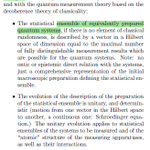
度々話題にしていますが、射影公理は基本的な量子測定理論から導出可能です。
確率が何に対して定義されているか?を真面目に考えると自然に出てきます。
むしろ古典確率にはない状態更新ルールを追加するべきでないと考えています


Peter Warwick Morgan retweeted

10年ほど前、量子コンピュータ(の話題)が大きく盛り上がった。それに釣られた日本政府が、量子コンピュータを2016年以降の国家的重大プロジェクトに指定し、今年で10年になる。
そろそろ現実に目を向けよう。西森先生の解説を読み、何らかの総括を行うべきタイミングだと思う
note.com/nishimori_h/n/n06af…


Peter Warwick Morgan retweeted

Sidney Coleman: “The problem is not the interpretation of quantum mechanics. That’s just getting things backwards. The problem is the interpretation of classical mechanics.”


Peter Warwick Morgan retweeted

What ppl seek is a portfolio of risk. Work on some difficult and risky but important problems and also work on some bread and butter science that has value but less risk.

Peter Warwick Morgan retweeted
New update to the #CORE1 contest for advanced explainer videos in physics / AI / philosophy. Share with creators who may be interested.

Peter Warwick Morgan retweeted

When I first joined the Department of Electrical and Computer Engineering as a researcher, coming from a maths and stats background, it shook me more than I expected.
I was used to the world of proofs and theorems… what shocked me was seeing those same ideas running real systems: probability steering signals in digital comms, optimisation shaping hardware, and information theory setting the rules. It made me question my own skills.😏
In my optimization course, Space Mapping was one of the concepts that really impressed me: you keep a computationally cheap coarse model f_c(x) that runs fast but lies, a brutally expensive fine model f_f(x) that tells the truth, and you iteratively adjust a mapping T so that f_c(T(x)) shadows f_f(x) where it matters, while doing almost all the optimisation steps on the cheap side and calling the fine model only sparingly. We will look at some real applications next.
John Bandler, a Canadian engineer and professor, formalised this in the early 1990s and showed that you could make full-wave electromagnetic optimisation practical rather than masochistic. He founded Optimization Systems Associates in 1983 to commercialise these ideas, and in 1997 Hewlett-Packard bought the company and folded its tools into what became HP EEsof, then Agilent, now Keysight’s RF design stack. 🫡
#SpaceMapping
#Electromagnetics
#RFDesign
#Optimization
#AppliedMathematics
#AntennaEngineering
Peter Warwick Morgan retweeted

Renormalisation
Leonardo Di Giustino
(Invited contribution to the Encyclopedia of Particle Physics)
arxiv.org/abs/2511.02005

Peter Warwick Morgan retweeted

I worked as a research assistant for a few years in grad school. I worked hard and learned a lot. I'm troubled at how much better a research assistant ChatGPT is, at least for short tasks, than I was. It raises the bar for junior researchers, and I'm not sure how that plays out.
Peter Warwick Morgan retweeted
Kernels also give us a well-defined tool as part of new ways to introduce nonlinearity when constructing interacting Quantum Field Theories, instead of introducing singular Lagrangian deformations of free QFTs. So they're also worth knowing about for future physics applications.
Peter Warwick Morgan retweeted
I am an 𝕏-Boomer, but to be 1957-born in England is to be of a different world than to be of the same time elsewhere. 100 miles may be enough a world away for decades to be as nothing.
Peter Warwick Morgan retweeted

in some ways! it's a very delicate and subtle point.
in brief, and simplified somewhat, the idea is: there is no such thing as a Self in the sense of unchanging individual-personal-identity-through-time. but insofar as all cognitions are identical in terms of what you could call their "merely experiential nature" (—which is explicitly identified with/as the "luminosity" of reflexive awareness—and insofar as this "luminosity" is really just another name for what sometimes gets translated as "buddha-nature," there is a crucial sense in which all sentient beings have the same basic nature, which is pure, perfect, Good-in-a-manner-beyond-the-dualistic-opposition-between-good-and-evil, etc.
this is, in a nutshell, how tantric deity yoga (i.e., self-visualization as an enlightened being) works: BECAUSE our nature is intrinsically pure and perfect, it is not actually separate from the nature of the deity, and never has been. furthermore it is often said that "by accomplishing one deity, you accomplish them all," in other words that although there is effectively an infinite variety of enlightened beings that we could practice, there is no need, because although enlightenment manifests in an infinite variety of ways (corresponding to the infinite number of enlightened beings), from the awakened perspective all phenomena have "one taste."
so strictly speaking we could have said "all sentient beings are Tārā/Mañjuśrī/[etc.] in disguise" and that would not have been an incorrect statement. but Vajrasattva is in some sense special or particularly elevated because he is identified as the indivisible union of all five primordial buddhas (who are themselves identified both with/as the true nature of the five wisdoms and with/as the true nature of the five phases of matter i.e. solid, liquid, gas, plasma, and vacuum). so Vajrasattva is "all-encompassing" in a somewhat unique way.
but now I fear I have answered your question by creating a few dozen more!