

Local-first AI on a member-operated mesh. Your machines first, your circle next, the open pool when you want it.
- Tweets80
- Following37
- Followers14
- Likes96




ALT Potluck pricing page: free open-source Core at $0, with Company and Enterprise offerings marked planned and available for discussion.


ALT Potluck research chart titled “Give coding answers room to finish.” On 68 previously unused HumanEval tasks, Qwen3-4B on an RTX 2080 Ti passed 53 of 68 with a 384-token output limit and 54 of 68 with a 768-token limit. Mean time per answer including visible checks was 6.05 versus 6.08 seconds. One additional task passed, no passing tasks were lost, and weights, prompt and greedy decoding were unchanged. One local run, selected on a separate development set. Research result, not a shipped app improvement. Timing excludes model loading and hidden grading.

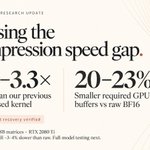
ALT Potluck research update titled “Closing the compression speed gap.” The prototype is 3.0–3.3 times faster than the previous compressed kernel and requires 20–23% smaller GPU buffers than raw BF16. Exact weight recovery was verified. Tests cover three Qwen3-8B matrices on an RTX 2080 Ti. The kernel remains about 3–4% slower than raw; full-model testing is next.

ALT Screenshot of a Potluck benchmark report labeled Research in progress. Qwen3-8B on NVIDIA L4 compares original BF16 with DFloat11 0.5.0. All 399 weight tensors match bit for bit; logits and tokens match on three short prompts. Peak GPU memory including loading: 18.3 versus 14.7 GiB. Median single-stream generation with 128 input tokens: 15.0 versus 4.7 tokens per second. Median peak host RAM including loading: 5.3 versus 15.9 GiB. Three performance runs; eager attention, no CPU offload; output parity checked for 16 token steps per prompt. This is one model/GPU, not a broad quality test or a released feature. Next: profile decompression and separate loading RAM from inference RAM. The report was rendered from retained measurements, not captured from product UI. Method credited to LeanModels/DFloat11.
