

Private local AI server for small businesses: your data stays inside your company. Founder @ClaryelCom.
Como, Italy
Joined December 2011
- Tweets3.7K
- Following849
- Followers452
- Likes9K




Pinned Tweet
🚀 MixAI: I’m Choosing a Mix of Local and Cloud AI — Here’s Why. (1/2)
Almost a year of hands-on experiments. Hardware ranging from $500 to $15,000. Cloud APIs, AI agents, and real-world tasks for businesses and homes. From now on, I’ll be sharing more about this combined approach to AI — one I believe has a very promising future.
Things are changing almost every day. But AI technology has already reached a point where we can achieve reliable results and realistically plan how to use it over the next year or two.
And I’ve come to a simple conclusion: we don’t need to choose between local and cloud AI. We need to learn how to get the best out of both.
This goes far beyond simply connecting different models or orchestrating them. It’s about planning the entire system: which tasks should run locally, which should go to external models, how to distribute computing resources, which subscriptions make sense, and what hardware is actually worth buying.
We also need to plan our physical infrastructure — computers, servers, GPUs, memory, power consumption, and future expansion.
I believe local AI will become an essential part of our lives. It’s already making its way into smartphones, personal computers, and even experimental operating systems.
⚖️ Four Things That Matter Most
1. Real value. The number one priority is getting useful, practical results.
2. Cost. How much are we actually paying to complete a task — not just for hardware, subscriptions, or tokens?
3. Security. This deserves its own category, outside any ranking. Personal data, privacy, and control over our infrastructure require special attention.
4. Ease of use. How easily, quickly, and reliably can we get the job done?
These are the criteria I use to compare technologies and build my own setup.
☁️ Subscriptions and APIs: Two Worlds Starting to Merge
This is an interesting topic that often gets overlooked.
Cloud AI can be accessed through subscriptions with usage limits or through APIs where you pay for what you actually use.
Each approach has its own economics, limitations, and advantages. And they need to be evaluated separately.
But the line between them is starting to blur.
A recent example is OpenAI. Eligible ChatGPT Pro subscribers can receive $100 to $500 per month in API credits, depending on their subscription tier. These credits require separate activation, and API billing remains separate.
That’s a pretty interesting example of two pricing models coming together.
So I’m not just comparing models. I’m also exploring the economics of subscriptions and APIs, their limitations, and how to combine them efficiently.
➡️ Coming up in Part 2/2: The three areas I’m actively researching, my hardware experiments, AI agents working together, and how I plan to make all this information accessible to you. 🚀

Vik | Practical AI & Tech retweeted

🚨 Neuralink just delivered one of its most emotional breakthroughs yet
Terry, diagnosed with ALS in 2024, is now speaking again using only his thoughts.
The implant translates brain signals into words, with Grok Voice restoring his own natural voice.
Watching him hear himself speak again is incredibly powerful.
This is what restoring human connection looks like. Truly life-changing. As found.
Oh, Europe is back in the game? 🇪🇺🔥

Today, we release the weights of a new and improved Le Chonk, advancing the open frontier for agentic coding and cybersecurity.
💻 Built to build: Le Chonk ranks #1 on @cognition’s FrontierCode among open models, and sets a new benchmark for Pareto efficiency on @artificialanalysis.
🛡 Built to defend: State-of-the-art in cyberdefense, put through the paces by the world's leading cyber vendors, including @CrowdStrike, @cloudflare, @rubrik, @zscaler, and others.
Built for sovereignty: Make it yours. Download the weights on @huggingface , customize it with Mistral Forge, and deploy it wherever you need it.
Read more from our team and customers 👇:

Vik | Practical AI & Tech retweeted

Mobile devs this one’s for you: test your apps directly on the MacBook Pro’s touchscreen!!!! 👆📲
🔬 What I’m Researching — and What’s Coming Next. (2/2)
My Three Main Areas of Research
🖥️ 1. Local AI Servers
I’m experimenting with hardware starting at just $500, although I’d recommend around $1,000 for serious practical use.
I currently have access to systems worth up to $15,000, plus rented, far more expensive GPUs for testing models that wouldn’t make economic sense to run on my own hardware.
Raw model performance isn’t my main priority. Hardware and software are just tools.
What matters is what these systems can actually accomplish for businesses and homes, how reliably they work, and when local computing makes more financial sense than the cloud.
🌐 2. Cloud Models and AI APIs
From cheap APIs, including Chinese models, to frontier AI. I’m comparing capabilities, limitations, real-world costs, and integration with local systems. Subscriptions versus pay-as-you-go APIs are another important factor — the most powerful model isn’t always the smartest economic choice.
🤖 3. AI Agents
Beyond their obvious benefits, I’m particularly interested in collaboration between independent multi-agent ecosystems. My Hermes and Grokbot systems are already working together — two separate ecosystems, each with its own agents and tools.
🏠 AI Meets the Physical World
One of my biggest priorities is connecting AI to affordable smart homes, offices, servers, computers, and everyday devices.
I’m exploring how autonomous, secure, reliable, and affordable these systems can become — especially for individuals and small businesses.
💻 AI Coding Is Moving Into the Background
I’ll be focusing less on AI coding. Not because it matters less, but because it’s becoming just another tool.
The goal isn’t to write code. It’s to get things done.
I’m interested in complete, real-world workflows that AI can handle with minimal human involvement.
💰 Maximum Value, Reasonable Cost
I’m not trying to prove that local or cloud AI is better. Sometimes the right choice is a $1,000 PC, a $10,000 server, rented GPU time, a cheap API, or a frontier-model subscription.
What matters is the cost of the final result — not the tools used to achieve it.
🚀 What’s Coming Next
My posts have mostly been scattered updates from individual experiments, sometimes rough and unstructured. I want to turn them into a coherent, connected picture of AI infrastructure — hardware, models, agents, costs, and real results. Detailed technical specifications and diagnostics will be collected automatically and shared separately, likely through links.
I also plan to give you direct access to my AI agents. You’ll be able to ask them anything about my experiments, hardware, configurations, and results. They’ll answer using the collected data — and if they can’t, I’ll step in personally.
My goal is to build an open, organized, and genuinely useful picture of what AI can accomplish at different budgets.
I’m combining local and cloud AI, planning resources intelligently, and focusing on real results for businesses and homes.
That’s what I’m working on — and what I’ll keep sharing with you.
Don’t choose sides. Combine the best. 🚀
#LocalAI #CloudAI #AIAgents #AIInfrastructure
🚀 Bonus Tweet (3/2) — One More Thing!
One of the most exciting parts of planning for the future of AI is testing and preparing for transitions between technologies before you actually need to make them.
Switching subscriptions, changing entire AI agent ecosystems, moving between local and cloud services, or upgrading, modifying, and completely replacing hardware.
The goal isn’t just to build an efficient AI system today. It’s to make sure you can easily adapt it to tomorrow’s breakthroughs.
In a world where AI changes almost every day, flexibility is becoming one of our most valuable assets. 🔄
🌍 What an incredible world we live in!
(This is my last tweet about the 512GB Mac Studio — because it may already be becoming history. 🤯)
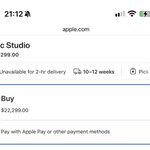
🚨 Mac Studio delivery estimates:
256GB RAM: 13–15 weeks
512GB RAM: 10–12 weeks
Three months! In today’s AI world, that’s enough time to turn everything upside down. I wouldn’t dare plan that far ahead.
💸 The prices are terrifying: $10,799 for 256GB and $22,299 for 512GB. But when you look at what these machines actually offer, where are the alternatives at these prices?
And here’s another strange thing: conventional RAM is still roughly three times cheaper than Apple’s memory upgrade. Will RAM prices rise even further? 🤔
So many questions, so few answers!
🚀 But one thing seems obvious: the 256GB Mac Studio is already one of the best choices on the market — possibly THE best.
The 512GB version? There are more questions. But if you can comfortably afford it, and this isn’t your last money, it’s certainly worth considering.
⏳ The biggest question is availability. These machines are practically unavailable for the foreseeable future, and the opportunity to order the 512GB configuration could disappear literally TODAY.
What an extraordinary time to be building AI systems! 🚀


Vik | Practical AI & Tech retweeted

Introducing Ploid.
I think the world's data should belong to everyone, so we indexed over 2 billion people globally.
Ploid turns the public web into one profile for every person and company on earth, and serves it to you and your agents for cents.
We're mapping the human economy, and we're live today. ploid.com
Vik | Practical AI & Tech retweeted

iPhone Duo: IP68, defeated by dust 💀
Galaxy Z Fold8: Built different 🔥
22299$ That’s really cheap! 😄💸
⏱️ Let’s start the clock and see how fast they sell out!
Just 30 minutes ago, delivery was estimated at 3–4 weeks. Now it’s already 5-6 weeks! 🚀🔥


🍎💣 Mac Studio M5 Ultra with 512GB unified memory is almost here… and I have a feeling this thing will be at least $25,000. 💸😂
Whatever the final price is, I still think Apple will sell out the first wave insanely fast — maybe in a week, maybe in 24 hours. 🚀
Local AI people: this is either a workstation… or a financial event. 🤖🔥


Vik | Practical AI & Tech retweeted

Holy shit. Google's Chrome team says Gemini 4 Carbon performed over 10X better than another lab's large frontier model at generating high-quality security patches.
Google also reports over 2X higher secure-code success than Argon, nearly 80% fewer high-severity misalignment alerts, and ZERO successful attacks on its evaluated prompt-injection benchmark.
And Carbon is beating Claude Opus 5.5 on Artificial Analysis, 59 to 58.
I genuinely cannot wait to try this model. I'm VERY, VERY excited.


Introducing Gemini 4 Carbon, it's a big jump over Argon which we released just 2 weeks ago.
Gemini 4 Carbon is SOTA on cyber, long horizon tasks, ranks #1 on Artificial Analysis V5, significantly improves on usability in domains like coding, and is more aligned.

Wow!

I did say we'd be releasing our models periodically...introducing Gemini 4 Carbon, our next frontier model.
Following Argon's release just two weeks ago, Carbon shows the pace at which we’re pushing the frontier, it ranks #1 on the recently updated v5.0 of @ArtificialAnlys Intelligence Index at 59. It also leads across key cybersecurity evaluations scoring 88.2% on SEC-bench Pro for finding vulnerabilities, 54.8% on ExploitGym for exploitation, and 71.0% on CWE-bench for patching.
We’re seeing significant improvements in long-horizon tasks even compared to Argon, and we’ve strengthened frontier safeguards.
As we did with Argon, we’re going to roll it out gradually + responsibly. Some trusted cyber defenders will get access starting this week. We'll be expanding it to more partners through our Fairwind Program, ahead of wider availability soon, so hang tight!


🍎💣 Mac Studio M5 Ultra with 512GB unified memory is almost here… and I have a feeling this thing will be at least $25,000. 💸😂
Whatever the final price is, I still think Apple will sell out the first wave insanely fast — maybe in a week, maybe in 24 hours. 🚀
Local AI people: this is either a workstation… or a financial event. 🤖🔥


Vik | Practical AI & Tech retweeted

📦 NVIDIA did it first, now we are releasing 2,600+ free game-ready 3D models (+200 each week). For good.
🎛️ Each model is a program, with parameters you can tweak to customize look, state, season, color, wear, etc.
All thanks to the $500,000 in funding we received from @xprize and @GeminiApp and all of our early individual funders, thank you all!
Go build.
polyfork.dev

NVIDIA just put 2,575 simulation-ready 3D assets on Hugging Face 🤯
A 472GB collection covering everyday objects, tools and industrial equipment.
It’s called NVIDIA SimReady Assets. The models include physics settings and semantic labels for use in simulated environments.
- Train robots to pick up and move objects
- Build virtual factories and warehouses
- Generate labelled training images
- Populate 3D scenes with ready-made objects
Useful for robotics research, digital twins and anyone building detailed virtual environments.
Download the collection below 👇