Rick Searle (@RickSearle1) header
Rick Searle (@RickSearle1) profile picture

Writer and Educator Books: Rethinking Machine Ethics in the Age of Ubiquitous Technology, Blogs @ Utopia or Dystopia, @RickSearle@universeodon.com

Central Pennsylvania
Joined February 2012
Photo by Rick Searle (@RickSearle1)Photo by Rick Searle (@RickSearle1)Photo by Rick Searle (@RickSearle1)Photo by Rick Searle (@RickSearle1)Photo by Rick Searle (@RickSearle1)Photo by Rick Searle (@RickSearle1)Photo by Rick Searle (@RickSearle1)Photo by Rick Searle (@RickSearle1)Photo by Rick Searle (@RickSearle1)Photo by Rick Searle (@RickSearle1)
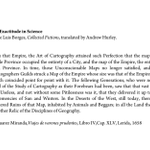
ted chiang called it i'm afraid
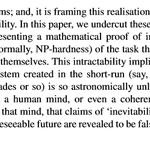
Someone out there needs to start the Journal of Mathematical Hermeneutics, which is explicitly devoted to human-written interpretations and expositions on AI-generated proofs.
8
111
8
1,151
31,636
Rick Searle retweeted
On Riemann, and Increasingly Subtle Goodharting still processing the riemann hypothesis result despite the last few months i still feel pretty shocked for some reason apart from the non-math implications, I'm thinking about Terry Tao's point about the AIs goodharting open problems ideally the solution to an open problem opens up a new world to mathematics and that's what often happens when humans solve them but of course there could be multiple ways to solve a problem I am curious about whether claude discovered a bunch of new theory in order to make this work, or whether RH was "within the convex hull" of existing ideas and humans were just not competent enough to make it work an analogy is the story of Newton's Principia, which (to vastly oversimplify) solved the problem of "what is the shape of the orbit of a planet under an inverse-square force?" Newton wrote the Principia using geometric reasoning for the proofs, despite having already invented his "fluxion" based version of calculus It turned out that solving problems like the inverse-square law is technically within the "convex hull" of Euclidean geometry (including Euxodus' theory of proportion and Archimedes' method of exhaustion) - you just need to be Newton to do it that way Newton was just so good at geometric reasoning that he could do in a complicated elementary geometric way the stuff we find much easier with modern algebraic calculus Imagine if you had [internal Claude model] in the 1600s and asked it to solve the inverse-square problem (using your current understanding of math, which included only classical geometry) It would have succeeded (geometrically), and you would have declared victory but doing that would have impeded the development of calculus, which is far more general and works in cases that don't have closed form geometric solutions, and doesn't take genius to apply in fact something vaguely similar did happen: along with Newton's infinite series and geometric limit reasoning, Leibniz had also invented a third, more symbolic form of calculus. continental European mathematicians rewrote Newton's geometric results into Leibniz "dy/dx" notation and progressed much further, because the algebraic methods generalized better. The Brits, out of loyalty to Newton, stayed with geometry (and infinite series) and fell behind for a century, until they too adopted Leibniz notation so it's unclear to me whether knocking down open problems with Claude-shaped brute force is the best way to progress math. maybe it is! maybe we run out off convex hull and have to invent better problems but attention is a finite resource and it will only get scarcer - so maybe "open problems" as a call to arms may no longer exist RH may be the last (or second last) time the solving of a math problem is a major news story
28
43
10
520
33,281
Have been thinking quite a bit lately about Prague under Rudolf II — a cosmpolitan wunderkammer of intellectual ferment and outrageous frauds, unbelievable power wielded for inexplicable ends, where Brahe and Kepler’s work was taken as seriously as John Dee and Edward Kelley’s.
Today’s claim on the Riemann Hypothesis helps demonstrate what I mean when I speak about Computational Reenchantment. If the proof holds, we’ll likely simplify its explanation to some extent. But as it stands, it’s 250,000+ pages. Long enough to indicate that “pages” is a vestige of a mode of formal comprehension we’re rapidly leaving behind. So really no one, including the proof’s human “author”, comprehends the nature of the proof at full resolution. But because computational verification scales far more steeply than human comprehension, and because it can offer certain functional guarantees, we will use abstractions we comprehend less and less to do more and more. At some point this process will produce physical creations indistinguishable from magic and the paranormal, even to their creators. As we push into the deepest realms of analytic formalism, the phenomenological bottom drops out, leaving us once again grasping for understanding amidst an age of generally inexplicable Angels and Demons.
1
1
12
1,573
Ah yes, Lord of the Rings, the famous Tolkien parable about how we should totally just grab the ring first!
23
60
23
752
123,227
Rick Searle retweeted
‘since man is not strong enough to get by without the miracle, he creates new miracles for himself, his own now, and bows down before the miracle of the quack and the witchcraft of the peasant woman, even though he is a mutineer, heretic and atheist a hundred times over.’
Jaron Lanier in the @nytimes on the machine-god cult: "we need to be honest with ourselves. There is nothing wrong with a new religion, but there is everything wrong with an imposed new religion." nytimes.com/2026/11/09/opini…
4
2
15
1,482
The only reason I can make sense of this tweet is that I can't see all the individual pixels on my computer screen, let alone hold them all in my head. A galaxy-scale intelligence lacks this defect, so it would have no notion of "tweet" or "talking head" or "wrong argument".
The Navier–Stokes equations wouldn’t exist for a galaxy-scale intelligence. Our model of reality and our laws of physics come from our limitations as the observer. Take water, for example. When we look at it, we see the properties of a continuous fluid: density, momentum, energy, temperature, and pressure. These properties come with the fact that we can’t see individual molecules. But a galaxy-scale intelligence with the capacity to track the trajectory of every molecule wouldn’t understand the properties of water that we are talking about. That is why it wouldn’t come up with the Navier–Stokes equations. Even though a Superintelligence would understand humans very well (since it was initially trained on human data), it would have a very different construct of reality. The question is: what would that construct be? More importantly, would we be able to understand each other? Watch the full interview with Jonathan Gorard here 👇 youtu.be/dwI0mXKKf1A
37
50
12
695
48,399
Rick Searle retweeted
What's crazy is that music like this could have been played for centuries, just no-one thought to do it. What else are we missing?
É a primeira vez que eu vejo uma música eletrônica analógica
350
963
71
19,283
818,833
Rick Searle retweeted
Self-replicating, multi-agent AI systems are an overlooked existential risk. I want to lay out why I believe this, via example. Each dot is a simple creature with a randomly evolved NN brain. There is no training; yet complex, unpredictable survival drives always emerge. 1/14
38
67
23
510
49,862
Rick Searle retweeted
One of my hardest prediction about the future of language modeling technology is that any profitable deployment will require such immense scale that HBM during inference will remain a bottleneck to long-term coherence of these systems. It's kind of like looking at a tree and thinking to yourself: wow this is a powerful creature with incredible endurance.
Replying to @acidshill
I think people are vaguely imagining some post-singularity world which is crazy, but not *too* crazy. in which there are machine intelligences smarter than humans, but not *too* much smarter. the details of these visions are rarely described, much less justified
4
2
1
49
5,511
Rick Searle retweeted
wrote about AI AS THE INFINITE WORK MACHINE, creating a world where we're all just constantly deploying agents to fight against everyone else's agents, running constantly to end up in the same place: bloomberg.com/news/newslette…
55
144
40
884
111,082
Rough physical analogy: you are in an infinite road-network (some roads one-way). Suddenly all get paved and you get a thousand-times faster car. You are then still in an infinite roadnetwork, and the problematic decisions where to drive when have been multiplied exponentially.
2
2
1
9
552
Rick Searle retweeted
increasingly concerned that ai is revealing the mathematical world as negatively curved. instead of everyone wandering about in idea-space and clustering around the same famous conjectures (local positive curvature), ai is pushing out the boundaries rapidly and revealing that the space of mathematical ideas is ~hyperbolic (negative curvature). though this means there's lots left to discover, it also means that small separations between people/agents will lead to wandering alone. we may be emerging into an idea-space where there's so much to see and do but everyone is alone in a private heaven, unable to share their subtle joys with others...
196
176
73
2,453
405,512
Rick Searle retweeted
" Thus it will be readily understood that, in order to demonstrate a theorem, it is not necessary nor even useful to know what it means. We might replace geometry by the reasoning piano imagined by Stanley Jevons; or, if we prefer, we might imagine a machine where we should put in axioms at one end and take take out theorems at the other, like that legendary machine in Chicago machine where pigs go in alive and come out transformed into hams and sausages. It is no more necassary for the mathematician than it is for these machines to know what he is doing. " ––– Henri Poincaré, Science and Method (1908)
6
27
6
194
10,812
This is the way backward to fuming occulted oracles.
If we want to continue progress in science, we must be prepared to acknowledge that the correct description of nature will eventually simply be too complicated for humans to understand. I do not think it is wise to make human understanding a requirement. AI is the way forward.
4
3
1
63
1,275
Replying to @LGcommaI
There can be no question that this plateau of difficulty exists, but Where it is will be one of the most exciting questions of the next decade imo
2
2
2
146
Two different directions 'human excellence' could go in a world where AI's superior at mathematical, artistic, philosophical production: math, art, and philosophy become more like a sport or become more like meditation
7
7
1
75
Rick Searle retweeted
Replying to @hassanrahim
they're trying to cut open the bird to find the song
102
2,083
253
16,198
947,190
The companies talk about it this way because they regard the process as inevitable and preordained, not something they are doing. They see themselves as the midwives, not the builders, of superintelligence.
Jack Clark of Anthropic now thinks it's more likely we see full RSI become possible in 2027 than in 2028.
11
4
2
86
4,496
Rick Searle retweeted
Replying to @RickSearle1
You want comments? ;) Here are some: - I agree on the large-scale epistemic crisis; true, covid exposed it; reasons mysterious although transformation of media is one. (Still, I find myself sometimes wondering, was it really better earlier, epistemically. Or is the current situation more like a trust crisis and fragmentation of common stories and identities?) - Yes Guilds do exist. And yes they are threatened, partly by counter-elites (see the US politics). Partly I'd attribute the threat as systemic: evolving capabilities of the infrastructure are inhuman and apolitical. Humans building the capabilities and counter-elites may occasionally collaborate, though. - I'm not sure how much the two above are related, and again, how they related to what has lately happened with AI (below). - Paradoxically, LLMs are now incredibly useful in "personal epistemics". I get more balanced reflections on news events and societal issues from the models than from any other source, mainstream media, social media and pundits and experts all included. (One reason is the unavailability of the experts without filters, another are their apparent political biases.) Solve for the equilibrium! (Sure, the setup with capital and power here may be problematic in the long run.) - Meanwhile, science is in disruption; beyond math that is not yet in the core processes of knowledge production like theory-formation and experimentation, rather in education, evaluation, and publishing. - Mathematics has become a special case, as AI goes deeper there. I see an asymptotic situation where AI builds the formal structure, somewhat human-directed probably, and humans try to interpret and understand it for their own, only partly utilitarian reasons. - If AI gets really good in maths so that human understanding becomes a totally optional side project, mathematics is in a deeper than mere transient institutional crisis. - We may end up with a similar situation on other fields of science later, although I'm relatively pessimistic with more empirical sciences and understanding has fragmented there already. Think of biosciences: they are already pretty non-theoretical, and most useful understanding seems to happen within neural networks like AlphaFold (or maybe Claude soon). Experimentation can be automatized with robotics, LLMs help to integrate and search; neither of those imply a structural revolution although both can be big speedups. - As you see, I have trouble focusing on politics and power relations. One reason may be that I feel they are distractions and want to see deeper, another one that I have no big personal stakes or identity there. (I see that this is not an optimal format for comments. I'm just too lazy setting up anything else..)
1
1
92
Rick Searle retweeted
The arthropod world feels like a truly fallen world: everything is armed and armored, poisons and chemical weapons abound, deaths are horrible, you're an inconsequential one of countless many. The natural world at the human scale is comparatively fuzzy and friendly and edenic.
78
627
40
9,077
123,202