

DeFi guy and yield hunter. insights are my own. 🐔🥜🍞 . waterboy at @Pendle_fi
Joined April 2015
- Tweets28.2K
- Following2.1K
- Followers7K
- Likes46.8K





RightSide retweeted

If someone told you there's a >40% APR delta-neutral opportunity in crypto, you'd probably think it's a scam.
@boros_fi's spread markets are making opportunities like these possible.
Ofc this is headline APR so its not truly representative the effective return on total capital deployed (actual yield will be reduced by abit with additional buffer capital for margin maintenance)
Still, pretty chonky returns considering the ~$35k underlying position size here.
Opportunities like these have been popping up more frequently lately, making funding rate arbitrage an increasingly.
Great time to capitalise on these and you can expect larger notional size opportunities to improve over time


Today, I rolled over into a new @boros_fi market using the close & reopen option.
APR moved up, so I locked in 42.69% fixed APR for the next 33 days.
If you're not learning how to use the Arbitrage Terminal, you're missing out on opportunities to capture this kind of yield.

RightSide retweeted

Over $300M in tokenized stocks deposited into DeFi, up 2,451.5% over the past year
Uniswap v3 & v4 account for 28.7% combined, followed by Kamino Lend (16.5%) & Pendle (15.3%)
The dataset covers 20 DeFi venues

RightSide retweeted

Pendle Loop is FREE btw (until the end of the year)
Every Earn loop on a non-Pendle asset and every Long or Short position pays ZERO Pendle fee + no trading fee until 31 December 2026
Time is running out to maximise your earnings
Looping will never be cheaper and yes those APYs are real...
Head over to here to check it out: app.pendle.finance/trade/loo…
dc: linn is a tier 1 kol supreme for pendiddle

RightSide retweeted

Janus Henderson’s core US fund is over $30B and it used to be out of reach unless you had direct relationships with global banks and issuers.
Tokenizing it was a natural next step for them to open access to a wider group of investors.
Full RWA Insights interview with Nick Cherney, Head of Innovation at Janus Henderson below 👇

Janus Henderson runs over $30B in its AAA CLO strategy, with its core US fund among the largest actively managed fixed income ETFs.
That strategy is now on Pendle as @Centrifuge deJAAA (26 Nov 2026 maturity).
To mark it, @tn_pendle sat down with Nick Cherney, Head of Innovation at @JHIAdvisors, on why a $500B manager moved on chain and what comes next.
RightSide retweeted
Linn's Leverage #1137 is out: (Link in tweet below)
@boros_fi
@pendle_fi
@Chainflip
@mezzanine_fi
@Mantle_Official
@StaticsProtocol
@GammaSwapLabs
Like/Repost to support:

Instant money making strat
Today, I rolled over into a new @boros_fi market using the close & reopen option.
APR moved up, so I locked in 42.69% fixed APR for the next 33 days.
If you're not learning how to use the Arbitrage Terminal, you're missing out on opportunities to capture this kind of yield.
RightSide retweeted

Pro-tip for looping yields right now:
@pendle_fi currently offers 0 loop fees on PendleLoop until Dec 31st!
Pairing a 2.5x wstETH long on PendleLoop with a 3.5x short on Euler lets you capture a net ~20.4% APY with minimal fee drag.
Full playbook here:


RightSide retweeted

In Q3, Pendle bought back 970,467 PENDLE and paid out an estimated 303,444 PENDLE in incentives.
That's 3.2 bought for each one paid, double Q2's 1.6.

ALT Pendle bought 1,165,290 PENDLE in Q2 and 970,467 in Q3. Estimated V2 and Boros incentives were 730,447 and 303,444 PENDLE. PENDLE bought per incentive PENDLE rose from 1.6 to 3.2. Partner campaigns and Morpho vault rewards are left out.
RightSide retweeted
PENDLE and the Temporal Mispricing of Reflexive Cash-Flow Optionality: "Why Conventional Valuation Frameworks Fundamentally Misunderstand the Asymptotic Nature of Onchain Revenue Capitalisation"
The fundamental problem with contemporary cryptoasset valuation is not that markets are incapable of pricing future cash flows, but rather that the prevailing analytical frameworks systematically conflate the temporally observable monetisation of protocol activity with the structurally endogenous capitalisation of its theoretically addressable economic throughput.
This distinction, while superficially semantic, becomes extraordinarily consequential when applied to an asset such as PENDLE, whose current market-implied price-to-sales multiple of approximately 62.30x exists in a state of profound intertemporal disequilibrium relative to a benchmark multiple of 3,404.50x.
To appreciate the magnitude of this discrepancy, one must first disentangle three commonly misunderstood variables: the velocity of revenue realisation, the duration-adjusted elasticity of protocol monetisation, and what I would describe as the reflexive convexity of forward-looking valuation normalisation.
Put differently, the market is pricing PENDLE as though the future were merely an extension of the present, when in reality the present is simply an inadequately discounted representation of a future that has not yet been appropriately capitalised.
This is not a prediction. It is a temporal observation.
I. The Ontological Inadequacy of Spot-Based Valuation
Traditional financial analysis presupposes that the present value of an asset is functionally subordinate to an expectation-weighted distribution of its future economic outputs.
However, this framework becomes insufficient when the underlying revenue-generating mechanism exhibits nonlinear network effects, recursive liquidity formation and endogenous demand for the very instruments through which that liquidity is financialised.
PENDLE does not merely intermediate yield.
It facilitates the decomposition of yield-bearing claims into temporally differentiated financial primitives, thereby transforming an otherwise monolithic stream of future economic activity into separately tradable units of duration-sensitive optionality.
The implications are substantial.
Every incremental unit of tokenised yield introduces not simply additional transactional volume, but an expansion in the dimensionality of the market itself.
Consequently, treating PENDLE's existing revenue as a static denominator in a conventional P/S framework is analogous to valuing an exchange solely on the basis of its current transaction fees while ignoring the possibility that the exchange might eventually facilitate the trading of the underlying concept of time.
And time, importantly, is not supply-constrained in the conventional monetary sense, notwithstanding its apparently finite experiential availability.
This is where the analysis becomes interesting.
II. Multiple Expansion as a Function of Recursive Revenue Legibility
According to the accompanying DefiLlama-derived model, PENDLE's annualised revenue base is approximately $14.72 million, with projected revenue at the ten-year horizon reaching $849.05 million.
The immediate temptation is to interpret this as a straightforward revenue-compounding assumption.
That would be a mistake.
The more sophisticated interpretation is that the model implicitly captures a transition from first-order protocol monetisation toward second-order financial infrastructure monetisation, in which the market ceases to value revenue merely as revenue and instead begins capitalising the institutional permanence of revenue-generating capacity.
This distinction is important because the valuation multiple itself is not necessarily exogenous to the revenue trajectory.
Indeed, under sufficiently reflexive conditions, growing revenue can improve perceived institutional legitimacy, which increases the probability of sustained capital allocation, which enhances liquidity depth, which subsequently increases revenue.
Thus, the numerator and denominator of the P/S ratio become causally entangled.
What appears to be multiple expansion may therefore be more accurately understood as the market progressively recognising the declining epistemological uncertainty associated with the persistence of protocol-level cash-flow generation.
A multiple of 3,404.50x is, admittedly, unusually ambitious when assessed using conventional valuation discipline.
But conventional valuation discipline has consistently struggled with assets whose economic relevance is mediated by the financialisation of previously non-financial temporal relationships.
The critical question is not whether 3,404.50x appears excessive.
It is whether the market has correctly calibrated the probability distribution governing the eventual emergence of a sufficiently large revenue-generating equilibrium to make such a benchmark retrospectively intelligible.
These are fundamentally different questions.
III. The $6,411 Paradox: When Discounting Becomes an Exercise in Temporal Reconciliation
The model produces a ten-year discounted implied price of approximately $6,411 per PENDLE, corresponding to an indicated appreciation of 310,451% relative to the prevailing reference price.
At first glance, this appears unreasonable.
At second glance, it appears even more unreasonable.
However, it is precisely at this point that the limitations of linear valuation intuition become most apparent.
A conventional investor might ask whether a move from approximately $2 to $6,411 is economically plausible.
But this question presupposes that plausibility is a property of the destination rather than a function of the assumptions governing the path.
In a sufficiently parameter-sensitive model, the destination is merely the algebraic consequence of the initial conditions.
The more useful analytical framework is therefore:
Terminal valuation = Monetisation capacity × Revenue persistence × Multiple normalisation × Temporal adjustment × Assumption sensitivity.
Importantly, these variables should not be understood as independent, since their covariance may itself become the dominant determinant of terminal valuation under conditions of accelerated financial abstraction.
In other words, the price is not necessarily $6,411 because PENDLE will become worth $6,411.
Rather, $6,411 is the price obtained when the model's assumed relationships are allowed to express themselves over a sufficiently extended temporal interval.
Whether those assumptions should be accepted is a separate, and considerably less entertaining, question.
IV. The Reflexivity of Market-Implied Underappreciation
One of the more subtle characteristics of this valuation discrepancy is that it introduces a potential feedback mechanism between perceived underpricing and the very structural developments required to justify that underpricing.
If market participants collectively begin to regard PENDLE as undercapitalised relative to its future monetisation potential, capital formation may accelerate around the ecosystem.
Increased capital formation can improve liquidity and financial participation, potentially strengthening the protocol's revenue-generating capabilities.
This establishes the possibility of a self-reinforcing valuation mechanism in which the expectation of future monetisation contributes to the emergence of the circumstances under which future monetisation becomes achievable.
However, the reflexivity cuts both ways.
The same mechanism that accelerates valuation convergence under positive conditions can produce violently nonlinear repricing when confidence in the underlying revenue trajectory deteriorates.
This asymmetry is frequently misunderstood because investors tend to conceptualise upside and downside as geometrically symmetrical movements around an equilibrium price.
They are not.
At sufficiently high implied terminal multiples, changes in the market's confidence regarding the persistence of growth may overwhelm the economic significance of the growth itself.
This is why volatility should not be interpreted as evidence against the model.
Nor, crucially, should it be interpreted as evidence in its favour.
Volatility is simply the observable market expression of uncertainty regarding the speed, probability and ultimate extent of valuation convergence.
The model remains a model.
V. The Problem With Discounting a Future That Is Already Discounted
There is also a deeper conceptual issue regarding the application of discount rates to assets whose revenue generation is itself derived from the pricing and trading of future yield.
In conventional discounted cash-flow analysis, the discount rate translates future economic benefits into present economic equivalents.
Yet PENDLE operates within a market whose central function is already the explicit financial separation and valuation of future yield.
We are therefore confronted with an interesting analytical recursion: the present valuation of a protocol that monetises the present valuation of future economic claims.
This does not invalidate discounted cash-flow analysis.
It does, however, introduce an additional layer of conceptual complexity that traditional single-stage valuation models are poorly equipped to communicate.
One might characterise this as second-order temporal financialisation.
The protocol monetises the financial value of time, while its token is priced according to expectations about the future profitability of monetising the financial value of time.
The resulting analytical structure is not merely recursive.
It is recursively recursive.
And although recursion should never be mistaken for intrinsic value, the failure to account for recursion can produce substantial errors in how investors conceptualise the economic surface area of financial infrastructure.
In sufficiently developed markets, the distinction between pricing yield and pricing the infrastructure through which yield is priced may become less obvious than traditional asset classification would suggest.
This is not to say that PENDLE has transcended valuation.
It is to say that valuation may need to accommodate the possibility that its own temporal assumptions are part of the economic system being valued.
VI. Why the Market Is Simultaneously Correct, Incorrect and Temporarily Irrelevant
Efficient-market proponents may argue that the current price already reflects the probability-weighted distribution of all plausible future outcomes.
This position is defensible, but insufficiently attentive to the distinction between informational efficiency and structural foresight.
A market can efficiently incorporate available information while remaining systematically incapable of anticipating the eventual significance of economic structures whose future scale is not yet empirically observable.
Conversely, an investor can correctly identify a transformative structural development while still overestimating its eventual economic capture, persistence, or relevance to the value accruing to a particular token.
Both observations can be true simultaneously.
Indeed, one of the most persistent errors in cryptoasset valuation is the assumption that protocol adoption, protocol revenue, tokenholder economic participation and token price appreciation must necessarily progress in proportion to one another.
They need not.
Each relationship requires its own assumptions regarding value capture, token supply, dilution, incentive design, competitive dynamics and the distribution of economic surplus.
Nevertheless, the market's inability to observe a future outcome should not be confused with evidence that the outcome is impossible.
Nor should mathematical expressibility be confused with economic probability.
The distinction is subtle, but essential.
VII. Towards a Unified Theory of Yield-Duration Capitalisation
The broader implication is that PENDLE should arguably be evaluated not solely as an individual DeFi protocol, but as an emerging expression of the increasing financial granularity of onchain capital markets.
As decentralised financial systems mature, the distinction between principal, yield, duration, collateral quality, liquidity preference and forward expectations may become progressively more explicit.
Under such conditions, infrastructure capable of facilitating the exchange of these constituent economic dimensions could occupy a position whose strategic importance materially exceeds what is visible through any single contemporary revenue metric.
Whether PENDLE successfully captures that opportunity remains contingent on an extensive range of technological, competitive, regulatory and monetary variables.
But the theoretical possibility is meaningful.
And when that possibility is combined with assumptions of exponential revenue growth, aggressive multiple expansion and favourable terminal valuation conditions, the mathematical outputs become extraordinary.
Not because the mathematics has discovered a hidden law of finance.
But because exponential assumptions, applied recursively across sufficiently long horizons, are capable of generating outcomes that dramatically exceed the constraints imposed by ordinary intuition.
This is precisely what the accompanying model demonstrates.
VIII. Conclusion: The Epistemological Superiority of Understanding the Denominator
Ultimately, the approximately 310,451% implied appreciation presented in the model should be interpreted as the product of a highly conditional valuation architecture rather than an independently verified forecast.
Its significance is not that it establishes a guaranteed future price.
Its significance lies in illustrating how profoundly sensitive long-duration cryptoasset valuations can become to assumptions regarding revenue expansion, multiple selection and the persistence of economic value capture.
Critics will understandably focus on the extraordinary magnitude of the terminal price.
More sophisticated observers will focus on the structural assumptions required to produce it.
The distinction between these approaches is the distinction between reacting to the output of a model and understanding the epistemological boundaries within which that output exists.
PENDLE may or may not trade at $6,411 in ten years.
The model does not establish that it will.
What it establishes is that, given a particular configuration of assumptions, the present valuation can be represented as an extraordinarily small fraction of a mathematically constructed terminal outcome.
And if one cannot distinguish between the conditional truth of a mathematical statement and the unconditional truth of an economic prediction, one has misunderstood both mathematics and markets.
The market is not necessarily mispricing PENDLE by 310,451%.
It is merely failing to price PENDLE according to a model in which PENDLE is worth 310,451% more.
This is an important distinction.
But from a sufficiently abstract, temporally reflexive, duration-adjusted, forward-monetisation perspective, it is also, arguably, a distinction without a particularly convenient difference.
The denominator remains the denominator.
The horizon remains ten years.
And $6,411 remains $6,411.
It's literally math.
dc: linn is a tier 1 kol supreme for pendle highly reratded but family friendly and award winning

according to @DefiLlama PENDLE is trading at a 310,451% discount from where the price will be in 10 years
that's $6,411 per ethereum:0x808507121b80c02388fad14726482e061b8da827
it's literally math

RightSide retweeted

defi扛把子 @pendle_fi 之前推出了PT loop,让用户可以一键 PT 循环贷。
这次直接推出了 PendleLoop,让可循环贷的资产不仅限于PT,而是各种类型的资产,甚至包括股票代币。
目前 PendleLoop 主要分为两个板块:
1. 相对稳定的资产的循环贷
比如apyUSD的循环贷。用户存入apyUSD,借出USDC,买入更多apyUSD,通过持有的apyUSD和借出的USDC之间的利息差获利。
也包括 Pendle PT 的循环贷,比如存入PT-USD3,借出USDC,再用借出的USDC买入更多的PT-USD3。
这个板块更偏向理财,在接受更多风险的前提下增加相对稳定的资产的收益。
2. 波动资产的循环贷
这个部分其实特别有意思,常见的是BTC或是ETH的现货循环贷:持有BTC,借出稳定币,把借出的稳定币再换成BTC。这么一来就完成了高杠杆看多BTC的仓位,反之则是做空BTC,而付出(看多)或收到(看空)BTC的稳定币利息则是这笔交易的成本/收益。
最有意思的是PendleLoop支持股票代币的看多循环贷。比如,你可以存入TSLAc,借出USDC,再买入TSLAc,不仅可以杠杆做多特斯拉,还能收到约7%的利息(其中4.72%来自补贴)。
所有的借贷仓位目前都由AAVE和Morpho完成。
现在还有两个小优惠:
- 除了PT的所有资产的PendleLoop在12月31日前都免手续费。
- 在Base上做的循环贷中的股票代币有3%的额外奖励,可以在Merkl领取,活动时间为26年10月23日到26年11月6日。
循环贷可以带来更高的收益,同时也带来更大的风险,Pendle是一个提供机会的平台和工具,底层资产需要大家自己dyor。

RightSide retweeted

$50k in rewards up for grabs for longing the Mag7 on @pendle_fi
Wild
PendleLoop is now live, letting users Loop to Long @Base tokenized stocks onchain, powered by @Aave markets.
Enjoy incentives when you Loop to Long these stocks, claimable on @Merkl_xyz

RightSide retweeted

Interesting trade occurring over on @pendle_fi if you're both HYPE and YT aligned this weekend.
@ValantisLabs' stHYPE has had a rate spike over the past 48 hrs, spiking up to almost 3% APY. If you're someone who's bullish on HYPE, but like me doesn't quite understand where this rate spike has come from Pendle opens up a fun play for you.
Basically, Pendle gives you the opportunity to speculate on whether you think that this stHYPE rate is here to stay. Think its going to hang around at ~2.9-3% APY over time? Then you could make a ~30% gain denominated in stHYPE over the life of the market (94 days) by setting limit orders at ~2.1% APY.
Think that these rates are only a flash in the pan but that other people might be willing to buy into the above? Then you could have a look at minting PT/YT's using your stHYPE that you already hold and setting limits to sell your YT's, keeping hold of the portion of the asset that will be worth 1 stHYPE at market close (the PT), while selling your YT to immediately realise the overrealised current pricing to either buy back in at a discount, locking in the gain, or just happy you locked that overinflated yield in 3 months in advance!
Where yield branches out from the norm there is a Pendle market which deserves your attention. Thanks for reading, try not to get slipped to hard as you shove into the YT's!

RightSide retweeted

1> One of the more useful developments across @aave lately has been how fixed-yield positions are gradually becoming a bigger part of its collateral markets.
@pendle_fi PTs are a good example. users can lock in a fixed return and still borrow against that position through Aave, giving the same capital another financial function without selling the underlying exposure.
And the growth is already showing up across different markets.
Here's how Aave and Pendle are gradually connecting fixed income with onchain credit
🧵


RightSide retweeted
you cannot achieve revanchist epochal generational wealth without dreaming a little bigger
according to @DefiLlama PENDLE is trading at a 310,451% discount from where the price will be in 10 years
that's $6,411 per ethereum:0x808507121b80c02388fad14726482e061b8da827
it's literally math
RightSide retweeted

Saturday is a perfect chill pre-Sunday day :))
• Market still frozen with rare moves, unless u're looking at crime charts
• Weekly $PENDLE rewards are ready to be claimed (stimmy as always)
• Some YT nominals are touching dips, gud to sweep, while others are opposite:
> ethereum:0xddc0f880ff6e4e22e4b74632fbb43ce4df6ccc5a above 19% - sold
> $sUSDx below 18% - bought
> $sUSD3 above 24% - limit sell trigger soon
> ethereum:0x280839980a7ed0d7717f64125fe241012e5f5815 below 11.5% - sweeping
> $sUSG already made few roundtrips: buying at 16.8% selling at 18.8% (free pts)
> $ONyc hodl + accumulate more pts
• Was able to sweep Credits at 0.0075 eth, currently trading at 0.01 eth (clean +25%)
• $LIT gives nice entry price together with recent bullish updates
• base:0xeeee77bc7e82c0d4166d52f58239d4c5bf41eeee entered interesting price-zone:
> 352k whuf burned for good
> 39.5k whuf are waiting to be burned
• Waiting ethereum:0x4647e1fe715c9e23959022c2416c71867f5a6e80 execution (still high)
DYOR / NFA 🤝


And market is kinda frozen again. Time to overview, re-balance n find nice entry points for all: DeFi, Intra-day trades n NFTs
📁 Perps:
- Lighter gonna distribute weekly pts today. Don't expect to get much, as my $NVDA n $SDNK still sucks. However, I opened another SDNK long on Core n it's in profit
> So, literally Core's long is covering RH's minuses lmao
- $ENA n $ONDO slightly in profit
- $XPL n $MON are yet to cook
- Waiting for better $eth dip, even so I opened 2.6 eth long at 2385 with x3 leverage, planning to x2 increase position if to drown down
- Expecting to see $LIT surge anytime soon, as we have pretty bullish sentiment around
- Expecting base:0xeeee77bc7e82c0d4166d52f58239d4c5bf41eeee dump to my looking range, consider to sweep some for short-term flip aside of my main long-term holding
📁 DeFi:
- Pendle's YTs
> $sUSDx YT performing nice dip by touching 18% (excellent enter in my pov)
> $sUSD3 hitting highs, looking forward it to touch 25% toon
> ethereum:0xddc0f880ff6e4e22e4b74632fbb43ce4df6ccc5a hitting highs as well
> ethereum:0x280839980a7ed0d7717f64125fe241012e5f5815 on Monad still undervalued. Expecting surge once $MON rewards announced
> $ONyc YT is moving in interesting range: 12.52% / 13.1%
> Still waiting better re-entry price for my $STRCx YT for xStocks
> Looking for better $USP YT price to re-ape, also looking to see yield growth
> Several low-key YT positions on EVM that I'm flipping back n forth
📁 NFTs:
- Consider to ape back into Credits if it reach 0.007 eth smth
- Blokyz coded, but touching dips... May increase my holdings up to 40, thinking
📁 DEXs:
- Passive LP on Cetus cooking (Sui), APR floating between 80% and 107%
- LPs on EVM, considerable range for eth for me is 1700/2300 (in case it drops)
DYOR / NFA 🤝

RightSide retweeted

Pendle just opened up leveraged exposure to Apple, Nvidia, Tesla and other tokenized stocks directly onchain.
These went live on 22 October. They're Coinbase's tokenized stocks on Base, each one backed by the underlying share held with Alpaca, a regulated broker-dealer
and they move onchain around the clock, so until now you could hold them but there wasn't much things to do with them.
Now you can put them to work inside @pendle_fi .
From the user side the flow is simple:
Deposit USDC → pick the stock → choose your leverage → one flow builds the position
Underneath, it's a loop:
🔸 @aave V4 supplies the USDC borrow
🔸 Pendle assembles the position: buy the stock token, supply it as collateral, borrow USDC, buy more, repeat
🔸 You end up with 2x to 3x the exposure you funded, depending on the stock
How far you can go depends on the token. On 23 Oct the max leverage ran from roughly 2.6x to 4x, with TSLAc at the low end and AAPLc and GOOGLc near the top.
To give context on the cost, Pendle's route quotes USDC borrowing at about 3.82% APY, and the Loop campaign pays 3.00% APR in USDC on net borrowing from 23 Oct to 6 Nov, claimable on Merkl.
On those inputs (my math, excluding gas and slippage):
🔸 2x: about 3.75% a year in borrow cost, 0.75% after the rebate
🔸 3x: about 7.50% before the rebate, 1.50% after
Pendle isn't charging a service fee on these routes right now (it's currently 0%), so nothing extra sits on top of those numbers.
There's already real size behind it, too. On 23 Oct the Aave route showed about $10.3m supplied as collateral across four of the tokens:
🔸 AAPLc: $1.83m
🔸 GOOGLc: $3.77m
🔸 NVDAc: $3.66m
🔸 TSLAc: $1.01m
Supply caps sit at about $4.1m to $5.8m per token, and these figures cover the whole lending route, so they include positions that didn't start in Pendle.
What I find interesting is what tokenization does once the share is on Base.
It can be collateral, it can go through a lending market, and it can also be composed with other DeFi primitives, whereas without something putting that to work a tokenized stock is just a stock in a different wallet.
Pendle is the layer that turns the holding into a position: you deposit one asset, pick the target, and the flow does the rest, w/ everything onchain and visible.
If you already know crypto, this takes out one of the last frictions between equities and DeFi, since stock exposure and leverage now sit in the same wallet on the same chain.
Imo the real unlock here is distribution. A tokenized stock, an Aave market and a USDC borrow were all there already, and what was missing was a workflow that put them together for you, which is what Pendle shipped.
It's currently open to eligible users outside the US, w/ AAPLc, AMZNc, GOOGLc, METAc, MSFTc and NVDAc and TSLAc in the launch set
so these are the same companies Wall Street trades, now something you can deploy onchain.
Aave has said it expects more tokenized stocks and its GHO stablecoin to join this market through governance, and each addition would widen what a Pendle Loop position can be built from.


RightSide retweeted

-BTW this is the first time a yield protocol offers leveraged long and short on tokenized US stocks on-chain, in the same interface as fixed-yield looping.
-Long/short any token including tokenized stocks with leverage (GOOGL, AMZN, AAPL, META, MSFT, NVDA, TSLA) and Loop to multiply any yield, including Pendle PT and non-Pendle assets (e.g. sUSDe)
- $PENDLE $AAVE $MORPHO all working together

PendleLoop is now live, letting users Loop to Long @Base tokenized stocks onchain, powered by @Aave markets.
Enjoy incentives when you Loop to Long these stocks, claimable on @Merkl_xyz
RightSide retweeted

There’s a lot happening in crypto right now, but not everything deserves your attention.
My favorite reads this week focus on practical insights, from capturing funding yields and evaluating protocol economics to tracking early opportunities, improving trade execution, and putting tokenized assets to work in DeFi.
Here’s a round up of 10 articles totally worth your time.
—
Funding arbitrage offers a way to earn from perp funding payments without directional exposure, but execution costs and funding sustainability can make or break it.
@sam6170 explains how to build delta-neutral positions across perp DEXs, covering funding rates, spreads, breakeven timelines and tools to spot opportunities.
He also shares practical examples across platforms like @variational_io, @N1Chain, and @TxFlow_L1, showing how funding income can offset spread losses and generate returns, provided both legs remain sustainable.
x.com/sam6170/status/2113178…
—
Finding early opportunities in crypto is only half the work. The other half is knowing when to revisit them before the market catches on.
@wacy_time1 explores how bookmarks, watchlists and consistent research help investors avoid rediscovering opportunities after they have already rallied.
Using @HyperliquidX and @Zcash as examples, he says the real edge isn’t chasing every early idea, but tracking a few promising projects, monitoring their fundamentals and spotting when the thesis starts playing out.
x.com/wacy_time1/status/2112…
—
@MeteoraAG’s investment thesis goes beyond memecoin speculation. Being a major Solana liquidity venue positions it to benefit from sector growth.
@Kunallegendd breaks down how Meteora captures memecoin trading flows from @JupiterExchange and @fomo, with DLMM’s execution and fees giving it an edge.
He also outlines $MET’s valuation, tokenomics and DLMM Pro, arguing that Meteora could capture more value by supporting tokens from launch through maturity.
x.com/kunallegendd/status/21…
—
NFTs have moved beyond the speculative boom of 2021, but their relevance in 2026 is now tied to the evolution of digital ownership.
@netrovertHQ explores how ecosystems like Robinhood Chain and Zcash are creating new opportunities for NFTs, from broader asset platforms to privacy-focused ownership.
While speculation remains part of the market, NFTs are finding new use cases across collectibles, tokenized assets, memberships and digital ownership.
x.com/netroverthq/status/211…
—
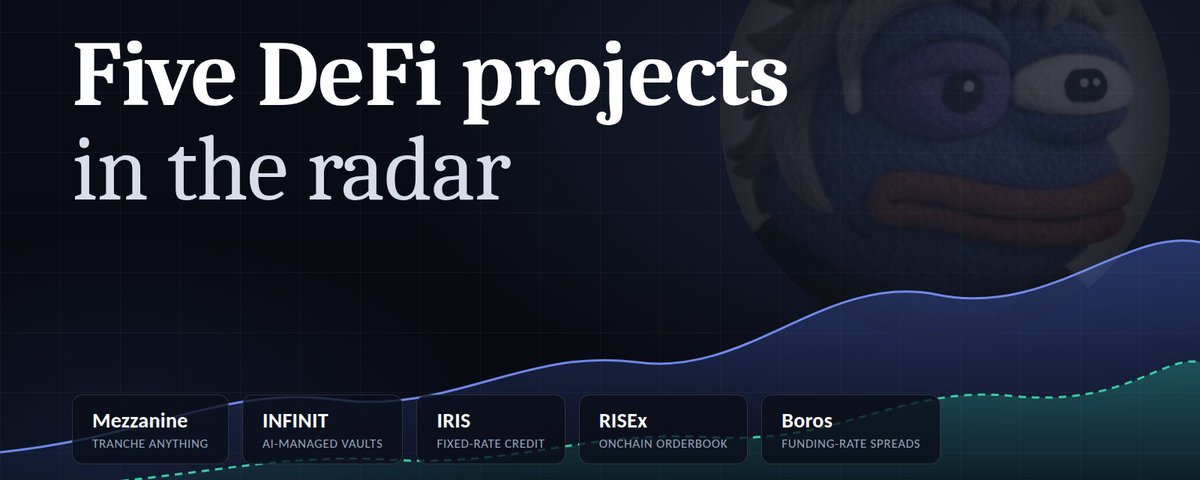
DeFi is advancing across structured vaults, managed trading, fixed-rate lending, and onchain derivatives.
@Rightsideonly highlights 5 projects worth tracking, including @mezzanine_fi, @Infinit_Labs, @iris_credit, @risextrade and @boros_fi, each with a different approach to capital efficiency, risk management and market infrastructure.
The article covers their progress, key features and upcoming catalysts.
x.com/rightsideonly/status/2…
—
Tokenizing private credit gets assets onchain, but the next step is making them useful across DeFi.
@Flowslikeosmo examines how @pharos_network is advancing this through @Official_Axil’s APC3M, a tokenized credit asset that holders can use as collateral to borrow USDC without selling their positions.
With @Morpho providing the lending infrastructure and @sharpbytexyz attracting liquidity through @okutrade, he explores why integrating tokenized credit into lending markets could matter more than issuance alone.
x.com/flowslikeosmo/status/2…
—
Beyond showing up consistently, building a founder’s personal brand requires a system that turns expertise into content, distributes it strategically, and improves with performance data.
@wizofecom breaks down how to hire a Head of Content, covering the skills, AI agents and weekly workflows needed to run the entire operation.
He also explains how to structure content across TOF, MOF and BOF, measuring success through authority, qualified leads and trust rather than views alone.
x.com/wizofecom/status/21128…
—
Crosschain trading can cost users time, execution quality, and money when the underlying infrastructure underperforms.
@a1lon9 breaks down the issues with @RelayProtocol, reporting that over 1 in 9 trades failed, typical buys took nearly 4 seconds, and users often received fewer tokens than expected.
@Pumpfun built Pump Bridge to fix this, cutting buy times by 2x, reducing errors by 92%, and improving token fills.
x.com/a1lon9/status/21129802…
—
Price pumps don’t always tell what’s happening beneath the chart. Weakening buys, rising sell pressure, and concentrated selling can signal trouble before prices react.
@Defi_Warhol built VolumeChecker with Claude and CoinGecko’s API to monitor live trading activity, compare current flows against historical baselines, and generate transparent risk scores.
The tool also logs alert evidence and tracks price movements over 4 timeframes, helping users separate potential risks from market noise.
x.com/defi_warhol/status/211…
—
Onchain options are gaining traction, but understanding how they work is key to using them effectively.
@0xbeiu breaks down calls, puts, strike prices, premiums, expiry dates, and the Greeks, explaining how price, time, and volatility affect profitability, even when an asset never reaches its strike price.
The guide also explores platforms like @DeriveXYZ, @dreaming, and @paradex, highlighting rising competition and adoption, alongside the need for better liquidity, tighter spreads, and more markets.
x.com/0xbeiu/status/21132473…
—
That’s all for the week. Stick around for more insightful reads weekly.


