
We are an interdisciplinary group working in Systems Biology. We participate in interdisciplinary projects with theoretical and experimental groups
La Plata, Argentina
Joined April 2018
- Tweets26
- Following24
- Followers36
- Likes1




Osvaldo Chara and Juan Fernández were interviewed (in Spanish) on the CONICET website regarding SysBio’s new article on cardiac syncrhony. Here you can find the interview:
conicet.gov.ar/disenan-una-h…

We have recently implemented this method through a custom device and software.
This study has been performed with the support from @SysBioGroup, @CONICETDialoga, @agenciaidiar y @Htal_Britanico.

We tested our dyssynchrony index against mechanical dyssynchrony (assessed by strain echocardiography):
It proved useful in predicting mechanical dyssynchrony.
We also verified its efficacy in identifying the most efficient activation sequence.
We found a cut-off value for the dyssynchrony index, separating synchronous from dyssynchronous populations.

When tested in patients with abnormal conduction patterns, our index reflected the magnitude of the dyssynchrony commonly associated to these types of conduction.

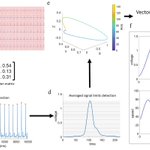
We found a correlation between voltage and speed in control subjects. From this observation we built a “dyssynchrony index” quantifying the deviation from the expected behavior.

Impairment of the electrical synchrony of the heart results in mechanical dysfunction.
There is still no reliable, universal method to assess cardiac electrical synchrony.
We developed a pipeline for the automated reconstruction of the vectorcardiogram from a single surface ECG.

Optimizing heart sisto-diastolic function: Is there a way to improve the work of a dysfunctional heart?
Check out this article from Chara’s lab in collaboration with @Htal_Britanico by @Osvaldo_Chara, @damiosp and @Juan08319226.
nature.com/articles/s41598-0…


When is it OK to assume a tissue as infinite? Read the last article from Chara's lab by @CeccarelliAS , @borgesaugust and @Osvaldo_Chara about spatiotemporal distribution of morphogens!
royalsocietypublishing.org/d…
(1/9)


Size matters - tissue size as a marker for a transition between reaction–diffusion regimes in spatio-temporal distribution of morphogens: ow.ly/lHS350HFrzc #RSOS #OpenAccess #ComputationalBiology #biophysics

SysBio retweeted

When is it OK to assume a tissue as infinite? Read the last preprint from Chara's lab by @CeccarelliAS @fiisau and @Osvaldo_Chara about spatiotemporal distribution of morphogens!
biorxiv.org/content/10.1101/…

Curious about how cell proliferation and cell recruitment interact?
Check out our new modelling and experimental adventure in Drosophila wing development by @Osvaldo_Chara and @H_Ariel_Alvarez in collaboration with Nahmad´s Lab published in @Dev_Bio_Journal !

A dynamic cell recruitment process drives growth of the Drosophila wing by overscaling the vestigial expression pattern.
@Osvaldo_Chara @SysBioGroup Our work with Nahmad´s Lab
sciencedirect.com/science/ar…