

I Talk About the TMT Sector & Deconstructing the Investment Process. Covering TMT for 20+ years. All Views/Opinions are not Investment Advice.
NYC
Joined March 2023
- Tweets2.1K
- Following483
- Followers9.2K
- Likes530



James Mackintosh (WSJ) on how the "obvious" post-election trades can sometimes (or often) be incorrect and how the consensus could be wrong about data centers

Don't Trust the Market's Knee-Jerk Reaction to the Midterms
wsj.com/finance/stocks/dont-…

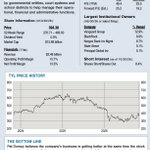
Tyler Technologies ($TYL) - great pitch in the latest Value Investor Insight (from Pat Dorsey)
$TYL is the dominant software provider for state & local govt, running payroll, property tax collection, court administration & school district finance.
• Compounder: Top line grows 10-12% a yr, op margins in the low to mid teens, retention in the high 90s, & the stock historically priced for 40-50x earnings for it.
• Derating: Two fears broke that, AI disruption & a SaaS transition that started later than the rest of software & muddies y/y comps.
• SaaS transition: ~50% of the base is on SaaS today, target 85% in 4-5 years, which lifts gross margin & cash conversion & cuts legacy support cost.
• Moat = inertia: Municipal buyers are a decade behind on tech & allergic to change, which slows the migration but makes an AI vendor with no references a non-starter in procurement.
• Runway: ~50% of the state & local market still runs on decades-old architecture, ransomware is forcing upgrades, & $TYL is the default when the decision finally gets made.
• Earnings power: 10-12% growth plus margin uplift as SaaS mixes up = ~20% EPS CAGR over 5 years, fading to low teens after.
• Valuation: 5% forward FCF yield at $394 embeds little of that, a rare case of the stock getting cheaper while the business gets better.


Listened to Craig Moffett on @stratechery. Great framing of the AI bubble/overbuild question.
What he learned in 1999 was to ignore revenue that moves between layers of the value chain. Telcos paying telcos for capacity was real revenue & it didn't matter. $NVDA selling to $CRWV is the same thing today.
What matters is money coming in from outside the system. Enterprises, consumers, governments paying the labs. Project that out and ask if it covers the cost of the whole stack underneath. Nobody can answer that yet, and we probably won't know until the capex is spent. That's why the market is nervous.
His worry is deflation. Drug discovery probably needs the best model. Customer service at a bank doesn't, and something two generations old does it for a fraction of the cost. Push that far enough and you get models running on a laptop, and the biggest capital investment in history ends up serving a thinner slice of the revenue than planned.
He's clear the products are transformational & that when revenue is there, capital usually finds it. His doubt is whether the money arrives before the bills do. All that fiber got used eventually & the industry probably did earn it back in the end. However, plenty of the companies that laid it in 1999 still went bankrupt along the way. The technology being real & the capex earning its return are 2 different questions.

Undercovered Semi / Recent Spin Worth a Look - Qnity (Q)
• The Setup: Spun out of $D in 10/25. Supplies polishing pads, lithography materials, bonding & thermal solutions to chipmakers. $TSMC is a top customer.
• The Valuation Gap: At $115, trades at ~23x NTM earnings vs. $ENTG at ~33x despite similar growth. A 30x multiple implies ~$160; bulls see $175–189 (50–65% upside).
• Why It’s Cheap: Just 10 analysts cover $Q vs. 25 for the average $SPY company. Bulls argue the discount reflects limited coverage rather than weaker fundamentals.
• The Track Record: Three quarters standalone, three earnings beats, each with 33%+ EPS growth. 2027 EBITDA estimates have risen from $1.6B to $2B since the spin.
• The Thesis: More layers, EUV & 3D stacking increase materials content per chip. Net debt of 2x EBITDA provides M&A flexibility.
• Risks: Obvious $TSMC concentration, semiconductor cyclicality, and valuation sensitivity. Shares are 35% below their $177 July high.
Thesis points summarized from Barron's article/investment thesis bullets in the picture are from Q's investor relations


Good $CDW pitch from the recent Value Investor Insight publication
• Misperceived quality: CDW is the largest U.S. value-added IT reseller, with 11+ year client relationships, scale advantages & industry leading profitability.
• Structural share gainer: CDW has consistently grown faster than overall corp IT spending in a durable reseller channel.
• Expectations are low: Shares are down >40% in two years amid tariffs, govt disruption, PC weakness and AI fears.
• Fundamentals remain solid: Despite these headwinds, 2025 gross profit grew ~6% and adjusted EPS ~5%.
• Headwinds look manageable: Govt disruption should normalize, PC pricing can offset weaker units, & CDW has limited exposure to software most at risk from AI.
• AI could be a tailwind: Customers need help deploying AI, while CDW can use it internally to boost efficiency. The recent $525M Lovelytics acquisition expands its AI capabilities.
• Valuation: Assuming just ~5% gross-profit growth, modest share gains & minimal op leverage, Longview (the author of the CDW write-up) estimates intrinsic value at ~2x today’s share price.
The bet: CDW has historically benefited from tech disruption. If AI is another opportunity rather than a structural threat, the market is materially undervaluing the franchise.
Conch Shell Capital retweeted

this article by mauboussin, I think may be 20 of the best pages, pound for pound, written on markets
"Thoughts on Valuation" (1997)
in it he destroys some of the most common myths of how markets work, and lays down what are really several "LAWS" of what drives stock prices...like ironclad, bulletproof, indestructible, 'do not argue with anyone who disagrees' type law
and a lot of people don't get it and refuse to get it
12mv2.com/wp-content/uploads…
--
1. "markets are short term oriented" -- no they are sure as hell arent...most stocks have 70-80% of their equity value tied up in cash flows 10+ years out, and in terminal value
2. "markets are inefficient" -- no, they really aren't...they move around a lot, but most of the time its based on data/newsflow which actually has an effect on valuation.
the daily data deluge, does not make it onto twtr...funds pay billions of dollars for this data, what appears as "random fluctuation" on twtr, is probably "data provider out with a call on the qtr"...none of which is ever posted on twtr
a lot of times when u hear "markets are short term oriented and inefficient," you can assume its from a guy who is down 40% from his cost basis
you ever notice how markets are never "inefficient" for a guy with green P&L? strange isnt it
3. "eps is everything" -- no, stocks trade off FCF, not eps. EPS doesn't capture capex, fcf does, so value-destructive capex can create EPS while destroying FCF (so the stock goes down)
I wrote a longer version of this in the quoted tweet, but there are several points he makes in the article which are
1. paramount to understanding how markets work
2. not understood by 99% of people
between the myth-busting, and replacing the myths with what is basically law...these 20 pages are "screw your head on straight" in making sense of markets
you have to ignore twtr and get used to saying "I'm not going back and forth with you." people will legitimately argue with you for 8 straight hours based on some theory of how markets work that they just invented
literally "source? I made it up"
they'll argue with me, over something I post from mauboussin or buffett..."no, stocks arent valued via dcf, those guys are both wrong"
like dog, you can take it up with those guys lol
and thats just my default response to a lot of shit... between mauboussin, buffett, and munger, you prob can get to 99.9% of what needs to be known / "LAWS OF MARKETS."
flush out any other opinions and install those
between these 20 pages and "expectations investing" you are in real good shape
12mv2.com/wp-content/uploads…


"Thoughts on Valuation" (1997, Mauboussin)
this one is straight to the point, and busts several market myths...stuff u see people get wrong every day
1. the market is short-term oriented, or "unsophisticated" or "irrational"...this is a myth.
2. EPS and EPS growth are what drive stock prices...also a myth.
theres other topics in here, he goes into CAP which is a good term/framework u can use forever...I will pull a few highlights
capatcolumbia.com/Articles/R…
1. how you can grow EPS and destroy growth (like Bezos' example)
"Let’s pretend I am an unlimited source of capital. Everyone in this room can come to me and I will give you all the money you want. There is just one catch: the expected return on the capital I give you, not the explicit return, but the implicit return, is 10%. Now, let’s say you can go out and reinvest the money I give you at 8%. I give you capital with a 10% “cost” and you reinvest it at an 8% return. Now here is the question. What is your earnings per share growth going to be for this venture? The answer is, It is going to be anything you want it to be! All you have to do is keep coming back to me for more money, reinvest it, and you will generate earnings growth at whatever rate you choose. Clearly, the more rapidly you grow earnings the worse off you are, because you are investing below the required rate of return.
That may make sense, but how does it apply to the real world? The answer is that the primary source of capital for most companies is retained earnings. (Roughly 75% of investments are funded internally.) Retained earnings have an implied opportunity cost—that is what shareholders could earn on that capital if they invested it in other ventures of similar risk—but most managers think of retained earnings as “free” money. Hence, managers who take cash generated by the business and reinvest it at below appropriate rates of return in order to drive earnings per share are doing their shareholders injustice. Mind you, investing in projects that do not earn the costs of capital may drive earnings per share growth, but will clearly destroy value. This type of investing goes on every day in corporations around the world."
2. the market sells off "EPS accretive" M&A
Here are some other illustrations in the last few months that demonstrate the earnings/value dichotomy. Tyco International—which has been a very good performing stock, by the way—announced in March it was acquiring a company called ADT. Tyco is in the building supply business, ADT is a leading home security company. It came in as a white knight. The acquisition is structured as stock-for-stock—formally called a pooling of interest. It is a mathematical truism when a high P/E company buys a low P/E company, EPS for the acquiring company go up. This point is axiomatic. This was also the case for Tyco and ADT. The day of the announcement, ADT stock was up 18%—no big surprise. Tyco suggested that the deal should result in EPS accretion of about 8%. The stock, however, declined 3% in a flat overall stock market. So earnings per share went up, the stock went down, and the company witnessed a 4 P/E point multiple contraction.
This underscores the important point that P/E multiples are not a determinant of value, but rather a function of value.
3. what's in a multiple? a lot
On Wall Street, the typical valuation formula is EPS x P/E = value. We just talked about earnings and how they can be misleading. Now we go to this thing called the P/E multiple. We are asking the P/E multiple to reflect growth, capital intensity, risk, quality of management, and competitive advantage. We are heaping a lot of responsibility on one number and we argue that it is practically impossible to know what that right number is.
--that bolded sentence is very important...very common question/pushback from new investors "why can't I just do a 2027 multiple, or 2030 multiple" etc
because u are obscuring all that shit, plus terminal value assumptions, into one number.
like you may as well just throw a dart. u arent doing real valuation work, ur just pretending these assumptions don't exit.
in a DCF, all those assumptions are made explicit - capex, roic, fcf, everything that moves stock prices...u model those and add confidence intervals/scenarios/probabilities where ur uncertain.
as opposed to just saying, "15x 2027 EPS." like closing ur eyes and saying, poof, doesn't exist
the only shortcut (which everyone uses) is thinking directionally...a stock price = cash flows and multiple.
so if u say a stock at $100, is worth $50, u have to explain...are cash flows going down 50%? or is the multiple going down 50%? or some combo? and why? (keeping in mind that the multiple captures all those variables laid out above)
ask LLMs if any of this isnt clear (multiple vs DCF) -- I'm not going to argue with you on how you think the sky is orange instead of blue, and LLMs will get this right.
4. short-termism myth
"The next myth is that the market is very short-term orientated. This one is a favorite of the business press, and is a theory in which many CEOs indulge. What is the evidence for “short-termism?” First, stocks react to quarterly earnings per share. Next, money mangers are evaluated every 90 days so they have to run fast to make sure their portfolio is well positioned for the short term. Finally, there is a disproportionate focus on next quarter’s earnings per share. This is particularly endemic to the sell side."
--someone is going to push back and say, "the market can be irrational"
yes, it can, its not perfect - "the market has predicted 9 of the last 5 recessions"
its still far more right than it is wrong. and the degree to which u understand this, tends to be linear to ur years of experience
mauboussin goes into examples of how the market is long term focused, but u can see that regardless - why is spacex worth a trillion dollars despite that theres no FCF for 5+ years?
because the market plays the long game. maybe its worth $2T, or $1T, or $500B, we'll see...but there's clearly a lot of value in there.
and on the flip side, u can see how AI/Claude has lopped off the terminal value of software stocks - those are long-term considerations, its not about next qtr being at risk, its 5-10 years out.
again, I'm not gonna argue with u here, go hit LLMs with ur opinions and views.
buffett 101: a stock is worth all the cash flow it will produce from now until kingdom come, discounted back at some rate appropriate to the business, risk, opportunity cost, 10-yr (he has many answers re: disc rate...but the point stands)
go argue w buffett, dont argue w me
5. cont - time horizon
"The next canard is that the market is “unsophisticated” or in some instances “irrational.” Allen Greenspan and Warren Buffett have recently contributed to this myth. Sumner Redstone, the CEO of Viacom, recently said that his stock price is depressed because the stock market is irrational; people don’t get it. All these portfolio managers, who are out to make money in a competitive setting, are collectively irrational. That is a difficult one to buy.
What does happen is a company makes an acquisition, tells the world it’s a great strategic deal, and is shocked when the stock is down 2% or 3%. Now in some cases the market doesn’t get it because the market doesn’t have the appropriate information. In that case, it is incumbent on the company to provide the relevant information so as to allow investors to make the right decision. Collectively, the market gets it a lot more times than it doesn’t get it."
6. CAP 🧢
"Now we come to the last component of the value-based model and it is a critical one. This idea is what takes the DCF from the classroom into the real world. It takes it from theory to practice. Most MBAs have not been subjected to anything like this before, yet it is really the key to securities analysis. It’s something we call competitive advantage period (CAP). CAP is defined as the period of time a company can generate excess returns on its incremental investments. It is based on the idea that competitive forces ultimately drive your excess returns down to zero, meaning the business earns the cost of capital. The ability to extend excess returns for as long as possible is the basic concept of competitive advantage. This is how competitive advantage is tied into this framework.
Generally, when companies or investors run a cash flow model they go out five or ten years. Why is that? Because that’s how many fingers you have. Literally, we live in a decimal world because that is how many fingers we have! What you really want to do is link the competitive position of your business and/or industry to an economically sound competitive advantage period.
CAP can be defined by three major variables. The first is the current return on capital—the higher the better. The second is the rate of industry change—if you are in a fairly dynamic industry where things are changing quickly, investors tend to shorten the competitive advantage period. And third, which is related to the first two, is the barriers to entry; the higher the barriers to entry, the longer the competitive advantage period tends to be."
--
Summary
there's more in there, but u will notice that like everyone u know, everyone u follow, is doing all this shit wrong.
mauboussin and buffett have it right, u do not have to question anything they've written, nor argue with someone who says "buffett has it wrong"
ok pal
here is the best path though. independently consult LLMs, make sure you understand all of this front to back, get all ur q's answered...develop your own understanding of this
and then after that, u can either tune the crowd out entirely (since u have confirmation ur logic is sound), or u can try and correct people when u see them doing it wrong.
the latter will have u laughing, people will spend hours arguing in defense of some point of view which they literally just made up
and where an LLM within 2 seconds wouldve said "dude lol. no."
so idk, arguing with strangers on the internet is like Caligula declaring war on the ocean....u are never gonna win, its a neverending battle.
do your own homework and trust in LLMs, they are laser-sharp on topics like this -- fundamental equity analysis and basic market theory -- and will have u operating with some semblance of confidence.
"don't follow the crowd, they're lost."
buena suerte 🫡


Conch Shell Capital retweeted

DB: In late July, we called for a rotation back into Tech—the fifth such rotation in two years. That rotation is now well advanced, but we believe it still has room to run.
Mega-cap growth and Tech stocks have risen 14% since the end of July, reaching a new record high. By contrast, the rest of the S&P 500 has fallen 3% over the same period, including a 5.5% decline over the past five weeks.
The relative outperformance of mega-cap growth and Tech has moved into the upper half of its long-run trend channel, but it has not yet reached the top of that range.



Conch Shell Capital retweeted

Yeah, but “AI is a bubble,” right?
The Nasdaq-100 earnings per share growth just crossed 50%, surging faster than the post GFC rebound and blowing past every expansion cycle of the last two decades. Revenue growth is vertical right alongside it.
Bubbles are built on multiple expansion and non existent earnings. What we’re looking at here is an absolute acceleration in real, cold hard cash flow—proving that the AI supercycle is backed by fundamental profit growth, not speculative hot air at all…


🇸🇦 The reopen of the East-West Pipeline removes a major supply bottleneck, giving Saudi Arabia its bypass around vulnerable Gulf shipping lanes.
By piping crude straight to the Red Sea, Riyadh bypasses the Strait of Hormuz entirely. That operational recovery immediately bleeds out the geopolitical risk premium added after the September 10 attacks, stabilizing energy flows when macro markets needed it most…macro is getting better!

Conch Shell Capital retweeted

As disturbing as the near-perfect price analog is between the semis today and the internet stocks 26 years ago (see below), the critical difference is that earnings were non-existent in 1999 and 2000 while they are booming today. So, at forward P/E of 20x, there is no valuation bubble as far as I can see. If the AI theme unravels at some point, my guess is that it will be because investors are choking on the firehose of capital raises as opposed to being deceived by earnings that don’t materialize.

Conch Shell Capital retweeted

Buyside semis survey suggests 2/3 say the top risk is we’re at ‘peak’ for the second derivative ie the % increase in AI capex going forward.
If you’re wondering why the group trades at such a discount to growth, this is why. The market has been trained time and time again that a decel precipitates a plateau/decline of spending in the very near future, aka a view that current numbers are unsustainable and will soon crash. This has been the right framework historically as supply-side analysis has typically predicted highly cyclical industries such as semis.
However, the demand-side drivers of this cycle continue to demonstrate they are completely unprecedented and indicate no end in sight. Even as AI Capex growth may be forced to decelerate due to the law of large numbers and physical constraints, spending will continue marching higher driven primarily by the ever improving quality of the models, token price declines, better harnesses and applications, and broadly a proliferation of the emerging AI ecosystem which combined with continued adoption and learning is proving to be an extraordinary source of innovation, value creation, and ROI. Moreover, agents are now showing the ability to perform a broad swath of long-running tasks autonomously which is creating another exponential step-up token demand.
All that’s to say, there still appears to be a material disconnect between the improving fundamentals of the token economy, the subsequent implications for the durability of AI capex, and the valuations semiconductor stocks, many of which screen extremely cheap even after the recent rebound for the sector. Not to mention, some of them are truly the best and most impressive technology franchises in the entire world. This still looks to me like an opportunity.
$NVDA $AVGO $AMD $TSM $INTC $MU $SKHY $Samsung $ARM
In 2022 $APP fell to a $3.8B market cap on $1B of EBITDA. Adam Foroughi stopped talking to investors.
"We generated a ton of cash. Let's start buying our own stock. Let's become our best investor."
By his count $6B of buybacks retired 20%-25% of the shares, worth $50B+ at peak.