

Tech investor | Posting since March ‘26 | Views my own, not advice
Joined January 2022
- Tweets416
- Following686
- Followers5.5K
- Likes13K






Pinned Tweet
Some thoughts on AI ROI, which I believe is misunderstood and severely understated. TL;DR: AI ROI is inflecting for end customers (most important) and infra providers. Pure model provider ROI is less clear, but models will keep improving regardless, driving the industry forward.
Of all the debates on AI, the biggest and most persistent is around ROI. The problem is that the debate revolves around a single, inconsistently applied definition, when in reality there are three: 1) ROI for model providers, 2) ROI for model customers, and 3) ROI for infrastructure providers
While cooperative, #1 and #2 are fundamentally at odds with one another. All else equal, the higher the margin a model provider captures on the tokens it sells, the lower the margin the customer of those tokens captures on the work being done. This is driving enterprises to rationalize spend where they can: if a job can be done as effectively with a cheaper model, the ROI on that job is proportionally higher than if it were done with a more expensive model. That’s not 'bad' for AI. It just represents margin shifting from the provider to the customer.
Meanwhile, the ROI for infrastructure providers is a collective function of both. And while there are nuances around returns for individual infra providers depending on the concentration of and share between the model and customer cohorts, the reality is that infrastructure ROI overall benefits as long as demand for tokens keeps growing, regardless of the ongoing push-pull between model providers and customers.
In the last couple of months, we seem to be heading in a certain direction: aggregate model customer ROI is accelerating as customers benefit from the utility of increasingly intelligent tokens (and apps) at falling prices. This is evidenced by nearly all of the token-volume metrics across the industry, which continue to show growth and/or acceleration. Both the qualitative and quantitative data points on positive customer ROI are growing in concert, most recently with AWS CFO John Felton remarking that he studied AWS’ own token usage and found that, in general, more is better. And for those who still don’t believe in return on token spend, I implore you to model out the number of tokens needed to complete a job of your choice and measure the value of that job relative to the underlying cost of the tokens, with or without the model provider margin. Sure, there can always be waste. But when utilized properly, the returns on tokens are extraordinary, which is exactly what's driving continued volume growth.
We’ve subsequently seen this flow through to the cloud infrastructure providers, whose payback periods have compressed and whose returns have also increased, primarily as a function of rising rental prices for GPUs/accelerators. And as those returns have increased, so has demand for the underlying infrastructure, benefiting the AI supply chain at large.
So far, so good.
That leaves the model providers, where the biggest question really lies. The fact that inference gross margins can be so high is certainly positive in addition to being obvious: the prices at which tokens are sold are multiples higher than the miniscule cost of the underlying FLOPs needed to generate them. And again, the value of the work being done by the end customer is multiples higher than the token prices, so everybody wins. However, inference gross margins paint an incomplete picture, because token prices are primarily a function of model quality, which is primarily a function of training spend. That spend, in aggregate, is causing model providers to burn lots of cash. And because competition remains so intense, it’s unlikely in my view that any model provider can retain its inference margins without continued aggressive training spend. So the two go hand in hand and should be assessed together. While Anthropic’s reported positive FCF in 3Q was a nice surprise, I don’t expect it to continue, especially as OpenAI remains committed to investing aggressively and burning cash for the foreseeable future.
So that’s the predicament. The market is unsure what the long-term business and economic model of a 'lab' is, and rightly so. That raises the question: if the labs can’t make money, who’s going to fund the training, and how will the models keep getting better, which is the critical ingredient in continued AI adoption and end-customer ROI?
I see a few outcomes to this question:
Scenario 1: Concerns about model-provider economics prove overstated, and the market expands rapidly enough to accommodate multiple profitable frontier developers alongside a thriving open-source and open-weight ecosystem, supporting broad-based growth with attractive margins. This is probably the cleanest outcome which is why the market tends to like it so much. I still think this is the most likely path in the fullness of time, but it’s admittedly unclear. The mega-pilled RSI scenario also fits within this outcome, mainly in the sense that the investment pays off.
Scenario 2: Because of heightened competitive intensity and elevated training costs, the aggregate model provider ecosystem simply operates at maturity with razor-thin margins and very tight/minimal free cash flow generation, like other extremely competitive and/or commoditized industries. This is at least where we seem to be today, and where we will likely remain for some time.
Scenario 3: Financial pressure causes weaker participants to exit, merge, or scale back large training programs, eventually giving way to consolidation and reduced frontier training intensity, which allows the remaining players to expand margins. This seems both logical and likely to happen to some unknown degree, which would be positive for the value of the remaining players. Note that megacap tech hyperscalers, who collectively generate hundreds of billions in operating cash flow from their core businesses and are also training models, can continue to tap into that cash flow for ongoing training (ie GOOGL, META, and more recently NVDA). That will persist regardless of what happens with OpenAI or Anthropic.
Scenario 4: Frontier labs eventually convert into true public benefit corporations (in more than just name), owned and funded by a broad coalition of companies and the USG, all with incentives aligned toward the ongoing training and development of new models, effectively making the labs public utilities rather than private corporations. I do believe there is tremendous value in the IP at both OpenAI and Anthropic, and consequently see this as a far more likely outcome than either of them “going bust” and ceasing operations. While this may seem scarier to markets and in the headlines, the actual end result could be quite positive and well distributed across the entire AI ecosystem (rather than concentrated in the two labs). And at the very least, I believe there is strong merit in a pool of government-funded dollars for model development, much like the CHIPS and Science Act of 2022, which authorized $280 billion in federal funding and incentives. The US federal government spends >$7 trillion annually. Point being, there is both ample budget and precedent for the USG (and megacaps/others) to contribute to this national cause.
All in, some combination of these four outcomes should play out. And while some paths are smoother than others and there will be inevitable volatility and hiccups along the way, they all ultimately lead to positive ROI on AI spend: better models drive better end-customer returns, which drive better returns on infrastructure. That flywheel is already in motion (as evidenced by rising token volumes, GPU rental prices, and infra returns), and it’s much more sustainable than the market fears. It will take time to get from here to there, but the endgame appears to be quite positive, almost any way you slice it.
Today was a clear wake-up call for the market. It’s apparent that most investors weren’t, and perhaps still aren’t, prepared for each of the big 5 (incl. SPCX) to potentially raise multiple hundreds of billions of equity/debt capital through 2030, and multiple trillions collectively. These investors also weren’t prepared for the capex growth to have no end in sight.
Ironically, many of the executives of these companies have been out in public clearly communicating their intention to keep spending very aggressively, with no plans to stop anytime soon.
And yet, for whatever reason, street estimates called for capex to slow dramatically into 2028 and basically plateau thereafter. The street modeled 50-60% capex growth across the big 5 in 2027 (which itself is low), and then MSD% growth annually. There is no good fundamental reason to model that unless you think companies spend less because the returns on the technology slow, or you think there are severe physical/power/financing constraints (though this would just result in slower growth, not the plateau that’s been modeled).
But it seems just as likely that out-year estimates simply defaulted to a plateau. Companies only guide a year out, and few on the sell-side are willing to model years of cash burn at this scale, so in their models, burn peaks in 2027 before FCF flips back positive in 2028 and scales from there. That path doesn’t require nearly as much capital issuance. To be clear, this would be a much happier and easier world for equity investors, who could go back to reaping the rewards instead of writing the checks. But for those who took the companies at their word and modeled continued elevated capex growth through the balance of this decade, these levels of issuance were a mathematical inevitability.
Yesterday’s filing from $META probably forced many to contemplate for the first time that each of these companies could actually burn and issue multiple hundreds of billions of dollars in the coming years. The credit markets have already shown signs of strain under the sheer magnitude of issuance, so more of this may need to be done through equity. That means there was also some front-running of eventual, unknown but likely material levels of dilution.
Equity markets don’t like being diluted, and they generally don’t like companies spending money at all. Especially not when the dollars get this big and when, rightly or wrongly, many still doubt the viability or magnitude of the returns, or at the very least don’t care to wait around to find out. Add in the crowding and leverage, along with a continued rise in oil on Middle East flare-ups, and you get a meaningful stock correction.
And so that’s what I believe the market priced in today: more burn, more issuance, more dilution, more leverage, more risk, more financing constraints (esp. for the most rate-exposed stuff, which got hit the worst today), along with some uptick in the chance this all falls apart.
This is going to sound perverse, but I think a day like today is very healthy. The companies are ambitious and the markets are stingy. And they will have to work with one another to get what they want. The companies want unprecedented capital to invest in what they believe is a re-platforming of the entire global infrastructure for an AI future, and the markets demand sufficient evidence that they’ll earn above the required return on the capital they lay out and the risk they take on. Ultimately, this forces the companies to be more disciplined and to show ROI as early and visibly as possible. That doesn’t mean they spend less, just that they have to prove the spend is working. I don’t think Zuck’s comment about monetizing Muse so much more rapidly than previous platforms was a coincidence. He knows what he needs, and he knows what he needs to show to get it.
So what now? Is AI a powerful enough driver to muscle its way through the fears being expressed by markets?
I think so. The big 5 may grow capex from >$1.3 trillion in 2027 to >$2.5 trillion in 2030, a ~25% CAGR. That implies a lot of paper, but in general, the hyperscalers can afford to pay higher rates, and there still seems to be demand from credit investors for it. At yesterday’s Robin Hood conference, execs at Diameter and HPS expressed a view that 7-8.5% yields on bonds from these companies are interesting. And I’d argue that’s for good reason: aside from SPCX, these companies generate massive operating cash flow and have largely benign net debt/EBITDA levels.
On the other hand, the more speculative companies that sit further out on the risk curve, pay higher spreads, and often don’t generate any cash at all will likely be forced to spend less. If you thought CRWV and NBIS would spend a combined ~$150-200 billion of capex in 2030 (vs. ~$60 billion in 2026), that might get cut in half because of financing constraints. But even a $100 billion reduction is only a 3-4% hit relative to the big 5’s 2030 capex, which, on net, is very manageable. That may be an issue for those companies, but it’s not enough to derail the ecosystem as a whole.
Ultimately, you have to believe there are attractive returns in AI, which I strongly believe are inflecting and wrote about here: xitter.cf/evergreencap3/status/2….
So even while things remain turbulent, the path still appears bright.

Some thoughts on AI ROI, which I believe is misunderstood and severely understated. TL;DR: AI ROI is inflecting for end customers (most important) and infra providers. Pure model provider ROI is less clear, but models will keep improving regardless, driving the industry forward.
Of all the debates on AI, the biggest and most persistent is around ROI. The problem is that the debate revolves around a single, inconsistently applied definition, when in reality there are three: 1) ROI for model providers, 2) ROI for model customers, and 3) ROI for infrastructure providers
While cooperative, #1 and #2 are fundamentally at odds with one another. All else equal, the higher the margin a model provider captures on the tokens it sells, the lower the margin the customer of those tokens captures on the work being done. This is driving enterprises to rationalize spend where they can: if a job can be done as effectively with a cheaper model, the ROI on that job is proportionally higher than if it were done with a more expensive model. That’s not 'bad' for AI. It just represents margin shifting from the provider to the customer.
Meanwhile, the ROI for infrastructure providers is a collective function of both. And while there are nuances around returns for individual infra providers depending on the concentration of and share between the model and customer cohorts, the reality is that infrastructure ROI overall benefits as long as demand for tokens keeps growing, regardless of the ongoing push-pull between model providers and customers.
In the last couple of months, we seem to be heading in a certain direction: aggregate model customer ROI is accelerating as customers benefit from the utility of increasingly intelligent tokens (and apps) at falling prices. This is evidenced by nearly all of the token-volume metrics across the industry, which continue to show growth and/or acceleration. Both the qualitative and quantitative data points on positive customer ROI are growing in concert, most recently with AWS CFO John Felton remarking that he studied AWS’ own token usage and found that, in general, more is better. And for those who still don’t believe in return on token spend, I implore you to model out the number of tokens needed to complete a job of your choice and measure the value of that job relative to the underlying cost of the tokens, with or without the model provider margin. Sure, there can always be waste. But when utilized properly, the returns on tokens are extraordinary, which is exactly what's driving continued volume growth.
We’ve subsequently seen this flow through to the cloud infrastructure providers, whose payback periods have compressed and whose returns have also increased, primarily as a function of rising rental prices for GPUs/accelerators. And as those returns have increased, so has demand for the underlying infrastructure, benefiting the AI supply chain at large.
So far, so good.
That leaves the model providers, where the biggest question really lies. The fact that inference gross margins can be so high is certainly positive in addition to being obvious: the prices at which tokens are sold are multiples higher than the miniscule cost of the underlying FLOPs needed to generate them. And again, the value of the work being done by the end customer is multiples higher than the token prices, so everybody wins. However, inference gross margins paint an incomplete picture, because token prices are primarily a function of model quality, which is primarily a function of training spend. That spend, in aggregate, is causing model providers to burn lots of cash. And because competition remains so intense, it’s unlikely in my view that any model provider can retain its inference margins without continued aggressive training spend. So the two go hand in hand and should be assessed together. While Anthropic’s reported positive FCF in 3Q was a nice surprise, I don’t expect it to continue, especially as OpenAI remains committed to investing aggressively and burning cash for the foreseeable future.
So that’s the predicament. The market is unsure what the long-term business and economic model of a 'lab' is, and rightly so. That raises the question: if the labs can’t make money, who’s going to fund the training, and how will the models keep getting better, which is the critical ingredient in continued AI adoption and end-customer ROI?
I see a few outcomes to this question:
Scenario 1: Concerns about model-provider economics prove overstated, and the market expands rapidly enough to accommodate multiple profitable frontier developers alongside a thriving open-source and open-weight ecosystem, supporting broad-based growth with attractive margins. This is probably the cleanest outcome which is why the market tends to like it so much. I still think this is the most likely path in the fullness of time, but it’s admittedly unclear. The mega-pilled RSI scenario also fits within this outcome, mainly in the sense that the investment pays off.
Scenario 2: Because of heightened competitive intensity and elevated training costs, the aggregate model provider ecosystem simply operates at maturity with razor-thin margins and very tight/minimal free cash flow generation, like other extremely competitive and/or commoditized industries. This is at least where we seem to be today, and where we will likely remain for some time.
Scenario 3: Financial pressure causes weaker participants to exit, merge, or scale back large training programs, eventually giving way to consolidation and reduced frontier training intensity, which allows the remaining players to expand margins. This seems both logical and likely to happen to some unknown degree, which would be positive for the value of the remaining players. Note that megacap tech hyperscalers, who collectively generate hundreds of billions in operating cash flow from their core businesses and are also training models, can continue to tap into that cash flow for ongoing training (ie GOOGL, META, and more recently NVDA). That will persist regardless of what happens with OpenAI or Anthropic.
Scenario 4: Frontier labs eventually convert into true public benefit corporations (in more than just name), owned and funded by a broad coalition of companies and the USG, all with incentives aligned toward the ongoing training and development of new models, effectively making the labs public utilities rather than private corporations. I do believe there is tremendous value in the IP at both OpenAI and Anthropic, and consequently see this as a far more likely outcome than either of them “going bust” and ceasing operations. While this may seem scarier to markets and in the headlines, the actual end result could be quite positive and well distributed across the entire AI ecosystem (rather than concentrated in the two labs). And at the very least, I believe there is strong merit in a pool of government-funded dollars for model development, much like the CHIPS and Science Act of 2022, which authorized $280 billion in federal funding and incentives. The US federal government spends >$7 trillion annually. Point being, there is both ample budget and precedent for the USG (and megacaps/others) to contribute to this national cause.
All in, some combination of these four outcomes should play out. And while some paths are smoother than others and there will be inevitable volatility and hiccups along the way, they all ultimately lead to positive ROI on AI spend: better models drive better end-customer returns, which drive better returns on infrastructure. That flywheel is already in motion (as evidenced by rising token volumes, GPU rental prices, and infra returns), and it’s much more sustainable than the market fears. It will take time to get from here to there, but the endgame appears to be quite positive, almost any way you slice it.
Now is a good time to buy memory stocks. If you want to make a bet on AI, the DRAM companies appear to be some of the most disconnected: high growth, high margins (which will stay well above prior peaks if AI demand holds), critical importance to AI workloads (there’s no AI without DRAM), concentrated industry structure, increasingly strategic customer engagements, lack of substitutes, and record capital return, all at valuations that embed a sharp cyclical decline sometime between 2027 and 2028. This is despite companies like Google reportedly expressing interest in locking up memory supply through 2035.
Additionally, Elon’s comments yesterday were an incremental positive for DRAM. He said Terafab would start with an SRAM chip slated for volume production in 2H28, which is 2029/2030 in Elon-speak. This implies Terafab is still years away and, importantly, will target a logic process first, not traditional memory/DRAM.
I believe this is because he understands how difficult it is to manufacture memory from scratch (especially at competitive yields/economics). Only 4 players do it at scale globally, and all are vertically integrated with proprietary IP. I believe this is also why Elon has been pounding the table so hard on volumes coming out of CXMT. He’s trying to pressure MU/the big 3 to expand capacity too.
Ultimately, I think the best outcome for Terafab/SPCX/TSLA and the memory industry is for them to work together. But Terafab is early, as is a lot of what SPCX/TSLA are trying to build, so the DRAM companies are understandably approaching this with care. The worst thing they could do is ramp capacity for the Elon-universe before the actual demand is there and end up oversupplied.
Regardless, I hope we eventually see a partnership, especially between Sanjay at $MU and Elon, who were both seated close to President Trump at last month’s superintelligence summit and are both running American companies that are very pro-American AI/SI.

Why it made sense for $META to build its own frontier model rather than rely on anyone else:
1) The model will increasingly be the heart of $META's entire business. At the simplest level, don’t outsource your heart if you don’t have to. Plus Mark already learned this lesson the hard way relying on Apple for platform distribution.
2) The ability to leverage a frontier model internally and at cost is an extreme advantage, especially versus others who must pay a 70-80%+ margin to a 3P.
3) If you believe RSI can eventually drive a virtuous cycle that accelerates model development even further, and creates an insurmountable gap versus all other model providers, then owning this is a must.
4) There is a skill gap in AI. Having an internal frontier research lab creates another competitive advantage.

Dumb question but what's the advantage of $META having spent 100b+ to develop their own model under Muse, as opposed to having kept that money and just built Muse with whatever model gets the job done?
A friendly reminder that we’ll soon have Astra- and Opus 5.5-quality tokens that are both extremely cheap and ubiquitous from the broader set of closed and open-source providers alike, all while the frontier keeps racing ahead.
Demand for AI will only accelerate in that environment, further exacerbating the supply/demand imbalance and pushing GPU rental prices even higher. That drives up the returns and paybacks for capex spenders, leading to even more reinvestment back into infrastructure.
There is a reason Elon is targeting a Terawatt of compute. Tokens are fundamental units of intelligence and intelligence is what drives innovation and the entire global economy.
We are still in the infancy of this revolution. Focus on the fundamentals and ignore the noise.

The market is overestimating how much AI capex depends on OpenAI and Anthropic’s revenues. Capex is a function of the supply and demand for tokens. And while I remain bullish on the labs, that imbalance will intensify regardless of the dynamics between these two companies.
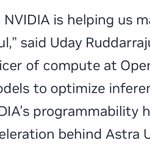
Great data point. OpenAI trained its models on Nvidia’s programming stack to unlock ultra-fast performance. Agents may ultimately find CUDA the easiest platform to accelerate because it has the deepest, broadest, and most mature substrate to work on. $NVDA


Up to 8x faster, and now you know why ⚡️@openai GPT-6 Astra Ultrafast runs on NVIDIA
Read the story: nvda.ws/3W2bZ5H
While the quoted a16z chart is technically factual, it's disingenuous in my view and lends to the flawed conclusion that "semis are making money while hyperscalers are losing money".
It's true that hyperscaler free cash flows have turned negative. But it's also true that the hyperscalers are more profitable than they've ever been as measured by operating cash flow, which is growing at accelerated rates (shown below). The fact that they are choosing to reinvest all of this excess OCF back into capex to fund further growth is correct given this dynamic, and is being reinforced by the elevated reported results and customer demand signals, which each indicate positive and increasing returns on invested capital ahead.
The free cash flow dispersion between semis and hyperscalers is just a function of the difference in business models and timing, and little else. Semis companies sell their systems at the beginning of the buildout and typically recognize 100% of revenues upfront, whereas hyperscalers spend the money upfront but then monetize that datacenter smoothly throughout a much longer period that spans a decade and beyond. Given that, there is no scenario in which the free cash flow profiles for either cohort would look any differently than they do right now given the magnitude of this ongoing buildout to support AI.
So I think these types of headlines are just so overblown. These companies need one another and that's not going to change. And they are both tremendously profitable beneficiaries and providers of the intelligence economy.
Having said all of that, the semis group generally still trades at an almost extreme discount to growth (ie NVDA is growing ~100% and trades at 10x), as the market continues to believe (very wrongly in my opinion) that these companies are overearning and that their current profits are not sustainable. And because I believe the buildout will persist at an outsized pace through at least the rest of this decade (and likely longer), I think the opportunity to invest in semis remains more attractive than just about any other sector I follow in tech.
But the hyperscalers are also extremely well positioned and undervalued relative to the role they will continue to play, the quality and durability of their franchises, and the accelerating growth rates they've demonstrated and continue to demonstrate.
All's to say, the world isn't black or white and I'm getting tired of the debates that pin two of the most attractive sectors in AI against one another. Happy trading.


The AI buildout in one chart: Big Tech's profits have become chipmakers' profits.
Approximate free cash flow, from 2022 to today:
- Hyperscalers: $275B → $0
- Semiconductors: $50B → $400B
More charts in State of Markets II: a16z.news/p/state-of-markets…


At first blush, dots looks focused on enterprise use cases within CGPT, a strategy that is clearly working for $OpenAI.
Alternatively, Muse seems like it might have a suspiciously clear path to becoming the overwhelmingly dominant consumer agentic platform. $META

Buyside semis survey suggests 2/3 say the top risk is we’re at ‘peak’ for the second derivative ie the % increase in AI capex going forward.
If you’re wondering why the group trades at such a discount to growth, this is why. The market has been trained time and time again that a decel precipitates a plateau/decline of spending in the very near future, aka a view that current numbers are unsustainable and will soon crash. This has been the right framework historically as supply-side analysis has typically predicted highly cyclical industries such as semis.
However, the demand-side drivers of this cycle continue to demonstrate they are completely unprecedented and indicate no end in sight. Even as AI Capex growth may be forced to decelerate due to the law of large numbers and physical constraints, spending will continue marching higher driven primarily by the ever improving quality of the models, token price declines, better harnesses and applications, and broadly a proliferation of the emerging AI ecosystem which combined with continued adoption and learning is proving to be an extraordinary source of innovation, value creation, and ROI. Moreover, agents are now showing the ability to perform a broad swath of long-running tasks autonomously which is creating another exponential step-up token demand.
All that’s to say, there still appears to be a material disconnect between the improving fundamentals of the token economy, the subsequent implications for the durability of AI capex, and the valuations semiconductor stocks, many of which screen extremely cheap even after the recent rebound for the sector. Not to mention, some of them are truly the best and most impressive technology franchises in the entire world. This still looks to me like an opportunity.
$NVDA $AVGO $AMD $TSM $INTC $MU $SKHY $Samsung $ARM
Some thoughts around frontier pacing and implications:
1) Expect there to indeed be some pacing and believe the safety concerns are real. Frontier progress will continue but at a somewhat slower rate than if things had remained totally unchecked. Note, this difference may not even be observable to the outside world but it will still exist in my view. We may get models in 6 months that we would have gotten in 3 months, or some variation therein. Still definitely expect strong progress but also a slowing to some degree.
2) Continue to believe this is very beneficial to all. The Hugging Face incident among others was a wakeup call. Models are now capable of both phenomenal and (in very rare instances) terrible things, and continue to improve rapidly. But the consequences even in the rare instances have become substantial enough that it's clear the industry needed to better formalize its plans around safety. I'm not going to get into how certain companies communicated versus others or who's doing more on safety already versus less - I don't think it's that relevant. Everybody needs to be on the same page putting safety paramount and continuing to compete aggressively under those bounds. China, of course, is a complete wildcard as to how they will (or probably won't) abide by the same rules (not to mention, what may or may have just happened to Xi, which we will find out soon enough). But regardless, continue to believe American AI with safeguards will win and that a good offense is the best defense against adversarial AI, which is why we need to continue marching forward (safely). Safe AI = a more sustainable/durable buildout and ecosystem.
3) I do think Software is a relative beneficiary of this, and especially the Cyber stocks who already are and will in my view continue to be enormous winners. Safer and more paced frontier development means some lowering of extreme tail risk for software broadly, and also an extraordinary tailwind in demand for cybersecurity spending. On the latter, agentic AI risk is so profound (from both internal agents misbehaving and adversaries) that Cyber should be the single most important priority for any enterprise globally, even ahead of investing in AI. Expect every enterprise globally to upgrade their entire security infrastructure as quickly as possible and do everything within their control to minimize exposure while maximizing protection. This means tiering up to the best of breed providers and increasing cyber budgets by a lot. Based on my conversations, expectations for the magnitude of acceleration in some of the leaders like $CRWD over the next 2-6 quarters appear far too low. Still see upside to cyber leaders even though some of the easier money has been made. $CRWD is the most advanced but also view $PANW favorably and even $MSFT to a lesser degree.
4) Finally, should be no change to compute investment plans going forward. Continue to believe we'll remain severely supply constrained even purely from the adoption of existing frontier models and applications built around them, along with emerging use cases like agentic swarms, and physical which is still to come. On a related note, Astra's capabilities have exceeded a major threshold in my view for agentic computer use and as the rest of the industry catches up to Astra over the next 6-12 months, token prices for Astra-level models should fall meaningfully, which is likely to have an extraordinarily positive impact on token demand and also ROI. We are still early. And still view memory companies and particularly DRAM as the most obviously mispriced $MU $SKHY, as the supply/demand imbalance is likely to exacerbate and remain for years, which will put continued upward pressure on pricing even as LTA mix grows (which also improves business quality).
A hot (or not so hot) take: a more defined regulatory framework and pacing at the frontier is actually bullish for the AI complex, because it reduces the tail-risk of what could otherwise become catastrophe, and increases the safety and durability of the cycle.

We Must Pace the Frontier: I’ve written a new essay on why the AI industry should slow down, with a three-part plan for doing so.
Anthropic is unilaterally committing to the first of these steps. We’ll provide third-party evaluators with permanent, employee-level access to our systems, so that they can verify adherence to our safety measures, report on incidents, and assess models’ alignment during training.
You can read the full post here: darioamodei.com/post/we-must…
