
Professional quant economist - pointing out peoples economic fallacies
Joined December 2010
- Tweets8.9K
- Following198
- Followers214
- Likes12.8K


Andy retweeted

Full text of article:
Jay Bhattacharya, head of the National Institutes of Health, has written to Nature Medicine journal demanding a “formal, independent investigation” into why a key scientific paper misled the world about the virus causing Covid, and concealed the contributions made by three senior scientists to commissioning, reviewing and editing the paper.
In a career as a science writer that spans more than four decades, I have never seen an alleged case of scientific malpractice as influential. Like many others I have called for the paper to be retracted. Twice, the editor of the journal, Joao Monteiro, has been sent letters from numerous leading scientists demanding an investigation or retraction of the misleading paper. He has ignored us.
I know the paper entitled “Proximal Origin of SARS-CoV-2” was misleading because I was among those misled. At the time I sat on the science and technology select committee of the House of Lords and we were conducting an inquiry to try to understand this new virus threatening all our lives. The possibility that it had been accidentally released from a laboratory, if true, would have significant implications for the public-health response: a virus marinaded in human tissues in a laboratory for weeks would be far more infectious than one newly arrived from bats.
Parliamentary colleagues were asking me what I thought. To my shame, I told them a lab leak could be ruled out. I did so based almost entirely on the authority of this one paper. That very phrase “ruled out” appeared in the press announcement of the paper from the institution where the lead author, Kristian Andersen, worked. The article itself left no room for doubt: “we do not believe that any type of laboratory based scenario is plausible… our analyses clearly show that SARS-CoV-2 is not a laboratory construct.”
That these words appeared in Nature Medicine gave them a stamp of authority, or so I believed. The paper was subsequently viewed millions of times and cited in thousands of academic papers. The journal and the authors of the paper therefore had a special responsibility not to allow themselves to be misled. Yet we now know that Proximal Origin’s arguments were flawed and released Slack messages and emails show several of its authors were expressing exactly the opposite opinion in private both before, during and after publication. They still thought a lab leak was “friggin likely”, in the words of Andersen.
Worse than all that, congressional investigations have uncovered records strongly indicating that three of the most senior medical scientists in the world, Francis Collins (Bhattacharya’s predecessor as head of the National Institutes of Health), Anthony Fauci (head of National Institute for Allergy and Infectious Diseases) and Jeremy Farrar (head of the Wellcome Trust) had not only seen the paper before publication, but – according to a House Select Subcommittee report – had prompted its authors to write it in the first place, had reviewed it and even suggested alterations in wording. Fauci referred to the paper from the White House podium, giving no hint of his own role in it.
These men were heads of the bodies that funded the scientists’ work, yet they were not listed as co authors or acknowledged in the paper, despite the journal’s stated policy that authors disclose any funder’s “involvement in the conceptualisation, design, data collection, analysis, and preparation of the paper”. Farrar even suggested a change of wording to strengthen its conclusion: from “unlikely” to “improbable”. Why was he not acknowledged? Robert Garry, one of the authors, wrote to his colleagues: “Jeremy has been an amazing leader – should be author.”
Ed Holmes, another author, replied: “I agree, and I offered, but he wants to remain independent.” As we wrote to the journal editor in 2024: “This omission of a significant role played by the head of a funding agency, allegedly to maintain his ‘independence’, represents a serious breach of publishing ethics that completely undermines the credibility of the journal and calls into question the motivation behind the paper.” Answer came there none.
It should infuriate the journal’s editor that the paper appears to have been commissioned, designed and intended to shut down all debate about a possible laboratory origin of the most destructive pandemic in a century despite going directly against its authors’ own opinions. For the sake of science’s integrity the journal must act on Dr Bhattacharya’s letter.


Andy retweeted

A couple on minimum wage, both working 40 hours a week:
Gross: £52,874
Take-home: £45,108
Child Benefit: £1,407 (1 child)
30 funded childcare hours: ✅
A single earner on £100,001:
Gross: £100,001
Take-home: £68,558
Child Benefit: £0
30 funded childcare hours: ❌
Losing those hours costs £11,890 a year in nursery fees.
So the single earner ends up with £56,668.
The couple ends up with £46,515.
That's £10,153 more for the single earner.
Despite earning £47,127 more.
Now add a second child.
The couple's Child Benefit goes up to £2,337.
The single earner's nursery bill doubles to £23,780.
Couple: £47,446
Single earner: £44,777
The minimum wage couple are now £2,668 better off.
Is this a fair system?
Andy retweeted

High-income workers are fleeing Europe.
Economic theory tells us that the more
mobile a factor of production becomes,
the lower its optimal tax rate. This is why taxes on capital, which is relatively mobile, tend to be lower than taxes on labor, which historically has been less mobile.
However, as the chart below shows, as elite human capital has become more footloose, high taxes have become increasingly counterproductive.
This is a huge existential problem for European welfare states, which have traditionally relied on heavily taxing their most productive workers.

Andy retweeted

The NGO sector is an arm of the permanent centre-left state, designed to look like it is an impartial array of expert advisors. A sizeable portion of any political manifesto is decided by the NGO sector.
From Migrant Help to Hope Not Hate, by way of the British Red Cross and RNLI – taxpayer and overseas donor money is laundered through funnel organisations to political causes & political lobbying.
The NGO sector is quite literally paid for, by the public unwittingly, to lobby for open borders.
More on that in @ReinersProject’s overview of @cambridgecircre’s “Breaking the Blob” paper: reiners.org.uk/cambridge-cir…


EXCLUSIVE: Charities that called for Mahmood's immigration U-turn received more than £1billion in taxpayers' cash
dailymail.com/news/article-1…

Andy retweeted

This is actually such a perfect description of the left/right dynamic, but I'm not sure the OP actually understands why.
What do they tell you in the emergency instructions on a flight? Put on your mask FIRST, then help your kids. You must be "selfish" in order to be of service to others. While leftist worldview may appear noble, it's actually very impractical and counterproductive in the real world. The right wing worldview is what builds, maintains, and rescues societies, though on a superficial level it appears to be selfish and icky.
This is how you see very good-natured, well-intentioned people fall into highly destructive socialist dogma; its veneer of virtue and selflessness is irresistible. They're not bad people (though the commie street animals are), they just have never built anything, nor rescued anything, nor dealt with an emergency, etc...so they don't understand how things actually work.
In BLS/First Responder training they'll test you with a hypothetical question: Let's say you're a firefighter. You're out mowing the lawn in front of the station, and you witness a massive car wreck. What's the first thing you do?
Most people reasonably say "run over and extract the driver" or "call for the ambulance and grab a fire extinguisher", and they fail. The correct answer is: turn off the lawnmower. If you don't slow down and do that first, it'll roll off into the street and cause even more destruction.
The first principle of emergency response is: ensure the scene is safe. There's no point in initiating a "rescue" if it's not safe, and you, yourself, need to be rescued. While the average person might be outraged because a first responder is not darting over to the patient with enough haste, it's because they do not understand how things can break bad. There's a checklist of procedures that has been developed over centuries, written in blood, that informs how they do things, and in what sequence. And what may appear "selfish" is actually just...responsible and pragmatic.


Andy retweeted

Not quite accurate. Low to middle earners wage growth is out pacing middle to senior growth. Wage compression is very real. Where someone with 5 years experience under their belt is earning nearly as much as someone with 25 years experience.

Andy retweeted

I find articles like this hilarious. They're written as though there's this thing happening that we can't explain.
Look at the data... quiet quitting is particularly pronounced among Gen Z and younger millennials.
Then look at the backdrop to their careers. These people have watched their futures being spent on bailouts, lockdowns and furlough.
Even if you work extremely hard and earn promotions (which is far from guaranteed), wages in the UK are so crap, and the cost of living so high, that the rewards often amount to very little.
The extra pay can be negligible. The extra effort and responsibility are not.
And if you've worked hard, trained and made your way up the greasy corporate pole, there's a good chance you've watched entry-level wages creep ever closer to yours. You might reasonably be asking yourself why you bothered in the first place.
Since the pandemic began, the National Living Wage has increased by nearly 55%. If you're someone with years of experience, training, progression and hard work under your belt, and your wages haven't kept pace, why wouldn't you question the value of all that effort?
The incentive has been inverted.
This is wage compression, and we're now witnessing the second- and third-order effects governments seem so oblivious to. When the financial reward for taking on more responsibility diminishes, so does the incentive to do it.
And this is what's happening. People are moving the dial they actually have control over… how much they give a shit about their job. And I don't blame them.
I think people are also starting to realise that much of the reward for their hard work is swallowed up by the ever-growing, increasingly wasteful blob that is the British state.
It's like having someone sitting on your shoulders, stealing half your food, getting heavier by the day, and repeatedly slapping you around the face as you try to go about your life.

'Quiet quitting' could be hitting the economy - here's why bbc.in/4ijTORZ

Andy retweeted

It's a complete mystery how this has happened


British workers have become more disengaged from their jobs in the past decade, according to data that also shows job satisfaction has plunged to its lowest level in the survey’s 35-year history ft.trib.al/EPjMBj3

ALT Commuters cross London Bridge during morning rush hour, with City of London skyscrapers visible in the background. Text on image reads: ‘Quiet quitting’ is real and may be hitting UK productivity, analysis claims (Credit: Toby Melville/Reuters)
Andy retweeted

Things in Western Europe will improve when a few hard realities are understood:
1. Europe has no God-given right to be wealthy or stable. Things can & will decline and fall apart if not maintained and adapted to new realities. Things that worked in the 1970s may be counterproductive now.
2. Energy is the basis of the economy. Without it, nothing else matters. While efficiency will be important, any economy where energy is scarce will inevitably be one that struggles
3. Not all cultures are equal. Some create prosperity, some lead to misery, some are outright evil. If Europe doesn't accept this, the cultural basis of its previous success & prosperity will be destroyed forever
4. Have kids, or die out. In the long term, few things matter this much. You can't create a European future if there are no Europeans left for it, and as the experiences of the last few decades show, non-European immigration simply makes Europe culturally less European - and doesn't magically make these people culturally European.
5. The state can not - and should not - save every individual from him/herself from him/her bad choices or ineptitudes. The idea of a nanny state which can ensure that everyone always live comfortably with minimal effort & contributions 100% of time is not feasible. The socialist promises of 30 years of wealthy retirements for everyone and Europe being able to take on endless low skill immigration were lies.
6. If a society has no way for ambitious & creative people to get rich from working hard, everyone will get poorer because of it. The hard truth is that much of our economic future depends on businesses being built & transformed by ambitious & sometimes ruthless individuals. Not everyone is able or willing to do this, and without them, there is no one to employ others and no wealth & growth to tax. But if businesses & wealth are seen solely as an evil force to be taxed into oblivion, they will go elsewhere.
7. In some cases, the best way for society to deal with a criminal is to lock them up and throw away the key. A small percentage of humans are ticking time bombs - low IQs, high aggression potential, psychopathic traits, socialised into criminal structures or a culture of lawlessness. Society can't fix them. They go in and out of court rooms and across Europe states, NGOs & social workers waste billions of hours & Euros to try & fix the unfixable. Not least because of mass immigration from dysfunctional societies, our legal systems & high trust societies built on principles such as the benefit of the doubt & correction via socialisation are overwhelmed by the amount of aggressive young men with no interest to contribute to society.
All of this is fixable. But the first step is accepting reality.
Andy retweeted

Part of Nigel Biggar’s article in The Sunday Times today, reminding us that a careful reading of history, by an historian who know what he’s talking about, is a big improvement on what too often passes for debate about slavery reparations.

Andy retweeted

Mindblowing chart from OBR. In 2029 real household disposable income per person expected to be just 1% higher than in 2019. What an unbelievably awful decade. It used to grow by 2%+ every year, not 1% in 10 years.

Andy retweeted

I earn £100 grand a year.
I have a detached house. 2 cars and my wife is a full time home maker.
I can just about afford this. I probably couldn’t afford the house I own if I was buying for the first time today.
My salary puts me in the top 5% of earners in the UK.
Top 5% to have a similar standard of living to Homer Simpson.
That is a disgrace.
We have a flatter salary distribution than Soviet Russia and the highest taxes and borrowing costs we’ve seen in generations.
Success is almost impossible because our tax system means hard work makes you a stressed out tax cow, not wealthy and certainly not free.
We need something radical.
Less state.
More family.
Less handouts.
More reward for risk.
Instead. Tomorrow, Labour will offer another batch of policies which will send one message to aspirational Brits: why bother.

I read a piece in the FT this week about the price of being middle class in Britain now and it said a couple earning £436,000 combined take home £216,000. That’s a crazy amount of tax, and it doesn't include VAT on purchases, council tax, stamp duty or other taxes (I think does include pension contributions). I can’t stop thinking about it.
Andy retweeted

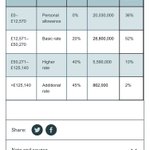
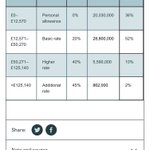
Back in 2010, the minimum wage was £12,064 and the 'higher earner' band started at £43,875.
You only paid 40% tax once you were earning 3.6x the minimum wage.
There was clear incentive to progress, learn and aspire for more.
As things stand, you now start paying 40% tax once you earn £50,270 which is just 1.83x the minimum wage.
If it was the same multiple as 2010, the 'higher earning' band would be £98,841 and everyone below this amount would be paying 20%.
Someone on £98,841 is effectively losing out on £9714.20 net per year if the bandings had simply moved in line with previous multiples relative to minimum wage.
This is one of the reasons why the middle class is being eroded and why there's a cost of living crisis in the UK.

An increase to £13.20p/h equates to a minimum wage of £27,456, based on a 40 hour week.
Once you factor in employers NI and basic pension contributions, the MINIMUM cost to hire a 21 year old for a company would be £31,461.
This is before you factor in any overarching business costs like office space, laptops, phone, software, training, support staff, vehicles etc.
This is going to be devastating to SME's who cant put together a simple 12 month budget without the goalposts being moved & their margins squeezed.
It'll also be catastrophic to youngsters opportunities because businesses will simply not be able to afford to hire them.
What's also incredible is that anything above £50,270 is seen as 'high earnings' in the UK and is taxed at 40%!
We are governed by financially and economically illiterate morons.
This will not end well.
Andy retweeted

The UK will continue to decline as long as it has two policies that are currently in place.
1. A commitment to end “relative poverty”
Combined with
2. Low-skilled migration
These two things are like strapping a Ferrari to a tractor.
The first rule is a commitment to make sure no one is living below 60% of the average household income.
On its own this might not be a bad idea. We’re all in it together so let’s pull the bottom up.
When this is combined with low-skilled migration it becomes a battle that can’t be won.
Brining in a million people who already fall below the 60% threshold breaks the deal.
Imagine a firm of lawyers. They all commit to making sure no partner earns less than 60% of the average. This goes well because they train up the junior partners. Then one day they decide that the firm will merge with a company that does basic bookkeeping. This company is rapidly expanding too so the game shifts. Now the lawyers have to massively subsidise basic bookkeepers. What would you expect to see happen? The top lawyers would leave because the deal is structurally stacked against them.
This isn’t theory. This is exactly what’s happening under Labour.


Flatter income distribution than the Soviet Union at the height of power

Time to post my biannual “how artificially compressed are British wages”.
Rising minimum wage and a 50k+ p/a tax bracket that runs to 40% of earnings, and hasn’t adjusted for inflation. This form of artificial wage compression has turned everyone in Britain into low productivity tax cattle - you have zero incentive to become anything other here.
This is also a form of ambition and productivity compression.
Source, ONS, Fig 5: ons.gov.uk/employmentandlabo…

21
Andy retweeted
Time to post my biannual “how artificially compressed are British wages”.
Rising minimum wage and a 50k+ p/a tax bracket that runs to 40% of earnings, and hasn’t adjusted for inflation. This form of artificial wage compression has turned everyone in Britain into low productivity tax cattle - you have zero incentive to become anything other here.
This is also a form of ambition and productivity compression.
Source, ONS, Fig 5: ons.gov.uk/employmentandlabo…

Andy retweeted
Where's the investment?
I just see hundreds of billions going into welfare and debt interest.

'Taxes are high because we need to invest in Britain', says Angela Rayner
lbc.co.uk/article/taxes-high…

Andy retweeted

This is what happens when you don’t build a single new reservoir since 1992, and grow your population by 12 million people in the meantime.

Exc: Ministers have been secretly warned that some English reservoirs are at risk of running dry, hitting water supplies to homes in the run-up to Christmas.
The government’s emergency committee, known as Cobra, is meeting up to twice a week to discuss the situation in the southwest of England and Sussex.
A secret “reasonable worst-case scenario” was drawn up, anticipating that several reservoirs’ water stocks could fall to 0 per cent — dubbed “day zero” — within weeks.
Officials warned that without action, supplies to some homes could be affected, along with disruption to the construction of a nuclear power station and operations at a prison.
Steps have been taken by ministers and water companies to try to mitigate the risks, which insiders stressed were already starting to push back the “day zero” dates.
Experts on the government’s Scientific Advisory Group for Emergencies (Sage) have also been brought in to help review water companies’ modelling for protecting stocks for the weeks ahead.
Heatwaves over the summer left half of England in drought. Sussex and the southwest were the most severely affected.
Wimbleball reservoir, which supplies more than 400,000 people in Somerset, has 13 per cent of its capacity, while Ardingly, which serves 280,000 customers across West Sussex, is at 17 per cent, figures from yesterday show.
Reasonable worst-case scenario plans were drawn up by the government, setting out a “day zero” envisaging Wimbleball and Ardingly reservoirs’ stocks being completely depleted by December.
Subsequently, the government privately said it was told by South West Water that it did not anticipate Wimbleball running dry due to measures it had put in place. South East Water is also taking action that has shifted Whitehall “day zero” forecasts at Ardingly into next year. Even if the reservoirs did run completely dry, water companies would probably be able to transfer supplies from elsewhere.
However, significant concerns remain in government about water disruption to properties supplied by Devon’s Venford reservoir in early November. “Day zero” risk monitoring has also started for Cornwall’s Stithians and Drift reservoirs.
Water companies were asked to model the impact of water-saving measures, which have been scrutinised by members of Sage. Ministers were told that shortages could affect daily operations at HMP Exeter and the construction of Hinkley Point C, a nuclear power station being built in Somerset.
Normal levels of rainfall over autumn and winter will not be enough to counteract the effects of the drought, which was extended to cover Yorkshire this month. Officials have calculated there will need to be 120 per cent of long-term average rainfall over the next six months for a nationwide recovery.
Andy retweeted

having tried my best to intuit the motives of the protesters in France today, I am struck by the fact that two of the most treasured pillars of the European postwar order are colliding:
1. unfettered immigration, especially from former colonies, justified by historical obligation and postcolonial guilt
2. protecting pensions and the elderly at all costs, even to the point of extreme fiscal strain
now you have first and second generation immigrants, as well as young native french people, taking to the streets because the french state is hell-bent on extracting whatever it can and feeding it into the maw of boomer luxury communism.
the younger generation is being asked to accept a deteriorating deal: pay more, receive less, and abandon the expectation of matching the living standard of their parents or grandparents.
the young immigrant newcomers have even less incentive to accept any kind this bargain. they are not bought in to the french social contract. they have no common identity with the french boomers they are being asked to sustain. they resent the fact that the entire machinery of the state is designed to exploit the young to serve the old.
the old do not care about the immigrants enough to trade away any of their entitlements for them. they have the advantage as they wield the franchise reliably and their share of the electorate is only growing, so they won't accept a decline in their own standard of living to fund a future they will never live to see.
now these two groups are on a collision course.
ironically, immigration was intended to ameliorate the worsening fiscal picture brought about by a demographic transition. but this did not happen. studies have repeatedly shown that immigrants do increase aggregate GDP (by simple brute force, by adding to population), but not the fiscal picture [1]. the most comprehensive paper using real-world data [2] segments immigrant types to France and finds non-EU immigrants to be persistently fiscally negative. EU immigrants by contrast are the most fiscally positive group, meaning that studies that consider immigrants as a whole are masking the negative impact of non-western immigrants (and Algeria, Morocco, and Tunisia rank #1 and #2 and #4. Africa accounts for 50% of the 8 million immigrants living in France today.)
immigration has not caused France's fiscal crisis. but it hasn't bettered the economic picture at all – it has deteriorated it somewhat – and it has created a combustible demographic that has little allegiance to the French nation. far from helping France deal with its aging workforce, immigration has added fiscal burden and created a permanent, non-assimilated disenfranchised underclass. the original justifications for immigration – labor scarcity, postcolonial obligation, and more recently workforce aging – have largely failed to manifest the promised results.
the pro-immigrationist policy has been defended in Brussels as necessary to defend the welfare state, but it has expanded the population making claims on the state, without eliminating the need for fiscal adjustments.
France now has an aging electorate aiming to preserve the benefits it was promised, mingled with a younger more diverse population that questions whether it will ever receive a similar deal. the young are vastly outmatched at the ballot box and so they take to the streets.
the french establishment is now trying to preserve a tenuous status quo: unlimited intergenerational obligations alongside a neverending immigration regime that continually changes the composition of the society intended to honor those obligations. the immigration regime also actively worsens the fiscal picture while creating these cultural fractures and inculcating a society more prone to sectarian violence.
the french state will have to renegotiate its social contract and disempower one of these groups. electoral gravity suggests that the old will continue to win until France finally reaches default and creditors renegotiate the welfare state for them.
the major contenders in 27 take different approaches to this tradeoff:
- the right in Le Pen looks to reduce immigration-related expenditure and focus public spending on French citizens, while resisting retirement age increases
- Macron in the center aims to control immigration somewhat and reform pensions by raising retirement age
- Melenchon's left, largely behind the protests this week, denies the tradeoff and aims to keep funding pensions and retirement at 60 while increasing immigration. as France has very little fiscal space it's unclear how this would be paid for
whether the french social contract can be peacefully renegotiated remains to be seen.
[1] For France, immigrants' net fiscal contribution averaged -0.85% of GDP over 2006-2018 when all public expenditure was allocated (and this includes ALL categories of immigrants including European, American and Asian) See: oecd.org/en/publications/int…
[2] See table 4 (translated below) shs.cairn.info/revue-economi…

Andy retweeted

Students supported Mao
Students supported Castro
Students supported Khomeini
Students supported Hitler
Students supported Mussolini
If find yourself blindly supporting every student lead movement, you’ll be wrong very often, in many eras, on many issues.

A good rule of history: if you find yourself opposing a student movement while siding with the ruling class, you're wrong. Every time, in every era, whatever the issue.
Readers added context they thought people might want to know
Student movements have not always been on the right side of history. Mao's student Red Guards persecuted hundreds of thousands. Students helped Castro and Khomeini rise to power, and Nazi student groups opposed the Weimar Republic.
britannica.com/topic/Red-Guar…
encyclopedia.ushmm.org/content/en/art…
aei.org/education/actu…