

Pushing the limits of Microsoft Excel.
Not Financial Advice
Joined January 2023
- Tweets5.9K
- Following470
- Followers3.7K
- Likes2.6K




LBO_Guy retweeted
Ahora que en Madrid anochece a las 18.00 de la tarde y todos nos queremos tirar por la ventana uno entiende 2 cosas: la primera es porque cuando sale el sol en el norte de Europa o Londres la gente no pega palo al agua. La segunda es, por si nadie se había dado cuenta ya, la remada que es vivir en esos sitios.
LBO_Guy retweeted
Pretty amazing to see 99% of ppl lost and not getting what I was tryna say. Obviously thought we were all on the same page, but we are clearly not. So let me explain.
The focus has been on GPU rental rates and @GavinSBaker ’s “no dark fiber” argument, which basically is that unlike telecom in 2000, the infrastructure is being used. GPUs are busy. Demand must therefore justify the buildout.
If you look at my chart, around 72% of Anthropic’s compute/infrastructure spending goes to training, research and internal use. Only c.25% goes to serving paying customers. Thus today, around 1/4 is used to serve customers. This is really important, because training is essentially an investment in FUTURE demand, a bet that future demand will materialize.
Let's say today there's around 25GW in use, that means today we're using around 6.25GW for inference. As per @SemiAnalysis_ there's another 50 GW coming up in 2027. A 75 GW installed base would be roughly 12x that. So basically, what this tells you is that potentially supply to serve customers could 12x almost instantly, as inference/training allocation is an allocation decision that can be switched instantly. In the telecom bust, around 97% of dark fiber was dark, so that is 33x (from 3% to 100%). Not as extreme today, but it is pretty big still and something cuts pretty directly towards Gavin's argument of dark fiber, which up until recently I found really solid.
The take here is that supply to serve customers can increase much faster than ppl thought about due to this, and we do not need to wait to 2028 or beyond for new GPUs to arrive and be energized. If funding tightens (happening a bit) or the economics of training the next model deteriorate, that allocation can change pretty quickly. Suddenly, hardware that was already “fully utilised” becomes additional inference supply.
Two implications follow. First, inference supply can expand sharply without an equivalent increase in installed hardware. Second, rental rates tell you how tight the market is under TODAY’S allocation. They tell you much less about durable scarcity when a large pool of compute could be redirected instantly. I always found rental rates pretty useless as an indicator of future economics or pricing power durability and this dramatically worsens that argument. If you can 12x supply instantly pretty clear that prices will drop, a lot. Now the question is if sufficient demand is created by such drop in prices (you need to look at QxP).
This basically brings us back to the Q x P formula, which is more difficult to solve. Essentially the underlying question is pretty clear (not that the answer is): can downstream customer spending ultimately cover operating costs and provide an adequate return on ALL consolidated upstream capex? Every GPU can be busy while the system as a whole is earning an inadequate return and if market conditions tighten and you run out of money, well, you're gone, despite how useful that model or whatever you were doing with those GPUs was.
This is why I think hyperscalers are much more favoured as you at least have a massive printing press online today with really good balance sheets that can help finance all this while others need to see quicker results.
My concern here is that while I believe AI is utterly useful (and trust me I spend quite a lot of money as % of my income) there's lot of ppl that max out at $200/month and don't want to pay more. As @benthompson and many other's have pointed out, consumers do NOT pay for being more productive, they pay to be entertained. So if budgets are constrained and have a top, the question that follows is, where are we in the penetration cruve? how many users are spending $0-50 and can go to $200/month? It is pretty obvious there is no clear answer on this and due to the capex figures being thrown around for 2026 and 2027 the market is starting to get nervous.
$META cutting it's workforce by 15% YoY and $MSFT trying to cut 60k employees yesterday (27% of workforce) is an example even companies that never thought about "budgets" or "capital limits" are starting to see them.
I think in this environment, the players that have the biggest optionality in monetization and have massive cash gushing machines are better positioned than the rest, and will survive. For me these are $GOOG and $META followed by $AMZN and $MSFT (it has enterprise). $SPCX has certainly stepped up its game with Grok Bot and I believe it has "entered the chat". Probably at par with amazon and just behind $META . The rest are pretty much levered compute vendors that I personally wouldn't touch. In the meantime, as all star CEOs are keen on spending, and given they pretty much control their companies, memory players seem really attractive at today's valuations. They certainly will capture most of that spending among the whole value chain.

Anthropic allocates 72% of compute to training. Crazy. This confirms what @insane_analyst and others have been saying about 75% going to training. Lot of compute not being used to serve customers but to improve models, LOL.

LBO_Guy retweeted
UPDATE. Ferrovial +10%.
Al parecer los de Ferrovial no estan tan locos. La pasta que tienes que adelantar es mucho menos de la que se pensaba la gente, lo apalancas un poco mas y ademas segun El Economista estan buscando socios (fondos de infra y de pensiones) para meterlos antes de empezar a construir, sobre todo en Atlanta, que es donde tienen mas exposicion. Lo mismo que ya hicieron en la I-77 con GCM Grosvenor y John Laing.
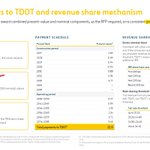
Cosa que parecia bastante evidente cuando nuestro querido Del Pino se juega toda su fortuna y ademas tiene mas datos que nadie sobre los queridos managed lanes en USA con un track record en rentabilizarlos bastante bueno. Mas likely eso que haya hecho 2 fat fingers seguidos (aqui no se hacen fat fingers) o que se les haya ido la cabeza a todos, no? Que es un poco lo que decia todo el mundo. En la I-24 de los famosos $24,8bn, durante la obra (2027-2033) solo se pagan $7,7bn, que es practicamente lo mismo que ofrecian en total ACS/Acciona ($7,25bn) y Sacyr ($7,4bn). El resto lo van pagando de 2036 a 2085 con los propios peajes. En valor presente todo junto son $21bn (no cambia tanto).
La diferencia de 3x, como mas o menos intuia, radica en lo que pueden cobrar a los conductores durante los 50 años. Aqui la unica liada (a toro pasado todos somos manolete) es que podias haber apretado mas en la subasta dado que el resto iba tan perdido. Por contrapartida, como es a sobre cerrado y no tienes otra oportunidad, si crees con tu numero ya tienes una buena TIR es mejor ir con eso que bajarlo por tratar de apurar y quedarte sin el negocio. Las empresas no estan para especular y hacer una TIR de 600%, con una del 15-25% vas que chutas.
Mañana call.
Lo que parece esta bastante clarinete es que cuando un tio con el 21% de la compañia y los datos de 5 managed lanes en la mano te hace un bid que nadie entendemos, lo mas probable es que los que no tenemos ni idea somos los que estamos en el otro lado. Ahora la gracia va estar en si se podia jugar asi en el pliego (reperfilar) o no.


LBO_Guy retweeted

Chinese 🇨🇳 tech giants Alibaba, Tencent and ByteDance are reportedly seeking long-term server memory supply deals with Samsung Electronics and SK Hynix.
Some customers are even requesting 10-year contracts extending through 2035, well beyond the usual 3-5 years.
The deals would cover DDR5 and LPDDR5 memory as Chinese cloud companies look to secure supplies for their expanding AI infrastructure.

LBO_Guy retweeted

According to Korean media reports, SK hynix plans to announce a KRW 60 trillion (US$46.2 billion) shareholder return package at its third-quarter earnings announcement on October 28.
The package would include KRW 30 trillion in share buybacks and KRW 30 trillion in dividends.
Samsung is reportedly also pursuing a shareholder return plan totaling KRW 110 trillion (US$82.9 billion).
hankyung.com/article/2026102…

LBO_Guy retweeted

I'm guessing the passenger of this cyber cab would be shitting his pants to see the car inching forward as an oncoming train approachs, like it wants to play chicken with the train.
Readers added context they thought people might want to know
This Cybercab is an engineering test vehicle and is NOT operating autonomously. The OP says this is in Seattle and Tesla does not operate autonomously there.
robotaxireport.com/cities/seattle/
tesla.com/support/robota…
LBO_Guy retweeted

I think the battle for Autonomous Austin might already be over.
Source: @RtaxiTracker

LBO_Guy retweeted

The most mind blowing stat we've seen so far is this:
"As of June 30, 2026, we had raised an aggregate of $141.1 billion of capital and had cash and cash equivalents of $112.4 billion and short-term investments of $19.3 billion."
That means to date, they have burned 9.7b, they are growing at a rapid pace, and are profitable on an operating income basis as of the June quarter! This is likely the most efficient scaling of a business in the history of capitalism.
xitter.cf/AnthropicAI/status/211…

Anthropic has filed an S-1 registration statement with the SEC related to its proposed IPO.
Read more: anthropic.com/news/s1-sec
Legal disclaimer: A registration statement relating to these securities has been filed with the SEC but has not yet become effective. These securities may not be sold, nor may offers to buy be accepted, prior to the time the registration statement becomes effective. This post does not constitute an offer to sell or the solicitation of an offer to buy these securities, nor shall there be any sale of these securities in any state or jurisdiction in which such offer, solicitation or sale would be unlawful prior to registration or qualification under the securities laws of any such state or jurisdiction.

LBO_Guy retweeted
TSMC is finally set to resume SRAM scaling with its A14 node, following a stall that began after N5, according to Korean media reports.
SRAM bitcell sizes have remained at 0.021 µm² for roughly eight years since the introduction of the N5 (5 nm) process in 2020. With A14, however, the size of a high-density 6T SRAM (static random-access memory) bitcell is expected to shrink to below 0.017 µm².
Korean media noted that this would put TSMC ahead of Intel’s 18A process, for which Intel reported a high-density bitcell size of 0.021 µm² and a maximum SRAM macro density of 38.1 megabits/mm² at last year’s ISSCC.
SRAM is the ultrafast cache memory used inside CPUs, GPUs, and AI accelerators. Smaller bitcells—the smallest individual memory cells—allow more memory to fit into the same area, directly affecting performance and power efficiency.
etnews.com/20261026000222

LBO_Guy retweeted

Las verdes en UK han parado la construcción de un Lidl (un Lidl!) usando el kafkiano planning process que paralizar el país (y el resto de Europa), y hay gente hablando de reindustrializar… ja ja ja


LBO_Guy retweeted

Dylan Patel @dylan522p of SemiAnalysis considers power as a manageable constraint compared to memory, substrate, and optics:
"Power is definitely a big constraint, but one thing that our research sort of shows that I think is counterintuitive to much of the market is that next year there are data center constraints but a lot less than people realize because there are nearly 50GW data centers being built globally. 7-8GW in China, 35GW in the US, and a bunch everywhere else - Australia, India, Malaysia."
"All over the world data centers are being built at a tremendous pace."
"While power is a huge bottleneck, people can find creative ways around that, whether it be turbines on site, reciprocating engines on site, or fuel cells on site. All of these things are helping alleviate the power bottleneck."
"As far as what people most people think, oh data centers and power are the biggest constraint? I think they are constraints but I think they are a lot less than substrates, memory, lasers, and other things in the optics supply chain."
Via CASPA on YouTube
$META $GEV $MSFT $AMZN $GOOGL $NBIS $CRWV
LBO_Guy retweeted
CEO of Amazon, Andy Jassy, on the cost of inference:
"The cost of inference has come down quite a bit in the last few years, but it is still an order of magnitude too expensive, in my opinion, for it to be used as pervasively as possible. If you are asking enterprises to rewrite their applications that use CPU today with AI accelerators, if the difference in those costs are very significant. The amount of incremental benefit they have to get from their AI accelerators on there is a much higher bar to want to rewrite those apps."
"If you can take the cost of inference down, that bar is much lower and all applications are going to be better and smarter and more capable with AI accelerators and inference. That is a really important part for customers to being able to use AI pervasively."
Via @a16z
$AMZN
LBO_Guy retweeted

$AMZN CEO Andy Jassy says AWS capacity is largely sold out through 2027, with a significant portion of 2028 already committed,
"There's only so much data center and power today. There's only so much memory, and I don't think that shortage ends in 2027. I think that, you know, one of the reasons, coming back to the capital investment, why I think we could invest a lot more and it wouldn't be a bad use of capital is that, you know, 2026 is obviously at this point sold out. 2027 is largely sold out. We always leave a certain amount for on-demand and our inference service, Bedrock or EC2, but largely sold out, all the big chunks. A good chunk of 2028 is sold out. Like, there's so much demand."
LBO_Guy retweeted

Listening to the earnings call knowing that it will determine how attractive my future wife will be

LBO_Guy retweeted
Citi: Muse secured over 10 million users in about 6 weeks following its launch in the US and Canada, with approximately 25% of users using it daily—more than double the engagement rate seen at the launch of Threads.
$META



LBO_Guy retweeted

Quest Diagnostics has been hacked. Patient data was exposed. They serve roughly half of U.S. hospitals and physicians. Investigation ongoing.


LBO_Guy retweeted
Pretty easy to guess $META capex and equity raise, or at least have a ball-park estimate. Sell-side consensus though is sleep at the well.
FY26 guide at $135–145bn implies $49–59bn in Q4 or $200–240bn run-rate. Given how capex is scaling up quarter on quarter, it wouldn't be crazy to estimate 2027 could be in the $250–300bn range. My guess is it's more towards the $300bn figure. Consensus is at $205bn, LMAO. OCF this year is around $130–140bn (cons $133bn) and 2027 consensus number is at v$168bn.
That put's, the gap at $80–130bn, which as said by mgm, it's too big to plug with debt alone. Equity raise could thus be around those figures, which matches $GOOG and $SPCX equity raises.


