
Robert Siscoe and John Salza, authors of True or False Pope?, tackle questions that are perplexing many Catholics today using Traditional Catholic Theology.
United States
Joined April 2025
- Tweets821
- Following1K
- Followers558
- Likes368




Reply to @FrLavery
Since our disagreement concerns the nature of the Church - what the Church is - we should begin with ecclesiology, not with the Baltimore Catechism's teaching concerning sins against the first commandment, which is something we both agree with.
Since you deny that the Roman Catholic Church consists of the local Church of Rome and the diocese throughout the world in union with it, please explain what you believe the Church itself is, and how it is formally visible.

Fr. Lavery,
The Protestants also claimed the Roman Catholic Church - i.e., the local Church of Rome and the diocese throughout the world in union with it - taught a New Religion. You are just as wrong as they were.
Regarding the Four Marks, the first points is that the instittional Church with Four Marks (i.e., the Roman Catholic Church as described above) also possesses the attribute of indefectibility, which guarantees, amoung other things, that it will always possess the Four Marks.
Now, if that Church does not have the Four Marks today, as you mistakenly believe, it couldn't have it had them during the Papacy of Pius XII, since indefectibility guarantees that the Church with Four Marks will never lose them. The contrary is also true: if the Church did possess the Four Marks during the Pontificate of Pius XII, indefectibility guarantees that it still possesses them today.
Moreover, if the Roman Catholic Church teaches a New Religion today, as you also mistakenly believe, it couldn't have been the true Church during the Pontificate of Pius XII, since indefectibility guarantes that the true Church will always teach the true religion.
What this shows is that the logical conclusion of both your errors is not merely that the Roman Catholic Church is not the true Church today; but that it never was the true Church, since the true Church is indefectible..
Second point:
You mistakenly believe that the Roman Catholic Church "no longer" has the Four Marks, yet you also claim to acceps Catholic theology.
The problem is that, according to the Catholic theology you claim to accept, the Roman Catholic Church is the only Church that can possibly posses the Four Marks. Why?
One reason is because the mark of Apostolicity requries a teaching Church - that is, a body of bishops with ordinary jurisdiction. Jurisdiction is the formal aspect of Apostolic Succession, which is a part of the mark of Apostolicity.
This is explained in the following article on Apostolicity, taken from the 1913 Catholic Encyclopedia:
"*Apostolicity is the mark by which the Church of today is recognized as identical with the Church founded by Jesus Christ upon the Apostles. It is of great importance because it is the surest indication of the true Church of Christ, it is most easily examined, and it virtually contains the other three marks, namely, Unity, Sanctity, and Catholicity.* Either the word "Christian" or "Apostolic", might be used to express the identity between the Church of today and the primitive Church. The term "Apostolic" is preferred because it indicates a correlation between Christ and the Apostles, showing the relation of the Church both to Christ, the founder, and to the Apostles, upon whom He founded it. "Apostle" is one sent, sent by authority of Jesus Christ to continue His Mission upon earth, especially a member of the original band of teachers known as the Twelve Apostles. Therefore the Church is called Apostolic, because it was founded by Jesus Christ upon the Apostles. ...
"In explaining the concept of Apostolicity, then, special attention must be given to Apostolicity of mission, or Apostolic succession. *Apostolicity of mission means that the Church is one moral body, possessing the mission entrusted by Jesus Christ to the Apostles, and transmitted through them and their lawful successors in an unbroken chain to the present representatives of Christ upon earth. This authoritative transmission of power [authority/jurisdiction] in the Church constitutes Apostolic succession. This Apostolic succession must be both material and formal;* the material consisting in the actual succession in the Church, through a series of persons from the Apostolic age to the present; *the formal adding the element of authority in the transmission of power.* It consists in the legitimate transmission of the ministerial power conferred by Christ upon His Apostles. No one can give a power which he does not possess. Hence in tracing the mission of the Church back to the Apostles, *no lacuna can be allowed,* no new mission can arise; but the mission conferred by Christ must pass from generation to generation through an uninterrupted lawful succession. ... *Apostolicity, or Apostolic succession, then, means that the mission conferred by Jesus Christ upon the Apostles must pass from then to their legitimate successors, in an unbroken line, until the end of the world.* (1913 Catholic Encyclopedia, Apostolicity)
Apostolicity requires a body of bishops with ordinary jurisdiction, and it must be morally one with that which has existed since the time of the Apostles (i.e., the Apostolic/Episcopal college).
Now, ordinary jurisdiction (the formal aspect of apostolic succession) is jurisdiciton that is attached to an office - to a legitimately established episcopal or apostolic see, or a canonical equivalent. A bishop receives his jurisdiction when he is appointed to the office and, as Pius XII teaches in Mystici Corporis Christ (and other places), Bishops receive their jurisdiciton directly from the pope and only from the pope, since the Pope alone appoints bishops.
Now, the only Church that even claims to have a body of bishops appointed to a legitimately established episcopal or apostolic see (or canonica equivalent), by the Pope, is the Roman Catholic Church. Therefore, it is the only Church that can possibly have bishops with formal apostolic succession, and because formal apostolic succession is part of the mark of Apostolicity, it is the only Church that can possibly posses the mark of Apostolicity and hence the only Church that can possible possess the 4 marks.
The Sedevacantist heretics certainly don't have them, and they never can, since they have no episcopal sees with ordinary jurisdiction attached to them (much less a pope who could appoint them if they did). The Sede bishops are all episcopus vagans, which are forbidden by the Council of Trent, which they claim to accept.
To recap:
If the Roman Catholic Church was the true Church in 1958, it is the true Church today, beause the true Church is indefectible.
If the Roman Catholic Church is not the true Church today - which we be the case if it lacks the 4 marks and teaches a New Religion - it wasn't the true Church in 1958.
The Mark of Apostolicity requires a body of bishops - numerically one morally body with that which has existed since the time of the Apostles - with ordinary jurisdiction (jurisdiction attached to an office).
Bishops receive their jurisdiction from the Pope, and only from the Pope, since the Pope alone appoints bishops.
Since the Roman Catholic Church is the only Church that even claims to have a body of Bishops with ordinary jurisdiction, it is the only Church that can possibly possess the mark of Apostolicity, and hence the only Church that can possibly possess the Four Marks.
One final point is that the Church with Four Marks is the Church outside of which there is no savation. And you, and all of your fellow Sedevacantists, are outside of that Church - not because you are invincibly ignorant of that Church (which could excuse), but because you have all been deceived into believing it defected by morphing into a New Church that teaches a New Religion - which is EXACTLY what the Protestants claimed.
Two totally and fundamentally different things. One is the case of a layman (Esquire, et al.) trying to pick apart papal teaching that has not the slightest evidence of heresy, let alone blatant heresy, in it, simply because he thinks he knows more than the Pope and can judge better than the Church.
The other is a case of a manifest and complete absence of the Four Marks of the Church in a new religion that even an untrained theologian can see is not the Catholic one.
If it was forbidden to all except the most highly trained theologians to decided upon or recognize the absence or presence of the Marks of the Church in any particular religious body, then it would be impossible for anyone to ever recognize the Catholic Church as the true one unless he had first received a doctorate in theology from the very Church whose authority he had not yet recognized as true. This is an untenable position, completely erroneous, leading to the conclusion that we are all hopelessly lost and can never arrive at the truth.
There is a reason Popes and theologians teach that manifest heresy bars one from membership in the Church, because such is totally and forever incompatible with being a member of that visible society.
This is a perfect description of the Sedevacantist apologists. Luther had similar complaints about the laity who followed him.
Luther:
"Noblemen, townsmen, peasants, all classes understand the Gospel better than I or St. Paul. They are now wise and think themselves more learned than all the ministers."
"This one will not hear of Baptism, that one denies the Sacraments, another puts a world between this and the last day: some teach that Christ is not God, some say this, some say that: there are about as many sects and creeds as there are heads. No Yokel is so rude, but when he has dreams and fancies, he thinks himself inspired by the Holy Ghost and must be a prophet."
"How many doctors have I made by preaching and writing? Now they say, ‘Be off with you. Go off with you. Go to the devil.’ Thus it must be. When we preach they laugh. ...when we get angry and threaten them, they mock us, snap their fingers at us and laugh in their sleeves.”
"There is no detractor greater then the one who has heard a sermon or can read a chapter in German, makes a doctor of himself, and crowns his ass, convincing himself that he knows everything better than all who teach him…29"
"When we have heard or learned a few things about Holy Scripture, we think we are already doctors and have swallowed the Holy Ghost, feathers and all."
One of the sad fruits of our day is a horde of laymen completely shooting from the hip when it comes to theology. Very often this is accompanied by confident expressions of "facts" or "principles" that are nothing of the sort. While I am not saying that laity have no business discussing theology, I am saying they are not the teaching authority of the Church and need to be aware of the limitations of their own knowledge.
Making grant statements of principles without really knowing what you are talking about does not serve the Church and can often do harm where one intended to do good. Moreover, disobedience to the magisterium by know-it-all laity (or clergy!) is always the work of the devil and is a symptom of pride.
4
8
1,005
Someone needs to explain to John Henry Weston that there are two powers - the Church and the State. The fact that the Church is a monarchy, and that the pope enjoys spiritual authority as its head, in no way implies that he is forbidden to cast a vote in the election of civil authorities.


In our next podcast, we will address the loss of office for heresy, and specifically the Sedevacantist error that the mortal sin of heresy (and loss of faith) causes the loss of office. If that were true, an occult heretic would be ipso facto deposed, since occult heretics are guilty of the sin of heresy.
Bellarmine, who the Sedevacantists mistakenly believe supports their position, refuted this error in numerous places. For example, in De Ecclesia Militanta, he wrote:
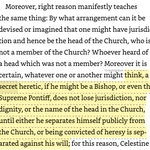
"It is certain that an occult heretic, if he be a bishop or even the supreme Pontiff, does not lose his jurisdiction, or dignity, or the title of head in the Church, until he either publicly separates himself from the Church, or, being convicted of heresy, is separated against his will.” (Bellarmine, De Ecclesia Militante, bk III, ch. X)
Notice what he said. If a pope falls into formal heresy (an occult heretic is guilty of formal heresy), but has not separated himself from the Church, he will remain pope and retain his jurisdiction unless and until he is "convicted of heresy" by the Church.
Bellarmine teaches the same in De Romano Pontifice, book 2, ca 30. In reply to the second opinion, he explains that a pope who falls into heresy is not ipso facto deposed by divine law. Rather, just as he is made Pope by God through the agency of men, so to is he deprived of his jurisdictio by God through the agency of men:
"The second opinion is that the pope, by the very fact that he falls into heresy, even if it is only interior, is outside the Church deposed by God, for which reason he can be judged by the Church—that is, he is declared deposed by divine law—and, if he still refuses to step down, deposed de facto. This is the opinion of John de Turrecremata, Book 4, Part 2, Chapter 20. However, it does not convince me.
"For jurisdiction is indeed given to the pope by God, but with the cooperation of human agency. as is obvious; because this man, who beforehand was not Pope, has from men that he would begin to be Pope, Therefore, jurisdiction is not taken away by God except through human agency. But an occult heretic (internally only; not externally occult) cannot be judged by men, nor would he relinquish his power voluntarily. Moreover, the foundation of this opinion is the claim that occult heretics are outside the Church, which we have shown at length to be false in Book 1, On the Church." (De Romano Pontifice, bk 11, cap 30)
The human agency through which one is made pope are the Cardinal electors; the human agency through which he is deposed are the bishops at a council. God both confers jurisdiction on a pope, and deprives him of it, through the agency of men.
That is the teaching of Bellarmine. And it is confirmed from the fact that no prelate has ever been ipso facto deposed for heresy while he remained in possession of his see.
Bellarmine’s Refutation of the Sedevacantists of His Day
In his book on the Marks of the Church, Bellarmine refutes the Sedevacantists of his day (the Protestants) who, like their counterparts in our day, claimed that the Pope and bishops in union with him had defected from the faith and been ipso facto deposed.
How did Bellarmine refute them? Did he attempt to defend the orthodoxy of the Pope and bishops agaist their accusation? No. That would have been a useless effort, since the Protestants were convinced that they alone had the true faith. How, then, did he refute them? He did so by explaining that Catholic Bishops, who are in peacefully possess of their sees, cannot be deprived of them until they are first legitimately judged.
The following is Bellarmine's reply to the Lutheran Sedevacantist, Johannes Brentius:
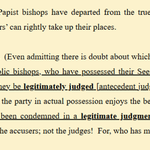
“They [Protestants] object that Papist bishops have departed from the true faith and are no longer bishops; thus, pious ministers can rightly take up their places.
“I answer Brentius' argument as follows (even if we concede that there is doubt as to who has the true faith, although we are certain that it resides with us): Catholic bishops, who have possessed their Sees peacefully for so many centuries, cannot be deprived of them unless they be legitimately judged and condemned. For, in every controversy the party that is in actual possession enjoys the benefit of the doubt. Now, it is certain that the Catholic bishops have never been condemned in a legitimate judgment. For who has condemned them, aside from the Lutherans? But they are the accusers, not the judges! For, who has made them our judges?” (Bellarmine, On the Marks of the Church, cap. viii)
Catholic bishops who remain in peaceful possession of their sees cannot be deprived of them unless they are legitimately judged. Clearly, the Sedevacantists of our day do not agree with this teaching of Bellarmine. On the contrary, they agree with the Protestants, whose opinion Bellarmine refuted using an argument that equally refutes them.
In his book On Councils, Bellarmine answers another objection raised by Protestants, which sheds further light on his position. The Protestants raised the following objection:
“The Roman Pontiff should not convene a Council, nor preside over it; rather, he should be on the side as one of the litigants - since he is the very person being accused - and the same person should not be both judge and party [to a case].”
Here is Bellarmines reply:
“The third condition is unjust, because the Roman Pontiff cannot be deprived of his right to convene Councils and preside over them—a right he has held for 1,500 years—unless he is first convicted by a legitimate judgement, and not the Supreme Pontiff. As for the argument that the same person cannot be both judge and party, I maintain that this applies to private individuals, not to a supreme ruler; for a supreme ruler, as long as it has not been declared or legitimately judged to have fallen from his position, remains the supreme judge, even when he himself is a party to a dispute.”
As we see, according to Bellarmine a pope (one accused of heresy) remains pope and retains the authority to convoke and reside over a council, unless he has bee legitimately judged and convicted of heresy and is no longer pope.
Bellarmine goes on to explain who could convict a pope of heresy:
“It should also be noted that the Pontiff is not the sole judge in a Council; rather, he has many colleagues—namely, all the Bishops. If they were able to convict him of heresy, they would also have the authority to judge and depose him, even against his will. Therefore, heretics have no grounds for complaint if the Roman Pontiff presided over a Council before he had been condemned.” (De concilii,lib. 1, cap xxi)
It is the bishops at a council who have the authority to convict a pope of heresy.
But how could they then depose the pope, which is a coercive act, when the pope is not subject to any coercive power on earth?
The reason they can do so is because, according to Bellarmine’s opinion, the pope would be deprived of his jurisdiction – and ceased to be Pope - the moment they convicted him.
So, the pope who possessed the authority to convoke the council, is deprived of his authority (by God) during the council, through the agency of men.
How can this be reconciled with Bellarmine’s teaching that a "manifest heretic" is ipso facto deposed?
As we saw above, Bellarmine taught that one of two things is required for a heretical pope (an occult heretic) to be deprived of his pontifical dignity, jurisdiction, and his title as head of the Church. One is being convicted of heresy by the Church. The other is openly separating himself from the Church (falling into schism).
To defend his opinion that a manifest heretic being ipso facto deposed, Bellarmine quoted St. Cyprian's teaching concerning Novatian. Novation didn’t merely err in doctrine; he was a schismatic, who had been illicitly consecrated by three intoxicated bishop (per Pope Cornelius), before declaring himself Pope. Novation was an antipope who was never a member of the episcopal college.
What Cyprian says in the quote that Bellarmine referenced to support his own position, is that, even if Novation had been ordained legally before he left the Church, he could not hold the episcopal. Why? Because he was separate from the body of bishops: In Cyprian's own words:
"He [Novatian] could not hold the episcopate, even if he had been made a bishop before, since he has cut himself off from the body of his fellow bishops and from the unity of the Church; since the apostle admonishes us to mutually sustain one another, and not withdraw from the unity which God has appointed, saying, 'Bearing with one another in love, endeavoring to keep the unity of the Spirit in the bond of peace.' (Ephesians 4:2-3). He who observes neither unity of spirit nor the concord of peace, but severs himself from the bonds of the Church, and from the fellowship of her priests, cannot have episcopal power or honor, since he has refused to maintain either the unity or the peace of the episcopate.” (Cyprian)
The reason Cyprian said Novation could not possess the episcopate is because he was separated from unity with the body of bishops.
So, the example Bellarmine used to support his position that manifest heretic is ipso facto deposed, wasn’t someone who merely erred in doctrine; it was a heretic who was also a schismatic, which is what the Fathers of the Church almost always mean when they speak of heretics. A heretic was one who belonged to a heretical sect (a heretic who was also a schismatic). St. Thomas confirms this when he says, “whoever is a heretic is also a schismatic, but not conversely." One can be a schismatic without being a heretic, but they can’t be a heretic without being a schismatic.
It is heretics, understood in this sense, who are separated from the Church. This is clear from the following taken from the Douay Catechism of 1649:
“Question. Why may not Heretics and Schismatics justly claim to be in the Unity of the Church and Members of Christ's body?
“Answer. Because Catholics can show to each sect of Heretics and Schismatics the time they began; the date of their separation from the Church: the name of the person or persons of their sect who first separated themselves, and the cause of their condemnation; whilst the Catholic Church always was from the beginning. (Douay Catechism).
Heretics are those who belong to a heretical sect, or those who have been convicted of heresy by the Church.
A heretic in the ecclesiastical forum
Another way to understand this is by distinguishing those who are guilty of the sin of heresy (in the internal forum), and those who are legally recognized by the Church (in the ecclesiastical forum) as heretics.
A person can certainly be guilty of the sin of heresy without being in schism or have been juridically declared a heretic; but, if they have been lawfully received into the Church, they are not considered to be heretics by the Church (in the ecclesiastical forum), unless they leave the Church or are juridically declared heretics. And if they are not deemed heretics by the Church, they can hold office in the Church, even if they are interiorly guilty of the sin of heresy.

How did we reach the point where a non-Catholic sect that denies collegiality, which was described as an evident dogma by Cardinal Billot (Tractus de Ecclesia Christi 1898), who conflates supreme authortity with the Primacy and the "munera" of teaching and governing with actual jurisdiction (in actus secundo), who believes the episcopal college is something that the pope "brings into existence" during a council; who believes "the intention to do what the Church does" requires indending the sacramental effect, who rejects the Catholic Church's universal Profession of Faith ('89 Professio), who believes the "danger of death" that triggers supplied jurisdiction refers to spiritual death; who believe bishops receive their jurisdiction from the laity "who confer it upon them"; who claim that a three sentence letter signed by a Cardinal (not the pope) constitutes a Decretum Laudis that raises them to a society of pontifical rite with the authority to incardinate priests? How can this sect, whose funder died under a declared excommunication, whose clergy are excommunicated, and whose lay "formal adherents" must be received into the Church by a formal process, can be looked upon by Catholics as defenders of the Faith, is not only a mystery, but an evident manifestation of the diabolical disorientation spoken of by St. Lucy of Fatima.
SSPX Bishop Goldade: “How did we reach the point where controversies within the Church have sunk to such a level, with topics like communion for the divorced and remarried, the worship of Pachamama, the blessing of same-sex couples, the separation of Church and State, or even the idea that all religions are paths leading to God, etc.?
The answer is simple: the theologians of the Second Vatican Council, who had been silenced under the pontificate of Pope Pius XII, were restored to their roles under the pontificate of Pope John XXIII and were granted privileged positions by Pope Paul VI.
They introduced their formulations and innovations into the Council’s documents, which were then integrated into the Church’s official teaching. What had initially been merely ambiguous formulations thus became contradictions with the deposit of the Faith.”
lifesitenews.com/news/sspx-b…

This is an exampe of a false statement that would be qualified as schismatic (propositio schismatica). It's one thing to dissobey a specific command if it violates divine law, and another to refuse any obedience to the pope because you think he is causing confusion.
unavailable
2
11
550
Do Muslims Worship the One True God?
In Tractatus de Fide, Disputatio XVIII, § IV, Suarez makes a distinction between two classes of infidels (unbelievers), and places the Muslims in the same category as the Jews who, he says, "worship the one true God."
Suarez: "Finally, there remains a question arising from what has been said—which St. Thomas treats in Summa Theologiae 2-2, q. 10, a. 11—namely, whether the rites of infidels should be tolerated in the realms of the faithful. For it seems to follow from what has been said that they should not be tolerated, because they are superstitious and offensive to God, whose true worship those rulers are bound to promote. However, St. Thomas rightly distinguishes between two types of rites: some are contrary to natural reason and to God as known by the light of nature—such as idolatry, etc. Others are indeed superstitious when compared to the Christian faith and its precepts, yet are not in themselves intrinsically evil or contrary to natural reason—such as the rites of the Jews, and perhaps many rites of 𝘁𝗵𝗲 𝗦𝗮𝗿𝗮𝗰𝗲𝗻𝘀 [𝗠𝘂𝘀𝗹𝗶𝗺𝘀] 𝗮𝗻𝗱 𝘀𝗶𝗺𝗶𝗹𝗮𝗿 𝗶𝗻𝗳𝗶𝗱𝗲𝗹𝘀 𝘄𝗵𝗼 𝘄𝗼𝗿𝘀𝗵𝗶𝗽 𝘁𝗵𝗲 𝗼𝗻𝗲 𝘁𝗿𝘂𝗲 𝗚𝗼𝗱 (qui unum tantum verum Deum adorant). ... This reasoning applies generally to 𝗦𝗮𝗿𝗮𝗰𝗲𝗻𝘀 𝗮𝗻𝗱 𝗼𝘁𝗵𝗲𝗿 𝗶𝗻𝗳𝗶𝗱𝗲𝗹𝘀 𝘄𝗵𝗼 𝗮𝗰𝗸𝗻𝗼𝘄𝗹𝗲𝗱𝗴𝗲 𝗮𝗻𝗱 𝘄𝗼𝗿𝘀𝗵𝗶𝗽 𝘁𝗵𝗲 𝗼𝗻𝗲 𝘁𝗿𝘂𝗲 𝗚𝗼𝗱.” (Suárez, Tractatus de Fide, Disputatio XVIII, § IV, n. 9.)
So, accusations from demons against nameless members of the hierarchy are publicly presented as facts by Fr. Ripperger. All this preternatural gossip does is scandalizes the laity and instill further distrust in the hierarchy.

Exorcist Says Demons Are Naming People High Up in the Catholic Church youtu.be/zDGvkbsl-XA?is=3Q7s… via @YouTube

Don't tell John Henry Westen, but Pope Leo XIII taught the same in Humanam Genus (1884): “Amongst the many benefits to be expected from it will be the great benefit of drawing the minds of men to liberty, fraternity, and equality of right; not such as the Freemasons absurdly imagine, but such as Jesus Christ obtained for the human race and St. Francis aspired to: the liberty."
Pope Leo praises French Revolution's Masonic motto of liberty, equality, and fraternity, claiming it is inspired and fulfilled by the Gospel message.
"Liberty, equality and fraternity are not simply words emblazoned on the front of your public buildings; they refer to universal ethical imperatives that also find in the Gospel message an inexhaustible source of inspiration and fulfillment."
lifesitenews.com/news/pope-l…

Traditional Franciscan Publisher Writes Open Letter of Concern on the SSPX onepeterfive.com/traditional…

Sedevacantism and the Manifest Heretic. An historical and theological refutation Sedevacantism tradanswers.substack.com/p/s…
1
5
436
The Unfailing Faith of Peter: A Reply to Ron Conte open.substack.com/pub/tradan…
Sedevacantist Debate: Robert Siscoe vs. Fr. Kramer open.substack.com/pub/tradan…
An Old Catholic priest (public non-Catholic) accuses Taylor Marshall of not being Catholic? Are we in the Twilight Zone?
This quoted post is unavailable.
Fr. Cekada, who dies outside the Church, continues to decieve unsuspecting Catholics from beyond the grave.
As Cardinal Billot explains in the quote below, a "material heretic" is not a Catholic (i.e., one who submits to the Church's magisterium as the rule of faith) who errs in good faith; it is a public non-Catholic (e.g., a Protestant, Sedevacantist, etc.) who errs in good faith. A Catholic who errs in good faith can be in material heresy, but he is not a material heretic.
As Billot also explains below, "if by 'material heretic' you understand one who professes dependence upon the magisterium of the Church in matters of faith, but denies something defined by the Church because he is ignorant of the fact that it was defined, or holds an opinion contrary to Catholic teaching because he mistakenly thinks that it is taught by the Church, then it would be utterly absurd to put material heretics outside the body of the true Church; but this would also be to distort completely the true meaning of the word."
Both formal heretics and material heretics are outside of the Church, since both terms refer to public non-Catholics; that is, those who are separated from the body (or structure) of the Church.
Cardinal Billot, Tractus De Ecclesia Christi (1927):
"Formal and Material Heretics
"Now, heretics are divided into formal and material. Formal heretics are those to whom the authority of the Church is sufficiently known. Material heretics are those who, affected by invincible ignorance concerning the Church herself, choose in good faith another rule to determine what they are to believe. The heresy of material heretics is not imputed as a sin; on the contrary, it is possible for them to have even that supernatural faith which is the commencement and root of all justification; for, they might believe all the principal articles explicitly, and believe the others, not explicitly, but implicity, by the disposition of their minds, and the good intention they have of believing all truths whatsoever are sufficiently proposed to them as revealed by God. Consequently, they can still belong in desire to the body of the Church and meet the other conditions necessary for salvation.
"Nevertheless, because we are concerned with real incorporation into the visible Church of Christ, our thesis does not distinguish between formal and material heretics—understanding the latter according to the notion of a material heretic that we have just explained, which alone is the proper and genuine sense of the term. For, if by “material heretic” you understand one who professes dependence upon the magisterium of the Church in matters of faith, but denies something defined by the Church because he is ignorant of the fact that it was defined, or holds an opinion contrary to Catholic teaching because he mistakenly thinks that it is taught by the Church, then it would be utterly absurd to put material heretics outside the body of the true Church; but this would also be to distort completely the true meaning of the word. For, a sin is called “material” only when all the elements of that sin are present materially, but without advertence or deliberate choice. Now, heresy by its nature requires departure from the rule of the ecclesiastical magisterium. In the case cited, there is no departure; there is only an error of fact about what the rule dictates. Such an error cannot be heresy, even materially so.
"Since, in the present discussion, it makes no difference whether one be a formal or a material heretic, we will direct our attention to another division.
"Notorious and Occult Heretics
"Heretics are divided into occult and notorious. Occult heretics are, in the first place, those who by a purely internal act disbelieve dogmas of faith proposed by the Church. Those also are occult, who do indeed manifest their heresy by external signs, but not by a public [i.e., notorious] profession. You will easily understand that many men of our times fall into the latter category—those, namely, who either doubt or positively disbelieve matters of faith, and do not disguise the state of their mind in the private affairs of life, but who have never expressly renounced the faith of the Church, and, when they are asked categorically about their religion, declare of their own accord that they are Catholics."

Part II Analysis of the SSPX's Decree of Excommunications and Explanatory Note youtu.be/VvAbwfsPYO4?si=ScUb… via @YouTube


