
Robert Siscoe and John Salza, authors of True or False Pope?, tackle questions that are perplexing many Catholics today using Traditional Catholic Theology.
United States
Joined April 2025
- Tweets821
- Following1K
- Followers558
- Likes368




Trad Answers retweeted

Sede Picante 🪑 🌶️
@realsedepicante has lost the argument 😭. No coming back from this.
Sedes lose. Stop quoting Bellarmine.
Pope Leo XIV is the Pope and Pope Leo XIV is a heretic just like his six predecessors:
John XXIII
Paul IV
JP I
JP II
Benedict XIV
Francis
lol.

In our next podcast, we will address the loss of office for heresy, and specifically the Sedevacantist error that the mortal sin of heresy (and loss of faith) causes the loss of office. If that were true, an occult heretic would be ipso facto deposed, since occult heretics are guilty of the sin of heresy.
Bellarmine, who the Sedevacantists mistakenly believe supports their position, refuted this error in numerous places. For example, in De Ecclesia Militanta, he wrote:
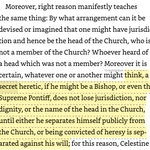
"It is certain that an occult heretic, if he be a bishop or even the supreme Pontiff, does not lose his jurisdiction, or dignity, or the title of head in the Church, until he either publicly separates himself from the Church, or, being convicted of heresy, is separated against his will.” (Bellarmine, De Ecclesia Militante, bk III, ch. X)
Notice what he said. If a pope falls into formal heresy (an occult heretic is guilty of formal heresy), but has not separated himself from the Church, he will remain pope and retain his jurisdiction unless and until he is "convicted of heresy" by the Church.
Bellarmine teaches the same in De Romano Pontifice, book 2, ca 30. In reply to the second opinion, he explains that a pope who falls into heresy is not ipso facto deposed by divine law. Rather, just as he is made Pope by God through the agency of men, so to is he deprived of his jurisdictio by God through the agency of men:
"The second opinion is that the pope, by the very fact that he falls into heresy, even if it is only interior, is outside the Church deposed by God, for which reason he can be judged by the Church—that is, he is declared deposed by divine law—and, if he still refuses to step down, deposed de facto. This is the opinion of John de Turrecremata, Book 4, Part 2, Chapter 20. However, it does not convince me.
"For jurisdiction is indeed given to the pope by God, but with the cooperation of human agency. as is obvious; because this man, who beforehand was not Pope, has from men that he would begin to be Pope, Therefore, jurisdiction is not taken away by God except through human agency. But an occult heretic (internally only; not externally occult) cannot be judged by men, nor would he relinquish his power voluntarily. Moreover, the foundation of this opinion is the claim that occult heretics are outside the Church, which we have shown at length to be false in Book 1, On the Church." (De Romano Pontifice, bk 11, cap 30)
The human agency through which one is made pope are the Cardinal electors; the human agency through which he is deposed are the bishops at a council. God both confers jurisdiction on a pope, and deprives him of it, through the agency of men.
That is the teaching of Bellarmine. And it is confirmed from the fact that no prelate has ever been ipso facto deposed for heresy while he remained in possession of his see.
Bellarmine’s Refutation of the Sedevacantists of His Day
In his book on the Marks of the Church, Bellarmine refutes the Sedevacantists of his day (the Protestants) who, like their counterparts in our day, claimed that the Pope and bishops in union with him had defected from the faith and been ipso facto deposed.
How did Bellarmine refute them? Did he attempt to defend the orthodoxy of the Pope and bishops agaist their accusation? No. That would have been a useless effort, since the Protestants were convinced that they alone had the true faith. How, then, did he refute them? He did so by explaining that Catholic Bishops, who are in peacefully possess of their sees, cannot be deprived of them until they are first legitimately judged.
The following is Bellarmine's reply to the Lutheran Sedevacantist, Johannes Brentius:
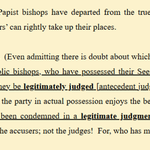
“They [Protestants] object that Papist bishops have departed from the true faith and are no longer bishops; thus, pious ministers can rightly take up their places.
“I answer Brentius' argument as follows (even if we concede that there is doubt as to who has the true faith, although we are certain that it resides with us): Catholic bishops, who have possessed their Sees peacefully for so many centuries, cannot be deprived of them unless they be legitimately judged and condemned. For, in every controversy the party that is in actual possession enjoys the benefit of the doubt. Now, it is certain that the Catholic bishops have never been condemned in a legitimate judgment. For who has condemned them, aside from the Lutherans? But they are the accusers, not the judges! For, who has made them our judges?” (Bellarmine, On the Marks of the Church, cap. viii)
Catholic bishops who remain in peaceful possession of their sees cannot be deprived of them unless they are legitimately judged. Clearly, the Sedevacantists of our day do not agree with this teaching of Bellarmine. On the contrary, they agree with the Protestants, whose opinion Bellarmine refuted using an argument that equally refutes them.
In his book On Councils, Bellarmine answers another objection raised by Protestants, which sheds further light on his position. The Protestants raised the following objection:
“The Roman Pontiff should not convene a Council, nor preside over it; rather, he should be on the side as one of the litigants - since he is the very person being accused - and the same person should not be both judge and party [to a case].”
Here is Bellarmines reply:
“The third condition is unjust, because the Roman Pontiff cannot be deprived of his right to convene Councils and preside over them—a right he has held for 1,500 years—unless he is first convicted by a legitimate judgement, and not the Supreme Pontiff. As for the argument that the same person cannot be both judge and party, I maintain that this applies to private individuals, not to a supreme ruler; for a supreme ruler, as long as it has not been declared or legitimately judged to have fallen from his position, remains the supreme judge, even when he himself is a party to a dispute.”
As we see, according to Bellarmine a pope (one accused of heresy) remains pope and retains the authority to convoke and reside over a council, unless he has bee legitimately judged and convicted of heresy and is no longer pope.
Bellarmine goes on to explain who could convict a pope of heresy:
“It should also be noted that the Pontiff is not the sole judge in a Council; rather, he has many colleagues—namely, all the Bishops. If they were able to convict him of heresy, they would also have the authority to judge and depose him, even against his will. Therefore, heretics have no grounds for complaint if the Roman Pontiff presided over a Council before he had been condemned.” (De concilii,lib. 1, cap xxi)
It is the bishops at a council who have the authority to convict a pope of heresy.
But how could they then depose the pope, which is a coercive act, when the pope is not subject to any coercive power on earth?
The reason they can do so is because, according to Bellarmine’s opinion, the pope would be deprived of his jurisdiction – and ceased to be Pope - the moment they convicted him.
So, the pope who possessed the authority to convoke the council, is deprived of his authority (by God) during the council, through the agency of men.
How can this be reconciled with Bellarmine’s teaching that a "manifest heretic" is ipso facto deposed?
As we saw above, Bellarmine taught that one of two things is required for a heretical pope (an occult heretic) to be deprived of his pontifical dignity, jurisdiction, and his title as head of the Church. One is being convicted of heresy by the Church. The other is openly separating himself from the Church (falling into schism).
To defend his opinion that a manifest heretic being ipso facto deposed, Bellarmine quoted St. Cyprian's teaching concerning Novatian. Novation didn’t merely err in doctrine; he was a schismatic, who had been illicitly consecrated by three intoxicated bishop (per Pope Cornelius), before declaring himself Pope. Novation was an antipope who was never a member of the episcopal college.
What Cyprian says in the quote that Bellarmine referenced to support his own position, is that, even if Novation had been ordained legally before he left the Church, he could not hold the episcopal. Why? Because he was separate from the body of bishops: In Cyprian's own words:
"He [Novatian] could not hold the episcopate, even if he had been made a bishop before, since he has cut himself off from the body of his fellow bishops and from the unity of the Church; since the apostle admonishes us to mutually sustain one another, and not withdraw from the unity which God has appointed, saying, 'Bearing with one another in love, endeavoring to keep the unity of the Spirit in the bond of peace.' (Ephesians 4:2-3). He who observes neither unity of spirit nor the concord of peace, but severs himself from the bonds of the Church, and from the fellowship of her priests, cannot have episcopal power or honor, since he has refused to maintain either the unity or the peace of the episcopate.” (Cyprian)
The reason Cyprian said Novation could not possess the episcopate is because he was separated from unity with the body of bishops.
So, the example Bellarmine used to support his position that manifest heretic is ipso facto deposed, wasn’t someone who merely erred in doctrine; it was a heretic who was also a schismatic, which is what the Fathers of the Church almost always mean when they speak of heretics. A heretic was one who belonged to a heretical sect (a heretic who was also a schismatic). St. Thomas confirms this when he says, “whoever is a heretic is also a schismatic, but not conversely." One can be a schismatic without being a heretic, but they can’t be a heretic without being a schismatic.
It is heretics, understood in this sense, who are separated from the Church. This is clear from the following taken from the Douay Catechism of 1649:
“Question. Why may not Heretics and Schismatics justly claim to be in the Unity of the Church and Members of Christ's body?
“Answer. Because Catholics can show to each sect of Heretics and Schismatics the time they began; the date of their separation from the Church: the name of the person or persons of their sect who first separated themselves, and the cause of their condemnation; whilst the Catholic Church always was from the beginning. (Douay Catechism).
Heretics are those who belong to a heretical sect, or those who have been convicted of heresy by the Church.
A heretic in the ecclesiastical forum
Another way to understand this is by distinguishing those who are guilty of the sin of heresy (in the internal forum), and those who are legally recognized by the Church (in the ecclesiastical forum) as heretics.
A person can certainly be guilty of the sin of heresy without being in schism or have been juridically declared a heretic; but, if they have been lawfully received into the Church, they are not considered to be heretics by the Church (in the ecclesiastical forum), unless they leave the Church or are juridically declared heretics. And if they are not deemed heretics by the Church, they can hold office in the Church, even if they are interiorly guilty of the sin of heresy.
Trad Answers retweeted

I am so happy I wasn't on Twitter when I was converting to Catholicism and in RCIA. I was already validly baptized, but the people on here who aren't even baptized and are catechumens who feel the need to lecture the Church on what needs to be changed show they do not understand Catholicism at all and have a spirit of Protestantism. Suggesting that the Church you're joining is wrong and needs to change before you're even a member shows both a massive pride and overwhelming stupidity.
Trad Answers retweeted

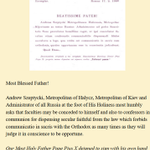
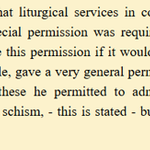
"conciliar decrees are the very essence of church doctrine... all conciliar decrees"
Including, e.g., canons 68 and 69 of Lateran IV (pics)? Or is +Barron right and things are actually a bit more complicated than "council = doctrinally binding"?


Bishop Barron went on EWTN's "World Over" and it wasn't pretty. ncronline.org/opinion/ncr-vo…

Trad Answers retweeted

Exclusive content contrathuc, all rights reserved😎 suscribe now.
Michael Mary Sim in what seams Papa Stronsay Scotland next to Pierre Roy, Rodrigo da Silva and member of the transalpine redemptorists.

Trad Answers retweeted

Confusion lingers.
Weeks after Rome handed down its decree of excommunication against the SSPX for its illicit consecration of bishops, questions remain:
Whom does the decree excommunicate? Just the bishops? The clergy? The laity attached to the SSPX?
Did the decree lawfully revoke the faculties to offer marriage and confession?
What is the effect of the SSPX's recent canonical appeal? Does it actually suspend the excommunications under Canon 1353, as they claim?
Attorney and Catholic apologist John Salza joins me on this episode to clear up the confusion.
FORWARD BOLDLY: SSPX—Clearing Up Confusion
youtube.com/watch?v=GioxqtWC…
Trad Answers retweeted

🚨BREAKING NEWS:The ultimate escalation.
The US military just took the fight straight to Tehran, targeting the IRGC's core Sar-Allah Headquarters.
The main command facility is reportedly burning down right now. Game over for deniability. ⚡
Trad Answers retweeted

Here’s a great resource that addresses and demolishes the various arguments of the SSPX regarding a supposed “state of necessity”, the consecrations, and other matters.
On Assisting at the Mass of Priests of the Society of Saint Pius X caniattendsspx.com/

Trad Answers retweeted

The Most Reverend Thomas Paprocki, Bishop of Springfield, Illinois, speaks on the "SSPX":
youtube.com/watch?v=qb-WvuKh…

Trad Answers retweeted
Side note: Availing oneself of the canonical recourse against a canonical penalty implies, provided it is meant sincerely, that one submits to the judgment of the competent ecclesiastical superior (to whom the recourse is addressed) if he declares the recourse to have no merit.
Trad Answers retweeted

"the SSPX is explicitly developing an ecclesiology of substitution that is foreign to Catholic Tradition. It considers itself to have received the mission — without specifying from what authority — of supplying for the alleged failures of the Church itself. Recognition of the Pope is now merely theoretical, since real authority is in practice transferred to the Society's parallel "jurisdiction," which decides for itself where authentic Tradition resides and when obedience to the Holy See may be suspended." rorate-caeli.blogspot.com/20…
Trad Answers retweeted

Exposing the Cult I Grew Up In: The CMRI and Sedevacantism Refuted — Part 1
youtube.com/watch?v=Oi5HP8bm…

Trad Answers retweeted

Archbishop Pozzo, former head of Ecclesia Dei and Chief Negotiator: In 2018, It Was the Society That Refused the Agreement
rorate-caeli.blogspot.com/20…

Trad Answers retweeted

"The Pope is infallible in actu, not in habitu--in his particular pronouncements ex Cathedra, not in his state of illumination, as an Apostle might be, which would be inspiration. I am told some wicked men, not content with their hitherto cruel conduct, are trying to bring in this doctrine of inherent infallibility, of which there is not a hint in [Pastor Aeternus]. Perhaps they would like to go on and call him a Vice-God, as some actually did, or sole God to us." St. John Henry Newman (Aug. 1870).

Trad Answers retweeted

Did Cardinal Koch really contradict Rome on the SSPX excommunications? The claim spread fast. But the timeline points elsewhere: he likely hadn’t read the decree he was accused of contradicting.
wherepeteris.com/the-context…

Trad Answers retweeted

Interesting canonical decree from Pope Pius XII concerning consecrations of Bishops without permission of the Holy See.

Trad Answers retweeted

Nothing seems more pharisaical to me than parsing Vatican statements in order to invent some legal justification justifying actions that the Vatican and the pope have made extremely clear are not justifiable.
Trad Answers retweeted

SSPX errors against Catholic faith:
-(1) They reject, by word and by deed, the penal efficacy of unjust excommunications. This cant be excused by appealing to alleged deficiencies in the CDF declaration, since they *preemptively announced during the consecrations* that *any censure* would have *no value.* That is precisely the logic that Clement XI and Pius IX expressly condemned because it would necessarily lead to ecclesial anarchy. Every heretic and schismatic is unjustly persecuted in his own eyes. Every heretic and schismatic perceives it as a crisis that the Church has condemned his errors.
-(2) They reject, by word and by deed, the supreme juridical authority of the Pope. They have reduced “The First See is judged by no one” to an empty formula. It is manifestly evident that they have relativized it in a way that robs it of its practical value in avoiding schism - the raison d’etre for the principle - and that is totally foreign to the understanding and praxis of the Church throughout its history.
-(3) They reject, in many and diverse ways, the indefectability of the Church. They teach that Roman Pontiffs and the overwhelming majority of the Church’s legitimate pastors have been “animated by a spirit contrary to the faith” for decades and that they have habitually abused their power to “kill everything” they touch - including the “sources of grace.” If their parallel ‘Church’ - which even they concede has not received jurisdiction in a visible, public, recognizable way - is the only part of the Church that gives life rather than death to its members, then the Church’s perennial teaching on indefectability cant be maintained.
-(4) They reject, in many and diverse ways, the disciplinary infallibility of the Church. They allege that a universally promulgated Mass is morally unsafe and positively harmful to souls. They reject the infallibility of the new canonizations using desperate and ad hoc reasoning - it is clear they only hold this position because they detest that the conciliar popes were canonized. But for their unwillingness to put effort into charitably interpreting a few ambigious texts in the Second Vatican Council in harmony with Tradition, I’m 100% certain all these guys would have agknowledged that the theological evidence against these positions is univocal and overwhelming.
-(5) They implicitly reject the perpetuity of the essential marks of the Church. They allege a dichotomous opposition between the “Catholic Church” and the institution they smear as the “modernist Church.” However, they claim to be in communion with and have (disingenuously) sworn obedience to a visible hierarchy that they believe to have been coopted by this “modernist Church.” Thus, they effectively deny that the visible, institutional Church pre-eminently and recognizably possesses unity, holiness, and apostolicity in the present age.
Each of these errors, taken individually, is far more serious than the doctrinal errors they allege concerning religious liberty or ecumenism in non-infallible teachings would be (especially if you set aside the extremely uncharitable hermeneutic thet they employ). Taken collectively, they amount to a wholesale rejection of Catholic ecclesiology by utterly trivializing all of the promises Christ made to his Church and robbing the Church of the practical authority and credibility that are necessary for its mission.
Trad Answers retweeted

After prayerful consideration and consulting with trusted traditional priests and theologians, I am removing all SSPX chapels from the Latin Mass Finder feature of @MissalPage.
Trad Answers retweeted

SSPX’s new act of schism isn’t a different posture toward the Church. It’s as it was from the first consecrations. And Rome’s response isn’t a revelation. The society has always been in rupture and proudly so, but they have run a rather effective propaganda campaign that convinced trads that there was a viable option with the Society.
The recent SSPX efforts at relevance have not been to restore unity but to grow the Society; to take advantage of public sympathies and pop influencers to draw as many Catholics out of the Church as possible. Trad Inc has done a marvelous job of marketing for them.
That campaign used emotion as bait, convincing many that it was a righteous intellectual journey. Stoking anger. Teaching readers and listeners to be discontented and angry during liturgy. Taking seeds of frustration and growing them to such a degree that even Christ seemed inaccessible. Because “Novus Ordo.” That’s spiritually abusive imo and I protested against it, only to be accused of being a modernist.
When I first saw the post below in ‘23 I objected to Hall’s inclusion as an author in Crisis Magazine. Hall can write what he likes (the Church is not a cult) but writing SSPX propaganda for a mag ostensibly committed to orthodoxy seemed like a poor fit.
At any rate, tradland continues to be a hot mess as it works out the problem of authority. Nobody said it would be easy, but SSPX is not the way and never was. We have to stop looking for a magic pill cure to the human problem in the Church and return with vigor and joy to friendship with Jesus Christ.
Jesus, be our peace.

Trad Answers retweeted

This letter on the Church in Armenia so closely matches the situation with the SSPX today.
If the SSPX were truly faithful to Tradition, they would see in the words of Bl. Pope Pius IX an obvious condemnation of their evil acts against Pope Leo and the whole Church.
"7. But to prove that they are Catholics, the neo-schismatics appeal to what they call a declaration of faith, published by them on February 6, 1870, which they insist disagrees in no regard with the Catholic faith. However it has never been possible to prove oneself a Catholic by affirming those statements of the faith which one accepts and keeping silence on those doctrines which one decides not to profess. But without exception, all doctrines which the Church proposes must be accepted, as the history of the Church at all times bears witness.
8. That the statement of faith which they published was deceitful and sophistical is proved also by the fact that they rejected the declaration or profession of faith which was proposed to them on Our authority in accordance with custom. They were commanded to accept it by Our venerable brother Anthony Joseph Archbishop of Tyana, Apostolic Delegate at Constantinople, in a letter of warning sent to them on September 29 of the same year. For any man to be able to prove his Catholic faith and affirm that he is truly a Catholic, he must be able to convince the Apostolic See of this. For this See is predominant and with it the faithful of the whole Church should agree.[7] And the man who abandons the See of Peter can only be falsely confident that he is in the Church.[8] As a result, that man is already a schismatic and a sinner who establishes a see in opposition to the unique See of the blessed Peter[9] from which the rights of sacred communion derive for all men.[10]"

