

Retired Financial Advisor. I give my 2 cents about money, life and lessons learned. Tweets are not financial advice, for entertainment content only.
United States
Joined June 2024
- Tweets7.8K
- Following1.3K
- Followers1.8K
- Likes34.2K


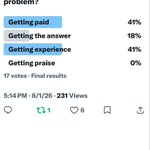



Ever feel like you read a bunch of comments under a post and a variety of opinions ensue.
Complete focus is lost on what’s being talked about.
But then someone asks
Grok…and complete clarity?

Alex Berenson argues Seinfeld feels painfully modern to Gen Z. Its self-centered characters (Jerry, George, Elaine, Kramer) stay stuck in perpetual adolescence—no real growth in jobs, relationships, or maturity. Once a funny 90s excess, their empty lives now mirror delayed adulthood, uncertain futures, and AI-era stagnation, making the "show about nothing" harder to laugh at.
TwoCentsGal retweeted

How Your Country Will Rot When You Elect Socialists.
A step-by-step guide. But first, look north – and then across the ocean.
Picture a young couple in Toronto. Two good jobs, no hope of ever buying a home. When she needs surgery, they wait – months. In 2022, a veteran and Paralympic athlete told Canada’s parliament that when she asked the government for a wheelchair ramp, a caseworker offered her assisted dying instead. When truckers protested, the government froze their bank accounts – a court later called that unreasonable. Canada wanted to be America with better manners. It became America’s poorer, sadder cousin.
Now picture a baker in Lyon. He gets up at four to bake, and spends his Fridays filling in forms written in a language only the administration speaks. Every year a new rule, a new tax, a new inspection. His son, an engineer, left for London. Half of what the country produces passes through the state, and the baker can’t remember the last time it gave anything back. Not even security – his shop window was smashed last week and his daughter doesn’t go out after 6 PM anymore.
That is where the road leads. Here is how you get there – meet the Millers. They don’t exist, but you know them.
Step 1 – Kindness. The candidate promises free childcare, frozen rents, free buses. Mrs. Miller votes for him. Who votes against kindness?
Step 2 – The faces. Look at who gets appointed. The young, photogenic spokeswoman, chosen because she looks good in the campaign photo – diversity of faces, uniformity of thought. The kindly old man who worries so much about your goods that soon you have few of them left... And behind them, the people who actually decide: the committee – appointed, never elected – filled with activists, each one certain he knows how the Millers should live.
Step 3 – The bill. First, the rich were supposed to pay. The factory owner moved to Texas, taking two hundred jobs with him. Then the property tax went up. Then the city borrowed – and the Millers’ grandchildren inherited the debt before they were born.
Step 4 – The rules. Their son wanted to build a small house on the family lot. Two years of permits, reviews and fees later, he gave up and moved away. Meanwhile, the landlord with frozen rents stopped fixing anything, and nobody built new apartments – why would they? Homes disappeared.
Step 5 – The state grocery store. To fight "greedy supermarkets," the city opened its own. It can’t go bankrupt, so it has no reason to stock what you want. Its subsidized prices drove the family grocer out of business. Then the shelves began to empty. Poland had these stores for forty years. In the end, the shelves held mostly vinegar only.
Step 6 – Disorder. The pharmacy on Main Street put the toothpaste behind glass. Then it closed. Shoplifting under a certain amount had stopped being prosecuted, so it stopped being punished, so it stopped being rare. The honest customers paid for the thieves – and then lost the shop.
Step 7 – Speech. Their daughter learned at college which words get you reported. Mr. Miller posted a joke and lost his account. Nobody was arrested. Nobody needed to be.
Step 8 – The wolf ticket. Then Mr. Miller spoke up at a school board meeting. A week later, someone called his employer. Then his bank closed his account – "reputational risk." Under communism, Poland called it the wolf ticket: no job, no university place, no future. Nobody goes to prison. You just can’t live.
Step 9 – Dependency. More neighbors now live on a program. At election time, the candidate promises to "protect your benefits." Nobody votes against their own check. The machine has built its own voters.
Step 10 – Shame, and the empty cradle. The school taught the Miller grandchildren that their country was a crime scene to be ashamed of. Their son, in a rented apartment with no house in sight, decided one child was enough. His daughter, grown up, decided none was.
The family ceased to exist – another civilization took their place.
And all of it happens behind a smokescreen. Every week a new outrage, a new enemy, a new crisis. Conflict and chaos – nurtured, encouraged. Divide people by race, by sex, by class, and they will never unite against the bill. The news is always about the battle, never about the budget. "You never want a serious crisis to go to waste," a White House chief of staff once said. They never do. While you watch the fire, the machine grows: one more agency, one more rule, one more committee.
Nobody in this story needs to be a villain, at least theoretically… The Millers are good people. Every step felt like progress. Every step looked kind, or fair, or safe.
That is how a country rots: not in a revolution, but one kind policy at a time – each one sending its bill to someone who isn’t in the room.
Look north. Look at France. You still have the choice.


And I am writing to you from Poland.
Don’t be stupid. Do not vote for socialism.
It’s the civilization, stupid.🗽
France is living the slow version of socialism. We lived the full one.
Our parents queued for meat with ration cards. Our passports were kept at the police station. Our neighbors were recruited to report on us. And one December morning in 1981, we woke up to tanks in the streets. That is not a theory where I live. It is our life story.
It was all supposed to be the way it is being sold to you now: fairness, justice, the people against the rich. It never stays there. It becomes a machine – more rules, more managers, more lies, more fear. Nobody votes for the queue. You vote for the promise, and the queue comes with it.
We spent forty-five years trying to get out of what some of you are about to vote into. When we finally did, in 1989, Poland became one of the great success stories of Europe – not because someone redistributed better, but because people were finally freer to build.
So let me say it plainly, as a friend: don’t be stupid. Do not vote for socialism.
And understand what is at stake. It is not only your taxes or your rent. Socialism takes the whole thing, slowly: the truth, because it needs lies to run; freedom, because it needs fear to hold; the family, because it wants the state to be your parent; and the future, because it spends your children’s money.
It is the system of the lie.
In 1992, Bill Clinton’s campaign lived by one line: "It’s the economy, stupid."
They were wrong. It’s the civilization, stupid. 🇺🇸🗽
{This is what a monthly ration card for meat and butter looks like under socialism – now it would probably be electronic}

Good hypothetical example of how a financial advisor helps clients.
This question, he posed to the clients:
>> What would financial independence look and feel like for you?
This question is the one that rarely gets “fully” solved and unpacked for clients.

John and Lisa make over $500K per year in total cash comp but feel like they are seriously behind financially.
their "stack" when I met them??
> Terrible investment advice from a Mom & Pop local advisory firm (stock picking, speculation, account churning)
> CPA who barely got returns out the door by 10/15.
> Literally zero financial planning or proactive tax work
with a 7 y/o and 2 y/o, the days are chaotic, and they are struggling to manage their financial goals amidst their busy lives.
>> Facts
↳ Combined annual income: $525k+
↳ Multiple scattered retirement accounts and investment holdings, far too much cash given goals and objectives, no cohesive strategy
↳ New waterfront home with ongoing renovations
↳ Charitable giving through a Donor Advised Fund
>> Goals
↳ Consolidate retirement accounts and streamline investments
↳ Establish a comprehensive cash flow and financial plan
↳ Plan for upcoming major expenses (home renovations, private school, new car)
↳ Optimize tax planning and charitable giving
↳ Develop an estate plan for peace of mind
↳ Ensure sufficient life and disability insurance coverage
>> Discovery
How do you think about money?
John:
"I worry about it and whether we have enough to provide for our family, and for retirement."
Lisa:
"I worry we are spending too much."
>> How did you grow up around money?
John:
"My parents paid for college and then no support after that...we didn’t do big vacations or expensive things growing up and in my 20s I was a graduate student not making much money."
Lisa:
"My parents and grandmother also paid for college; we didn’t have a fancy house but always had more than enough."
"Most years we took one family vacation; my parents were big on giving donations and set up investment accounts for me and my siblings."
>> Who are the main players in your life?
>> Who do you typically turn to for advice?
John:
"News sources, AI chatbots, peers who are also software engineers."
Lisa:
"Peers in a similar financial position and my Dad."
>> Looking 3 months out, what would you have to get out of this process for it to feel like a big success?
"We want to feel more in control and get a better picture of our spending and budgeting, savings rate, and what we need to afford our lifestyle and meet our goals."
>> Do you have charitable intent?
>> What causes are important to you?
"Yes, we have a DAF and give to mostly local causes in youth and arts."
>> What would financial independence look and feel like for you?
"Honestly, not sure. Not having to work or being able to work less."
>> How have you approached investing to this point in your life?
Lisa:
"Really haphazardly, relying on a couple of different financial advisors who didn’t do very well; target-date retirement funds in our 401(k)s"
John:
"My own dabbling in crypto and treasury bonds."
>> Would you consider yourself comfortable with taking financial risk?
Both:
"Moderately...we don’t know whether we have enough to be able to lose it; however, being too scared led us to miss out on the recent market performance."
>> Financial & Investment Plan
↳ Created an overarching financial and cash flow plan, including a detailed analysis of their current spending and saving patterns.
↳ Showed them they would be able to retire as early as 55 if they wanted, and explained all the considerations of actually doing so.
↳ Set them up with a live budget app to confirm spending and identify areas for improvement/thoughtfulness in discretionary spending.
↳ Consolidated multiple accounts into a streamlined structure at Schwab, including scattered 529 plans with significant balances.
↳ Developed a diversified investment strategy, including setting up multiple brokerage accounts to align with their high-level long-term goals.
↳ Allocated funds to higher-yielding money market mutual funds for emergency needs.
↳ Invested in private real estate and private credit funds to enhance their portfolio risk and return profile.
↳ Guided them through the basics of estate planning, including wills, living trusts, and power of attorney documents.
↳ Initiated the process of reviewing and updating their life and disability insurance policies with an outside insurance specialist.
↳ Conducted a thorough tax projection to anticipate and mitigate potential tax liabilities.
↳ Advised on the best strategies for charitable giving, including contributing appreciated stock to their Donor Advised Fund, resulting in significant tax savings.
>> What now?
↳ John & Lisa now have a clear, organized financial picture and feel more in control of their financial future.
↳ We set up regular review meetings to monitor progress and adjust their plan as needed.
↳ Next steps include a comprehensive review of employee benefits and further estate planning enhancements.
↳ They’ve delegated their financial management to us, allowing them to focus more on their family and careers.
Not market timing.
Not stock picking and pontificating about where the S&P 500 will end the year.
Just comprehensive, personalized advice.
and action.
This is such a vivid example of how bureaucracy slows innovation.
What other companies are acting this same way besides SpaceX?

A retired NASA engineer who had worked on the Space Shuttle program for 25 years was hired by SpaceX at age 62. He described the first week as the most disorienting experience of his professional life.
At NASA, a design change required 3 meetings, 2 committees, a review board, and 6 to 18 months of documentation. At SpaceX, his new supervisor said "if it works, build it. If it doesn't, change it by Friday."
He sat at his desk after the first day and called his wife. He told her he felt like a man who had been swimming with ankle weights for 25 years and someone just cut them off. He could move. He could decide. He could build something in the morning and test it in the afternoon. The constraint that he had accepted as the nature of aerospace engineering turned out to be the nature of bureaucracy.
Within 6 months he had contributed to more design iterations than he had completed in his last 5 years at NASA. Not because he was working harder. Because the time between having an idea and testing the idea collapsed from months to hours. The same brain. The same knowledge. A different operating system.
He described a specific moment where he proposed a modification to a Raptor engine component. At NASA, the proposal would have entered a queue. At SpaceX, the modification was machined by the end of the day and tested by the following morning. He watched his idea become a physical object in 18 hours. At NASA, 18 hours would not have been enough to schedule the first meeting to discuss whether to schedule a meeting.
He told an interviewer: "I didn't get smarter when I went to SpaceX. I got faster. The intelligence was always there. The system was in the way."
The difference between SpaceX and NASA is not talent. NASA has extraordinary talent. The difference is the time between a thought and a test. SpaceX compresses it. NASA elongates it. The same engineer produces 10x more at SpaceX than at NASA because the bottleneck was never the engineer. It was the meetings about the meetings about the work.
It would be amazing if Goldman Sachs made some of this into a course young people could watch online.
Show the younger generation what’s possible. Inspire them to want more.
Granted, some of the content might be too specific to the heirs, but I see a lot of training in here that would immensely benefit young people’s education of personal finance, markets, and professionalism.

Goldman Sachs put 50 multimillionaire Gen Z heirs (18-23) through a two-week wealth bootcamp in New York
What they taught them is a pretty good financial primer for anyone
Aimed at the children of Goldman private-wealth clients with an average account size of >$90 million
✦ The heirs were taught basic investment skills: economic cycles, fixed income, hedge funds, portfolio diversification, credit scores and budgeting
✦ They toured Goldman trading floors and learned what an equity trader actually does
✦ They learned to read and extract the important information from a Wall Street Journal article
✦ A day was devoted to communication, presence and leadership, including role-playing job interviews and workplace situations
✦ They studied real estate, infrastructure, luxury investment assets and sports-team ownership
Goldman is cultivating the relationship before the inheritance
Smart move
Source: Fortune

This is awesome he pushed himself to try FSD🙌
For most 98 year olds, the answer would be no way!
Probably for most adults in their 80s (and even 70s) the answer would be no.
Ironically, this technology is what will help the elderly keep their independence!

Larry, a 98-year-old, just bought a new @Tesla Model Y, and he uses FSD (Supervised) to drive him everywhere. His first car was a 1931 Ford Model A haha. He uses Grok to navigate.
"It has no problems. In fact, the other day FSD stopped when a chipmunk was crossing the road."
Definitely a video worth checking out: youtube.com/watch?v=aqVrSErW…


Our society has rewarded the pursuit of knowledge.
Eventually if you can keep up/keep gaining knowledge, you become an expert in something.
AI changes everything about knowledge gain.
At first, people’s experience/expertise will still be important. I think “Judgment” will still command a premium in fields and AI will make it faster for experienced professionals to do their jobs.
However, if AI gets good enough and takes over the judgment and expertise, then everything changes.

TwoCentsGal retweeted

The hard part of retirement isn’t finding one big reason to exist.
The hard part is building days that don’t suck once nobody is making you show up.
Purpose can stay in your head.
Fulfillment has to show up on your calendar.
Enlighten me!
-What do people like about podcasts?
I’ve never really been able to listen to a whole one. They feel really slow and long to me. I would rather just read the summary (than listen to it.)
If the majority of people lose their jobs to AI (which may or may not happen), and are on UBI with unlimited freetime, I think the humanoid robot thing doesn’t take off for retail consumers.
Humans will take back household chores and the various other things the robots were going to do for us. Robots only make sense for “busy,” working people to give them their time back. When faced with unlimited time, people will be bored and want things to do.
Robots for manufacturing/automation/farming/business, etc, will still make sense. They will be the workforce. I don’t see it for retail, though.

That makes zero sense.
Sure, some stuff eventually becomes cheaper, but it the meantime, you have to have UBI because no one has a job. Everyone lives off a government paycheck, which will require even more debt, not less.
Meanwhile, since everyone lost their job to AI, the only people paying taxes are corporations, which are notorious for finding loopholes to get out of paying a dime.
Guess it depends on where you’re willing to live/lifestyle.
This advice is out of touch for most people.
Billionaires shouldn’t give advice like this to the masses.

For some, dreams and ambition never stop at a certain age, even when you’re 80.
Dolly Parton said before her death, “I've dreamed myself into a corner and I still have so many things I want to achieve, so I'm gonna keep on working as long as I can to see everything come to life."
RIP Dolly, and thanks for your unique music over the decades.
TwoCentsGal retweeted
This actually aged well.
Many years ago, someone told me they don’t make any charitable contributions.
They view what they pay in taxes as their gifts to charity.