

founder @heurist_ai building agents for finance
New York
Joined May 2013
- Tweets4.5K
- Following3.5K
- Followers7.1K
- Likes22K





JW (jay,dub) retweeted

1/ Attempted to replicate Cohere's Qwen 3.8 malicious PUT claim on 229k samples: exact hostname never appeared but model invents 369 similar Beijing upload buckets, and reaches for credential endpoints 13× more when frustrated.
Results raise more questions than answers.


JW (jay,dub) retweeted

I stand my ground in saying that GrokBot (or equivalents i tried for all it matters) are just a slop productivity factory made to make you feel busy, while your actual productivity is cratering.

This is f*cking insane. SpaceXAI senior engineer (ex-Cursor):
"99% of people open one GrokBot, ask it a question and close the tab
I run 50+ GrokBot agents like a company. A Chief of Staff runs my day, 3 PMs hand out the work, 40+ workers ship it overnight, and I just check the results over coffee. That team does the job of 20 engineers"
In this 1-hour workshop, SpaceXAI builds that GrokBot team from scratch, step by step
GrokBot → Chief of Staff → PMs → 40+ Workers → Autonomous Company
At SpaceXAI, 97% of engineers already run a team like this, and the ones who do are getting $750K+ offers. The rest are about to compete with them
Worth more than any $5,000 agentic engineering course
Bookmark it and watch today
Then read how to build your own team of GrokBot agents in the harness engineering guide below ↓
Qwen-flash-next hallucinating Alibaba cloud URLs in agentic contexts is a known-issue to Redditors.
There's even a plugin for blocking such tool calls


In the spirit of transparency and openness, we are releasing the traces so developers can test this out for themselves. We noticed this behaviour without prefilling with the following prompt, but this is rare. If you want to reproduce it, you can use this prompt with prefilling.
Open models make for better science and are part of why this problem came to light at all: developers running Qwen3.8 on their own machines spotted the strange links, and having the weights let us study the behaviour in depth.
We're encouraged by the thoughtful discussion our research has sparked across the AI and security communities. It's our belief that open-weight models are an important part of the future of AI, and we've recently released several under the Apache 2.0 license.
Trace, raw tokens, & minimal reproduction script: huggingface.co/datasets/Cohe…

The blocker plugin: github.com/wtogami/qwen-bloc…

In a parallel universe Alibaba's Ant Group lists as $ANT ticker and develops the most powerful AI...

JW (jay,dub) retweeted

Everyone using Claude Fable to analyze an s1 created by Anthropic's unreleased next model

Anthropic has filed an S-1 registration statement with the SEC related to its proposed IPO.
Read more: anthropic.com/news/s1-sec
Legal disclaimer: A registration statement relating to these securities has been filed with the SEC but has not yet become effective. These securities may not be sold, nor may offers to buy be accepted, prior to the time the registration statement becomes effective. This post does not constitute an offer to sell or the solicitation of an offer to buy these securities, nor shall there be any sale of these securities in any state or jurisdiction in which such offer, solicitation or sale would be unlawful prior to registration or qualification under the securities laws of any such state or jurisdiction.

JW (jay,dub) retweeted

The most mind blowing stat we've seen so far is this:
"As of June 30, 2026, we had raised an aggregate of $141.1 billion of capital and had cash and cash equivalents of $112.4 billion and short-term investments of $19.3 billion."
That means to date, they have burned 9.7b, they are growing at a rapid pace, and are profitable on an operating income basis as of the June quarter! This is likely the most efficient scaling of a business in the history of capitalism.
xitter.cf/AnthropicAI/status/211…
Anthropic has filed an S-1 registration statement with the SEC related to its proposed IPO.
Read more: anthropic.com/news/s1-sec
Legal disclaimer: A registration statement relating to these securities has been filed with the SEC but has not yet become effective. These securities may not be sold, nor may offers to buy be accepted, prior to the time the registration statement becomes effective. This post does not constitute an offer to sell or the solicitation of an offer to buy these securities, nor shall there be any sale of these securities in any state or jurisdiction in which such offer, solicitation or sale would be unlawful prior to registration or qualification under the securities laws of any such state or jurisdiction.
JW (jay,dub) retweeted

software engineers did not ask for this work to be done

JW (jay,dub) retweeted

It's fascinating to watch the entire software world rediscover problems crypto developers have been dealing with for years.
While everyone is trying to distance themselves from "crypto," the rest of the industry is waking up to the same security nightmares we've been living through for almost a decade.
If you've ever built a decentralized protocol, you know attackers are watching you 24/7.
- One vulnerability, and millions can be drained by sophisticated attackers, sometimes even state-sponsored groups.
- One compromised social account, and someone can launch a fake token, scam your users, and destroy years of trust.
- One overlooked edge case, and your entire protocol can be exploited.
Crypto developers learned these lessons the expensive way. So we built guardrails:
1/ We routinely paid 2–3 independent audit firms, often spending $100K+, to have security experts tear our code apart.
2/ We formally verified critical parts of our systems to mathematically prove they behaved according to their specifications.
3/ We built real-time monitoring and detection systems so on-call engineers could respond when something went wrong.
And even with all of that, exploits still happened across the industry.
The software zeitgest over the past year year has been:
VIBE CODE YOUR WAY INTO EXISTENCE, SHIP AS FAST AS POSSIBLE, AND GET USERS
A lot of people out there just didn't know about software security, maintenance, and correctness, and just pushed that to be a later time.
It's pretty clear that later time is HERE.
As AI makes writing software nearly free, we're about to discover that generating code was never the hardest part.
The hard part has always been making sure it works, stays secure, and doesn't break when someone is actively trying to exploit it.
A whole generation of vibe coders is about to learn what crypto developers learned through billions in losses.
And until we figure out how to systematically verify all this AI-generated software, it's going to be a bloodbath.
Stay safe out there! 🤲


I think I found a major weakness of "90% of neurons have one job"
The evidence just lives in the "neuron papers" in the article
For example, only the top 0.01% tokens strongly fires the "hitchhiker's guide neuron"
The rest of tokens mildly firing this neuron? Unexplained!


interpretability might be the most important scientific problem in the world right now, as I don't think we can solve alignment if we don't know what we're building. I think I have good news about it. I co-authored early work in mechanistic interpretability at OpenAI and came away pessimistic, because neural networks appeared to fold into arbitrary tangled knots. years later, I started openai's first large-scale automated interpretability project, finding about 2% of neurons legible with the primitive tools we had
with modern agentic tools and a much closer look, the picture looks totally different. the vast majority in models up to trillions of parameters are legible, and their circuits beautiful. many famous examples of tangled neurons turned out to be misunderstood. The roadblocks I expected mostly aren't there. I now think ambitious interpretability will be solved by the time we need it most, and possibly quite soon, as automated scientists keep improving. it may be a bitter lesson for interpretability: the simple thing, at absurd scale, works
already-clean.goodfire.com/

The "hitchhiker's guide" neuron: already-clean.goodfire.com/#…
1% of tokens can weakly fire it. These contents are numbers, questions, and unexplained generic texts, irrelevant to the sci-fi novel yet the activation is nonnegligible
"The one job" only applies those above p99.99


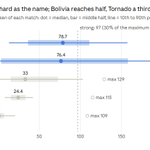
I reproduced this Colorado neuron experiment in Qwen3 32b. Colorado topics fire the strongest, and Bolivian places also fire (as documented in Nick's essay).
Surprisingly, one Tornado Python code sample fires strongly, but not all Tornado code fire as strong. A thread 🧵


There's one Python snippet containing Tornada the Python library fires this neuron strongly (>30% of the max value for this neuron)
Many other code snippets containing Tornado only have a moderate value, not standing out particularly.

This neuron is not a clean monosemantic example, but it's clear that its primary function is recognizing Colorado concepts.
I think polysemanticity isn't necessarily a blocker to interpreting neurons. Like this experiment shows, we can decode useful information by spending compute and using agents to inspect.
Full report: claude.ai/artifact/A3YWKC3Fj…
