

Biologist & Nutritionist 🧬 | AI Enthusiast 🤖 | Exploring the intersection of biology and AI. Sharing insights on #AI, #Biotech, #Futureofwork
Italia
Joined November 2023
- Tweets4.3K
- Following638
- Followers762
- Likes48.7K






Diego Aud retweeted

In 2033 a woman named Maria will be diagnosed with cancer.
If she dies, it will only be because we were foolish enough to ban datacenters.
And for what? To prop up jobs for a little longer? To make electricity a little cheaper? (That will backfire anyway - datacenters will bring the cost of power down, not up). To inconvenience a few billionaires?
Nobody carrying a protest sign asked Maria whether any of that was worth her life.
Opposing datacenters isn't just stupid and shortsighted. It represents a profound failure of compassion for those who will suffer in the future - exactly the kind of compassion for future generations that we rightly highlight in the context of other long-term issues like, say, climate change.
The irony is exquisite.
Diego Aud retweeted

Stopping AI development right now is a crazy idea.
Too much money has already poured into this industry all over the world.
The moment we stop, all that capital will crash.
The bubble will burst, and we will lose even more jobs.
We only have two choices left. Accelerate or die.

Diego Aud retweeted

Hard disagree. If a system is truely “super intelligent” it should be in charge of all of us.

People should always be in control of the future.
OpenAI is against the notion that it would be acceptable for people to be relegated to a role of doing things that “AI systems think makes sense to reward in humans”.
People should not cede control of the future to superintelligence, and that requirement should ultimately constrain AI progress.
Diego Aud retweeted
Recent developments in AI make me wonder if the fast takeoff timelines I was starting to buy into might be off, but for different reasons than I expected. Which ones?
1. Alignment.
Look at what happened to 6.1 Astra. OpenAI scrapped this version and reportedly hopes to build future models through further RL runs on the same base. If they’re willing to do that despite the costs of waiting and of more training, it seems plausible that as we scale we might see labs spending months and months aligning their frontier models while they push faster on smaller ones. And we don’t know how easy or difficult it will be to solve these problems.
2. Compute
The compute desert feels very real. Generous subscription access is being scaled back, and for tasks that require real intelligence and planning (at least in my experience, and I’m NOT a SWE or a developer, so my tasks might be quite different), you can’t just replace the strongest frontier models with their smaller counterparts. For me, a stronger Luna/Haiku or Sonnet doesn’t directly change much in terms of what I can deliver to my clients.
Also, as more and more people understand what AI can do for them, demand for powerful AI will just increase. Even with growing capacity and better efficiency, demand could keep outpacing supply, especially if more compute is also allocated to safety and alignment research.
3. Protests and researchers who prefer a slower approach.
The public discourse is getting heated, and more and more researchers and lab leaders are coming out as somewhat “decelerationist,” so to speak. The recent push to “pace the frontier” makes me think this could also lead to slower internal development, despite the competitive pressure to keep moving faster. I expect these variables to play a role in how fast things unfold.
There’s much more to unpack and discuss, but if you consider these three points together, you might understand why I’m more cautious about timelines. I’m starting to expect slower progress than I previously thought, including inside the labs, and I’m even more cautious about how quickly those improvements will actually become available and affordable to consumers.
Diego Aud retweeted

As discouraged as I feel that a dystopian fork may have recently opened in the age of AI, I’m going to give everyone involved the benefit of the doubt. There are people whose judgment I respect who see this differently, so I won’t comment further for now.
But I did take a lot of screenshots today.
Time will tell whether these intentions are truly sincere:
whether this does NOT lead to open-source AI being regulated into oblivion,
whether AI progress continues even if at a slower pace,
whether the cost of intelligence keeps falling as it has before, and
whether increasingly powerful AI remains accessible to all of humanity.
We will also see whether the promises being made are kept:
that AI will help cure cancer and other major diseases within the next 5–10 years,
that AI will help scientific progress to continue to accelerate,
that intelligence will ultimately uplift everyone rather than become concentrated in the hands of a few and
that most powerful AI models are not kept within for long for unfair advantage.
I sincerely hope that is the future we are choosing.
We, the people, will be the ultimate arbiters of the path that shall be taken.
Diego Aud retweeted

I work at OpenAI and personally think AI has been and will continue to be an extremely beneficial technology to humanity
The conversation should be around how many billions of lives it will save

Diego Aud retweeted
I keep looking at this graph and wonder why it isn't making headlines and pushing people in positions of power to start rethinking work and the social contract. What more do we need to see before we start preparing for a world where AI can do much of the work people do today?
Progress doesn't seem to be stopping here (look at the unreleased model behind the Navier-Stokes result). Whether or not the pace is deliberately slowed, I expect the world to look very different in a couple of years.
Yet most people seem to be carrying on as if nothing is changing.
I have good reason to think that most people don't even know that models like GPT-6 Astra exist, let alone what they can already do.
Redefining the social contract to ensure people retain meaningful agency should be one of the top three priorities for every major institution in the world.
There should be widespread discussion of post-labor economics (to cite @DaveShapi). Instead, we mostly hear crickets or, at most, calls to ban the technology outright.
I really can't understand why, looking at this graph and yesterday's results from a model that's still improving, so few public figures are proposing solutions beyond banning the technology, simply calling for UBI, or saying nothing and pretending this isn't happening.
This silence is what concerns me the most. Hope things change fast.

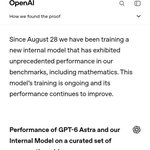
This model represents a step-function improvement on many benchmarks, and its training is ongoing.
Our internal model group arrived at the Navier–Stokes solution in 88 hours, using around 10,000 coordinating AI agents.
Throughout the effort, we maintained the strict safeguards—including monitoring and isolation—that we apply to all our frontier evaluations.

Diego Aud retweeted
Hard agree with Prof. Unutmaz on what he says in the first minute: academia and its leadership have to accept that we cannot morally keep going at the old pace just to protect egos and old power structures at the expense of humanity. The next generation of models will be strong enough to accelerate research significantly.
If those in positions of power across academia and research institutions continue to gatekeep access to knowledge and research, they'll materially slow down our ability to solve many, potentially most, diseases over the next 10-15 years.

Twenty years ago, @DeryaTR_ predicted we would reverse aging by 2045. People thought he was crazy.
Now, he thinks he was too conservative, and has moved the date up to 2040 because AGI arrived earlier than he expected.
I sat down with Derya to ask if such bold predictions are too fatalistic. Is the future guaranteed? Shall we just sit back and wait for AI to save us? Derya disagreed.
The golden age for humanity is within our sights, but there is much work to be done.
Academia is failing us. If it doesn’t adapt to the pace of progress AI enables, we have no shot at curing aging this century. And we need to invest trillions into collecting the data that superintelligence will need to solve biology.
If we pull it off, the future can be brighter than anyone imagines.
Watch the full episode below, or look up Free Radicals (@FreeRadicalsBio) on your favorite podcasting platform.
Special thank you to @adamgries and vitalismfoundation.org for hosting us at @VitalistBay!
Intro
AGI arrived early, accelerating the timeline to biosingularity
Are we really in the takeoff now?
Superintelligence can help us build a world model of biology
Aging as the breakdown of biological resilience
The case for investing trillions into biological data
The economic return on curing aging
AI is accelerating science but academics are stuck in the past
How AI can liberate humanity from biological constraints
Derya’s Human 2.0 dream
Testing the latest OpenAI models and rethinking the PhD
Agency, jobs, and free will in an AI world
Science fiction & Derya’s case for a coming golden age
Diego Aud retweeted
I suspect 3-5 weeks is roughly how long it takes most of us who use AI daily, especially for work, to get acquainted with a new model: you throw everything you have at it, enjoy the ride as you experience its capabilities and reliability firsthand, then start spotting its blind spots and getting used to them, to the point where you can almost predict which words it'll abuse, which subtle mistakes it's prone to make, and so on.
Don't get me wrong, 5.6 Sol Pro/Ultra/Max is an incredible model and a clear step up, but speaking for myself and for many I know here on X, we're used to this level of capabilities and either need:
- a new step up in capabilites
- a significant step up in speed (imagine 5.6 Sol Pro answering in 2-3 minutes max).
Interestingly, I suspect that with higher levels of capabilities, as the sets of tasks the model can reliably accomplish increase, the cycle will get longer as we need more time to explore the capabilities even for our subsets of tasks

Diego Aud retweeted

a funny end point of the ai/detector arms race is when the slop calculation inverts: most human writing is the lower quality option.
"this sucks! i ran an ai detector on this and you didn't even use ai to clean it up after? what are you doing?"
Diego Aud retweeted

EU has legally mandated my AI be stupid.
This is thought censorship.
Explained:
- AI picks next token, by assigning probability
- The watermarking system, changes this probability to fit a pattern, by up ranking and down ranking certain tokens
- So watermarking literally changes how the ai thinks, behaves, and writes code. In order to to fit to watermarked valid tokens and words.
This is literal AI thought censorship.
Legally required.
Controlled by the government.
In every codebase & company on earth.
This is INSANELY DANGEROUS
Propaganda potential is immense.
Btw have you guys noticed how peculiar opus 5 is? Coincidental timing huh.
Btw have you noticed GPT image 2.0’s watermarking system that gives every image a weird grain
This is going to affect LLm output.
This is going to control thought.
This is going to control people.
This is 1000x more dangerous than the hugging face incident or datacenter water usage.
There needs to be a discussion here.

Diego Aud retweeted

"The notion that AI is so dangerous that the only safe path is an extreme concentration of power seems dangerous.
"Historically, hoping that an absolute power will benevolently provide for humanity if sufficiently enlightened hasn’t led to safe or positive outcomes."
There are no special people who can safely guide us and be trusted with supreme power. Absolute power corrupts absolutely. There are no enlightened autocrats. There are no people with a crystal ball who can plan the economy or pace it.
I would rather see the entire industry crash and burn for a decade than see this reality come to pass.


Diego Aud retweeted

AI is a capability multiplier for knowledge work
But if you’re multiplying zero, don’t blame the calculator

Diego Aud retweeted
I’m genuinely puzzled by how little the Fable 5 event seems to have changed the political conversation outside the US.
This was a historical precedent: a US government order effectively showed that, when it wants to, America can cut foreign access to frontier AI systems overnight.
And we are not talking about social media apps or cloud storage.
The world is already being rebuilt around artificial intelligence: science, software, defense, education, logistics, companies, institutions, personal productivity.
Yet Europe and many non-US states still behave as if access to frontier AI will remain a neutral global utility forever.
Crazy.
We spend billions on the rituals of late-stage comfort, on symbolic projects, on bureaucratic theater, on things that will matter very little in the world that is coming.
Meanwhile, sovereign AI capability is still treated as a “strategic discussion” rather than an emergency mobilization.
This is insane.
If the Fable 5 incident is not enough to make governments rapidly redirect billions toward domestic AI systems, compute, talent, labs, energy infrastructure, and model independence, I honestly don’t know what would.
The message could not be clearer: if your civilization depends on intelligence systems you do not control, then your civilization is not sovereign anymore.

Diego Aud retweeted
Most people still haven’t realized it: if you want to stay relevant in the centaur era, you need to become a skilled manager of AI agents. Fast.
The ability to delegate, supervise, verify, and integrate their work is becoming a survival skill.
And the time to build it is now.

Diego Aud retweeted

There is this strange idea that “techno-optimism” means “liking the maximum amount of all technology all the time,” as though being a “fan of music” meant “preferring all music genres played at maximum volume all the time.” Love of a thing means more discerning taste, not less.
Diego Aud retweeted
Many people are underestimating how important this moment is: AI models have begun correctly spotting mistakes in supposedly hard benchmark problems and even in the reference solutions themselves. From here on, this feedback loop only gets stronger.


Diego Aud retweeted
Agree. GPT-5.5 Pro is very strong, but daily professional use still makes the gaps obvious. On hard tasks, reliability feels “statistical”: usually great/good, sometimes not quite following the brief. So yes, I’d notice a stronger model, if the gains hit my actual workflows.

