

An independent #investment research & online financial media company. Not #Investing Advice.
U.S.A.
Joined December 2009
- Tweets4.6K
- Following1.2K
- Followers698
- Likes1.8K






Invest Safely retweeted

US prepares to raise tariffs on China and other countries - WSJ wsj.com/economy/trade/u-s-pr…

Invest Safely retweeted

Bitcoin may be telling us that today’s equity rally had far more to do with the removal of NVIDIA specific risk than any meaningful improvement in liquidity.
The dollar hit a 19 month high, Treasury yields rose and Bitcoin surrendered most of its gains after an initial short squeeze. Nothing about today materially changed the underlying credit conditions or the broader deleveraging process.


Invest Safely retweeted
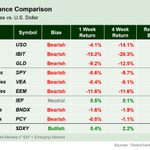
The $SPX is in a downtrend as we enter November.
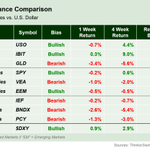
$BNDX, $XLV, $IWO outperformed; $IBIT, $XLC, $MTUM underperformed. Volatile week ahead; employment data & Congressional elections in play.
Analysis, charts & commentary at Invest-Safely.com: invest-safely.com/stock-mark…


Invest Safely retweeted


Invest Safely retweeted

Emotions are not the enemy of consistency.
Emotions exist to keep you consistent with every belief you hold.
Emotions arise automatically according to the beliefs you hold.
You consistently break your rules, and you consistently attach importance to winning and losing.
That is because you believe more strongly that "wins and losses have value" than that following your rules matters, and your emotions work to make you act consistently with that belief.
①
Even if it looks like the trade could win, you have to pass because your rules do not allow you to enter.
And if price then keeps moving in that direction, you suffer thinking, "I would have won if I had entered."
②
Your rules require you to take the stop.
But taking the stop locks in the loss, so you do not want to exit.
③
You are afraid of losing your unrealized profit, so you cannot wait for the take-profit point defined by your rules and want to take profit early.
At that moment, your emotions are not destroying your consistency.
"I want to win this trade."
"I do not want to lose."
"I do not want to lose the unrealized profit I have now."
Your emotions are trying to make you act consistently with those beliefs.
If you believe
"Winning the trade in front of me has value."
"Losing has a meaning that should be avoided."
"Protecting the profit in front of me matters more than following my rules."
then your emotions will work in a direction consistent with those beliefs.
That is why you want to enter even when your rules say you should pass.
You do not want to take the stop even when your rules say you should.
You want to lock in profit early even when your rules say you should wait for your take-profit condition.
And then you try to follow your rules while suppressing those emotions.
This turns trading into "a battle with your own emotions."
Consciously, you are trying to "follow your rules," but your beliefs place greater value on the immediate result reflected in "I want to win," "I do not want to lose," and "I do not want to lose my unrealized profit."
But the reverse is also true.
If you truly understand from testing and practice through your own hands that continuing to follow the rules of a system with an edge leads to long-term profitability, and that understanding has transformed your beliefs, then your emotions will now work in a direction consistent with those beliefs.
Following your rules becomes natural, and instead, you begin to feel strong resistance to deviating from them.
You no longer need to suppress your emotions every time just to keep following your rules consistently.
The function of emotion has not changed.
The beliefs that your emotions are trying to keep you consistent with have changed.
This is not a matter of controlling your emotions, nor a matter of mental toughness, nor a matter of eliminating emotions.
The goal is not to become better at fighting your emotions.
It is to reach a state where following your rules and your beliefs point in the same direction, so there is no need to fight your emotions in the first place.
Turn emotional gambling into a job where all you do is "wait and click."
A step-by-step process for turning your strategy into a repeatable system with an edge👇
payhip.com/b/bqKpV
Newsletter👇
yumi-sakura-newsletter.subsc…
Thank you for reading.

Invest Safely retweeted
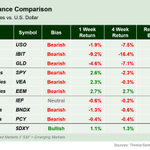
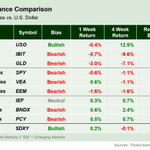
The stock market outlook shifted to a downtrend last week.
$USO, $XLE, $MTUM outperformed; $BNDX, $XLY, $IWO underperformed. Escalating conflict renewed the flight to safety trade ahead of this week's FOMC interest rate decision.
Full analysis & charts: invest-safely.com/stock-mark…


Invest Safely retweeted

Stock traders,
Great fundamentals can be great for finding stocks to put on your watchlist; but only buy them based on technical buy signals.
This will save you a lot of grief.



Invest Safely retweeted

SpaceX volatility just entered ordinary 401(k)s
Read more: thestreet.com/investing/spac…

ALT SpaceX volatility just entered ordinary 401(k)s


Invest Safely retweeted

The S&P 500 looks diversified.
It isn’t.
Just 10 stocks now make up 39% of the entire index.
Nvidia alone is bigger than hundreds of companies combined.
Passive investors think they own “the market.”
In reality, they own a concentrated bet on a handful of mega-cap winners.

Invest Safely retweeted
"Whirlpool has paid a dividend through 10 U.S. recessions and every global crisis since the 1950s. But the American manufacturer’s cash crunch has gotten so severe that it is suspending that payment until further notice," per WSJ


Invest Safely retweeted

Sharing this chart showing the inflation-adjusted market capitalization of gold and silver since 1900, with Bitcoin added in 2010. The bubbles show the 5-year price inflation rate (CPI) and the shading show the 5-year monetary inflation rate (M2). Gold is at $35 trillion, and silver and Bitcoin are at $1.8 trillion (using some creative assumptions on my part to determine the “above ground” supply of silver).
It’s amazing to me that it took Bitcoin 18 years to reach a market cap of $1.8 trillion it took silver five millennia. Apples to oranges of course, but still.

Invest Safely retweeted
In my view, commodities (including precious metals) continue to serve as important diversifiers in this era of fiscal dominance, regardless of who finances the debt and how. The somewhat cosmic looking chart below shows commodities and bonds since the cyclical bull started in October 2022, with the inflation-adjusted returns (y-axis) indexed against the S&P 500 nominal return (x-axis). The size of the bubbles shows the 52-week correlation to the S&P 500.
This chart highlights how quickly precious metals (gold and silver) have risen in the ranks despite their very low correlation, and how they have taken market share from Bitcoin in recent months. Long bonds, on the other hand, remain dead last, although their 52-week correlation has flipped from positive to negative. Should bonds become positively correlated again (in a bad way), we will need uncorrelated assets (including alts) to navigate risks.
