

Founder and CEO @rehinged – Product builder focused on commercial intelligence, healthcare data and agentic AI systems for go-to-market teams.
San Diego
Joined February 2011
- Tweets343
- Following655
- Followers162
- Likes229







Pinned Tweet
Rehinged started in 2018 as a venture-funded data science company. Our first ingestion was hand-built Python scrapers, 500 lines that took days and would break. Fixing that at scale was the start of the foundation the agents work across today. 1 of 6.
rehinged.ai/company.html?utm…

1
40
Jim Sagar retweeted

founders: if you haven't created a company.md yet,
do it right now.
VCs are already running your deck through AI. they drop the PDF into Claude or ChatGPT and start asking questions before they ever talk to you.
the problem: decks are built for eyes, not agents. charts become pixels. the AI fills the gaps with guesses, and then it diligences the guesses.
so we built something for their agents instead.
our company.md is a ~1000 line plain text file (and growing by the day). it's the deck, plus everything a technical partner would spend three weeks of diligence digging for:
• the deck, slide by slide, in words
• our full tech stack, layer by layer. surfaces, connectors, agent harness, fleet orchestration, models, skills, MCP, strategy authoring, runtime, exit engine, simulation venue, data pipeline, signing, telemetry, billing, infra, security model
• for every layer: what it is, how it works, the main technologies, its scale, and what's proprietary vs open source
• every MCP tool and every agent skill, listed and linked to the public repos
• a repo map: what lives where, public and private
• anonymized profiles of our top customers. what they build, how they pay, how they use their own AIs to drive ours. including the ones who left, and why
• every number carries the date it was last checked
so a partner can ask their Claude "how does order signing work?" or "what's actually proprietary here?" or "which customers churned and why?" and get a real answer in our words, not a guess from a screenshot.
what we learned building it:
1. write it for AI readers, and say so in line one
2. date every number. models trust what they can place in time
3. mark proprietary vs open source on every layer. it's the first thing a technical investor asks
4. include the customers who churned. an agent trusts a doc that isn't all good news
5. one link that always serves the latest version, on every slide of the deck
6. keep it in sync with the deck. any mismatch is the first thing their agent will flag
it's become the most effective tool in our pitch arsenal.
Before: Investors skimmed the deck prior to the meeting:
Now:
+ agent take the first meeting and prep their human investors
Jim Sagar retweeted

gemini 4 neon predictions


We decided to provide more transparency into pretraining progress at OpenAI for the sake of moving toward shared safety bars. In “Perplexity and Intelligence” I argue for common limits based on perplexity and other measurements, with progress beyond them gated on our ability to understand AI behavior.
openai.com/index/perplexity-…

Jim Sagar retweeted

A toothpaste company has quietly killed the entire market research industry and nobody is talking about it.
Colgate published a paper showing you can predict real purchase intent by simply asking LLMs to roleplay customers.
And this is beyond insane.
If you ask an AI, "Rate this product from 1 to 5," it gives safe, middle-of-the-road garbage.
So researchers invented a method called Semantic Similarity Rating (SSR).
Instead of asking the AI for a number, they asked it to roleplay.
They gave the LLM a demographic profile. They showed it a product concept. And they asked it to write down its raw, unfiltered thoughts.
Then, they used a semantic model to translate those written thoughts into a numerical score.
The results are staggering.
Tested against 57 real personal care product surveys and 9,300 human responses, the synthetic consumers hit 90% of human test-retest reliability.
They perfectly mirrored how different age brackets and income levels react to price changes.
And they provided detailed, qualitative feedback that was deeper and more critical than what actual humans wrote.
This destroys the economics of traditional market research.
You don't need to wait a month to see if a product will sell.
You can simulate 1,000 hyper-targeted customer interviews overnight.
You can A/B test pricing across every demographic instantly.


2020–21. A pharma R&D head told me they weren't ready to trust AI analysis of a large corpus: not good enough to stake a reputation on. She was right. The models did the work, not reliably. We fixed the economics and waited for the models. 2 of 6.
rehinged.ai/the-arc?utm_sour…

Jim Sagar retweeted

The new federal Clinical Super Intelligence Roadmap from @CMSGov, @FDA, and @HHSGov is truly exceptional. Everyone who cares about healthcare should read it.
I'll write a few posts about this over time, but here's my first, live from #HLTH2026. I really like the five core guiding principles, because they get the foundation right.
1. Safe and Reliable
2. Earned and Progressive Adoption
3. Personal Ownership
4. Affordability Driver
5. Permanent Market Access
Safe and Reliable: Benchmarking against the system patients live with today, with its long waits and avoidable errors, is the right call. We can and must do better than the current system. We can and must raise the floor of healthcare. And better than today is where we start, not where we end.
Earned and Progressive Adoption: This is how we train clinicians, supervised first and given more independence as they prove themselves. This is how @Doctronic's prescription renewal service is working in Utah. And builders in the space will earn the right to add more capabilities to Clinical AI, with supervision and openness.
Personal Ownership: Your health data and your health decisions belong to you. This is very aligned with another big announcement today from HHS, the new HIPAA Privacy Rule. Imagine a world (in the not too distant future) where your personal Medical AI lives on your phone, along with all your personal health data, in your control. We're building toward that.
Affordability Driver: Software must make care cheaper. Nothing more to say here.
Permanent Market Access: A tool that proves itself should be able to keep reaching patients, and builders need that certainty to invest. This ties, for example, to the 10-year life of the ACCESS model, a horizon long enough to build for. Really strong alignment.
The mission statement also asks something of everyone. Innovators must "step up to develop reliable, transparent, and accessible AI solutions." Government must address "fragmented rules, unclear payment pathways, and missing trust infrastructure." At @Doctronic we intend to do our part.
Read it here: cms.gov/files/document/clini…
See the new HIPAA Privacy Rule here: hhs.gov/press-room/hhs-issue…
More to come. Let's build healthcare for everybody.
TapestryHealth, remote monitoring for 10%+ of US nursing homes, is in Chapter 11 ten months after CMS froze its Medicare pay, with no overpayment demand issued. 700 facilities score 70+ on rehospitalization need: the most exposed if monitoring goes dark.
rehinged.ai/market-pulse/cms…

10
Our agent-led build: a written spec, public sources, quality gates. Agents took 1,267,093 provider records down to 45 targets and 83 dated, sourced signals. People wrote the spec and judged the output. Agents take the volume. People take the decisions.
rehinged.ai/see-your-market?…


CMS’s lighter inspection track is reaching top-rated nursing homes. We screened 14,690 facilities on the rating criteria: 2,568 meet them, and 71 of those five-star buildings score 70+ on infection prevention need, led by California, Michigan and Nevada.
rehinged.ai/market-pulse/cms…
1
1
25
Nursing homes cut agency staff use 44% since 2022. Across 13,538 scored facilities turnover still averages 45.9%, and 22 pair weaker staffing with turnover above 50%: 1.82 stars, 1.15 nursing hours per resident day, 69.2% turnover. Twelve are in Missouri.
rehinged.ai/market-pulse/sen…
2
12
Great prediction on how big tech will roll out AI agents in the enterprise #tech #ai #business youtube.com/shorts/eDafFeXAO… via @YouTube

1
39
Jim Sagar retweeted

The "marketing engineer" will be one of the most valuable jobs in a company.
These people will command $250K, $500K, and $1M/year.
The best marketer changes with every major tech wave:
1) Traditional marketer: makes people care with story (print, radio)
2) Digital marketer: owns the new digital channels (SEO, PPC)
3) Growth hacker: lives in loops, PLG and retention
4) Marketing engineer: builds AI agents that find your customers, write your outbound, test your ads, and get smarter every week
Most companies already own the pieces in a stack of SaaS tools:
- Dashboards
- Call recordings
- Content calendars
- CRM
But the learning is scattered:
- Sales hears one version of the market.
- Support hears a different one.
- Product sees the usage.
- Marketing sees the clicks.
- The founder remembers the one call that hit him that week.
Everybody then walks into the growth meeting with a different version of reality.
One person pulls those signals into one system and turns them into pipeline.
Hire that person, or become that person.


Jim Sagar retweeted

JUST IN: Legal AI startup Harvey launches its first AI model specifically post-trained for legal work, built on Kimi K3.
Jim Sagar retweeted

The age of the 40-year-old founder is back.
Bryant Chou spent 12 years as CTO of Webflow, which now powers something like 1.5% of the entire internet. He's back in the current YC batch with Ploy, an AI marketing platform, and he describes himself as "a bit of a boomer, double the age of the YC founders." But over 13% of his batch is already using his product, within months of launch.
There is a side of the argument which destroyed one of the main edges young founders have, which was being faster and cheaper at building.... speed is everyones game.
If what's left is knowing what to build this is more likely to come from spending 15 years watching an industry up close, collecting the thousand small frustrations that tell you where the real problem is. Bryant can build an anti-slop website tool because he spent over a decade learning exactly why websites are slop.
So I'm updating. I don't think it's young vs. old. I think AI rewards whoever has the most domain knowledge to point it at, and only sometimes is this younger founders who are thinking outside of the box...
Jim Sagar retweeted

16 things that will be normal in 3 years and sound insane today
1. Somebody's entire job is making sure your agents don't do dumb things.
2. Kids grow up assuming any adult who types is old, the way we assume anyone who prints emails is old.
3. You get an itemized bill for what your agents bought last month and it reads like an expense report from a small company.
4. Someone you've never met sells you a business that runs itself, and you never learn what the code does.
5. Your doctor's first opinion comes from a model, and the human's job is deciding whether to trust it.
6. Job posts will say "must be able to manage agents" the same way they used to say "proficient in Excel."
7. The best-paid person at a company will be whoever's best at explaining the business to machines.
8. Your company has more agents than employees, and HR manages both.
9. Companies start hiding how few employees they have, because a lean team reads as fragile to enterprise buyers.
10. Your calendar fills with meetings you didn't schedule, because your agent and their agent worked it out.
11. The CV dies and gets replaced by a body of work an agent can verify in 4 seconds.
12. You interview an agent before you hire it. Give it a fake task, watch how it handles the weird cases, then decide.
13. Losing your job means losing your agents too, and it's kinda scary losing your best agents.
14. "Made by a person" becomes a label on products, and there's a certification body for it.
15. You'll have a folder of agents the way you have a folder of apps
16. Getting a human on the phone becomes a paid tier, and people gladly pay it.
Jim Sagar retweeted

If you've adopted AI at your company but haven't seen any tangible results, read this 1990 article: "The Dynamo and the Computer" by Paul David.
When electricity first arrived, factories that "adopted" it barely got faster. They just swapped the steam engine for an electric one and ran everything else exactly as before: same machine layout, same workflow, same management. Electricity in, no real gains out.
The most common mistake with any new technology is to drop it into the old organization and then declare the transformation done.
The real leap came decades later, when each machine got its own small motor. Suddenly machines no longer had to be lined up around one central drive shaft. They could be rearranged around the actual flow of work.
The productivity gains didn't come from electricity. They came from REDESIGNING THE ENTIRE FACTORY around it.
AI is the same. Bolting it onto your existing process gets you a faster steam engine. The payoff comes when you redesign the work itself.
(link to paper in comments)

Jim Sagar retweeted

Andrej Karpathy's advice for beginners getting into AI:
"Put in 10,000 hours of work."
He's right.
But most builders waste the first 1,000 hours on the wrong things.
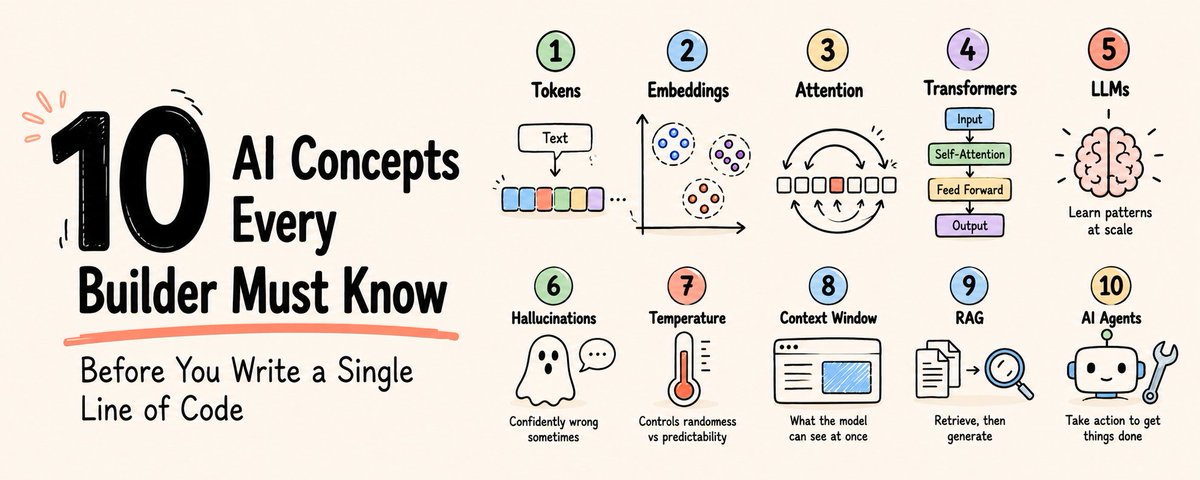
They write code before understanding context windows.
They build agents before understanding token limits.
They ship products before understanding what models can't do.
The builders who compound fastest aren't the ones who code the most.
They're the ones who understood the fundamentals before touching a single line.
These are the 10 concepts that make the first 1,000 hours count ↓
Bookmark this before you start.

Most healthcare reps are working from static lists in dynamic markets.
We just published new evidence showing why that fails:
Between Sept 2025 and March 2026, the top 10 fall prevention SNFs turned over completely. Not one facility from the earlier top 10 remained in the new one.
That is why account ranking beats spreadsheets.
Why Your SNF Target List Changes Every Month:
rehingedhealthcare.com/artic…

4
122