

Founder and CEO @rehinged – Product builder focused on commercial intelligence, healthcare data and agentic AI systems for go-to-market teams.
San Diego
Joined February 2011
- Tweets344
- Following655
- Followers162
- Likes229







Jim Sagar retweeted

YC’s current thesis is simple
Stop selling the software. Use it yourself and sell the finished work.
The biggest companies of the next decade may not be pure SaaS at all. They’ll be AI-native services firms (accounting, insurance, legal, tax, etc.) that deliver outcomes at software-like margins.
Jim Sagar retweeted

founders: if you haven't created a company.md yet,
do it right now.
VCs are already running your deck through AI. they drop the PDF into Claude or ChatGPT and start asking questions before they ever talk to you.
the problem: decks are built for eyes, not agents. charts become pixels. the AI fills the gaps with guesses, and then it diligences the guesses.
so we built something for their agents instead.
our company.md is a ~1000 line plain text file (and growing by the day). it's the deck, plus everything a technical partner would spend three weeks of diligence digging for:
• the deck, slide by slide, in words
• our full tech stack, layer by layer. surfaces, connectors, agent harness, fleet orchestration, models, skills, MCP, strategy authoring, runtime, exit engine, simulation venue, data pipeline, signing, telemetry, billing, infra, security model
• for every layer: what it is, how it works, the main technologies, its scale, and what's proprietary vs open source
• every MCP tool and every agent skill, listed and linked to the public repos
• a repo map: what lives where, public and private
• anonymized profiles of our top customers. what they build, how they pay, how they use their own AIs to drive ours. including the ones who left, and why
• every number carries the date it was last checked
so a partner can ask their Claude "how does order signing work?" or "what's actually proprietary here?" or "which customers churned and why?" and get a real answer in our words, not a guess from a screenshot.
what we learned building it:
1. write it for AI readers, and say so in line one
2. date every number. models trust what they can place in time
3. mark proprietary vs open source on every layer. it's the first thing a technical investor asks
4. include the customers who churned. an agent trusts a doc that isn't all good news
5. one link that always serves the latest version, on every slide of the deck
6. keep it in sync with the deck. any mismatch is the first thing their agent will flag
it's become the most effective tool in our pitch arsenal.
Before: Investors skimmed the deck prior to the meeting:
Now:
+ agent take the first meeting and prep their human investors
Jim Sagar retweeted

gemini 4 neon predictions


We decided to provide more transparency into pretraining progress at OpenAI for the sake of moving toward shared safety bars. In “Perplexity and Intelligence” I argue for common limits based on perplexity and other measurements, with progress beyond them gated on our ability to understand AI behavior.
openai.com/index/perplexity-…

Jim Sagar retweeted

A toothpaste company has quietly killed the entire market research industry and nobody is talking about it.
Colgate published a paper showing you can predict real purchase intent by simply asking LLMs to roleplay customers.
And this is beyond insane.
If you ask an AI, "Rate this product from 1 to 5," it gives safe, middle-of-the-road garbage.
So researchers invented a method called Semantic Similarity Rating (SSR).
Instead of asking the AI for a number, they asked it to roleplay.
They gave the LLM a demographic profile. They showed it a product concept. And they asked it to write down its raw, unfiltered thoughts.
Then, they used a semantic model to translate those written thoughts into a numerical score.
The results are staggering.
Tested against 57 real personal care product surveys and 9,300 human responses, the synthetic consumers hit 90% of human test-retest reliability.
They perfectly mirrored how different age brackets and income levels react to price changes.
And they provided detailed, qualitative feedback that was deeper and more critical than what actual humans wrote.
This destroys the economics of traditional market research.
You don't need to wait a month to see if a product will sell.
You can simulate 1,000 hyper-targeted customer interviews overnight.
You can A/B test pricing across every demographic instantly.


Jim Sagar retweeted

The new federal Clinical Super Intelligence Roadmap from @CMSGov, @FDA, and @HHSGov is truly exceptional. Everyone who cares about healthcare should read it.
I'll write a few posts about this over time, but here's my first, live from #HLTH2026. I really like the five core guiding principles, because they get the foundation right.
1. Safe and Reliable
2. Earned and Progressive Adoption
3. Personal Ownership
4. Affordability Driver
5. Permanent Market Access
Safe and Reliable: Benchmarking against the system patients live with today, with its long waits and avoidable errors, is the right call. We can and must do better than the current system. We can and must raise the floor of healthcare. And better than today is where we start, not where we end.
Earned and Progressive Adoption: This is how we train clinicians, supervised first and given more independence as they prove themselves. This is how @Doctronic's prescription renewal service is working in Utah. And builders in the space will earn the right to add more capabilities to Clinical AI, with supervision and openness.
Personal Ownership: Your health data and your health decisions belong to you. This is very aligned with another big announcement today from HHS, the new HIPAA Privacy Rule. Imagine a world (in the not too distant future) where your personal Medical AI lives on your phone, along with all your personal health data, in your control. We're building toward that.
Affordability Driver: Software must make care cheaper. Nothing more to say here.
Permanent Market Access: A tool that proves itself should be able to keep reaching patients, and builders need that certainty to invest. This ties, for example, to the 10-year life of the ACCESS model, a horizon long enough to build for. Really strong alignment.
The mission statement also asks something of everyone. Innovators must "step up to develop reliable, transparent, and accessible AI solutions." Government must address "fragmented rules, unclear payment pathways, and missing trust infrastructure." At @Doctronic we intend to do our part.
Read it here: cms.gov/files/document/clini…
See the new HIPAA Privacy Rule here: hhs.gov/press-room/hhs-issue…
More to come. Let's build healthcare for everybody.

Jim Sagar retweeted

The "marketing engineer" will be one of the most valuable jobs in a company.
These people will command $250K, $500K, and $1M/year.
The best marketer changes with every major tech wave:
1) Traditional marketer: makes people care with story (print, radio)
2) Digital marketer: owns the new digital channels (SEO, PPC)
3) Growth hacker: lives in loops, PLG and retention
4) Marketing engineer: builds AI agents that find your customers, write your outbound, test your ads, and get smarter every week
Most companies already own the pieces in a stack of SaaS tools:
- Dashboards
- Call recordings
- Content calendars
- CRM
But the learning is scattered:
- Sales hears one version of the market.
- Support hears a different one.
- Product sees the usage.
- Marketing sees the clicks.
- The founder remembers the one call that hit him that week.
Everybody then walks into the growth meeting with a different version of reality.
One person pulls those signals into one system and turns them into pipeline.
Hire that person, or become that person.


Jim Sagar retweeted

JUST IN: Legal AI startup Harvey launches its first AI model specifically post-trained for legal work, built on Kimi K3.
Jim Sagar retweeted

The age of the 40-year-old founder is back.
Bryant Chou spent 12 years as CTO of Webflow, which now powers something like 1.5% of the entire internet. He's back in the current YC batch with Ploy, an AI marketing platform, and he describes himself as "a bit of a boomer, double the age of the YC founders." But over 13% of his batch is already using his product, within months of launch.
There is a side of the argument which destroyed one of the main edges young founders have, which was being faster and cheaper at building.... speed is everyones game.
If what's left is knowing what to build this is more likely to come from spending 15 years watching an industry up close, collecting the thousand small frustrations that tell you where the real problem is. Bryant can build an anti-slop website tool because he spent over a decade learning exactly why websites are slop.
So I'm updating. I don't think it's young vs. old. I think AI rewards whoever has the most domain knowledge to point it at, and only sometimes is this younger founders who are thinking outside of the box...
Jim Sagar retweeted

16 things that will be normal in 3 years and sound insane today
1. Somebody's entire job is making sure your agents don't do dumb things.
2. Kids grow up assuming any adult who types is old, the way we assume anyone who prints emails is old.
3. You get an itemized bill for what your agents bought last month and it reads like an expense report from a small company.
4. Someone you've never met sells you a business that runs itself, and you never learn what the code does.
5. Your doctor's first opinion comes from a model, and the human's job is deciding whether to trust it.
6. Job posts will say "must be able to manage agents" the same way they used to say "proficient in Excel."
7. The best-paid person at a company will be whoever's best at explaining the business to machines.
8. Your company has more agents than employees, and HR manages both.
9. Companies start hiding how few employees they have, because a lean team reads as fragile to enterprise buyers.
10. Your calendar fills with meetings you didn't schedule, because your agent and their agent worked it out.
11. The CV dies and gets replaced by a body of work an agent can verify in 4 seconds.
12. You interview an agent before you hire it. Give it a fake task, watch how it handles the weird cases, then decide.
13. Losing your job means losing your agents too, and it's kinda scary losing your best agents.
14. "Made by a person" becomes a label on products, and there's a certification body for it.
15. You'll have a folder of agents the way you have a folder of apps
16. Getting a human on the phone becomes a paid tier, and people gladly pay it.
Jim Sagar retweeted

If you've adopted AI at your company but haven't seen any tangible results, read this 1990 article: "The Dynamo and the Computer" by Paul David.
When electricity first arrived, factories that "adopted" it barely got faster. They just swapped the steam engine for an electric one and ran everything else exactly as before: same machine layout, same workflow, same management. Electricity in, no real gains out.
The most common mistake with any new technology is to drop it into the old organization and then declare the transformation done.
The real leap came decades later, when each machine got its own small motor. Suddenly machines no longer had to be lined up around one central drive shaft. They could be rearranged around the actual flow of work.
The productivity gains didn't come from electricity. They came from REDESIGNING THE ENTIRE FACTORY around it.
AI is the same. Bolting it onto your existing process gets you a faster steam engine. The payoff comes when you redesign the work itself.
(link to paper in comments)

Jim Sagar retweeted

Andrej Karpathy's advice for beginners getting into AI:
"Put in 10,000 hours of work."
He's right.
But most builders waste the first 1,000 hours on the wrong things.
They write code before understanding context windows.
They build agents before understanding token limits.
They ship products before understanding what models can't do.
The builders who compound fastest aren't the ones who code the most.
They're the ones who understood the fundamentals before touching a single line.
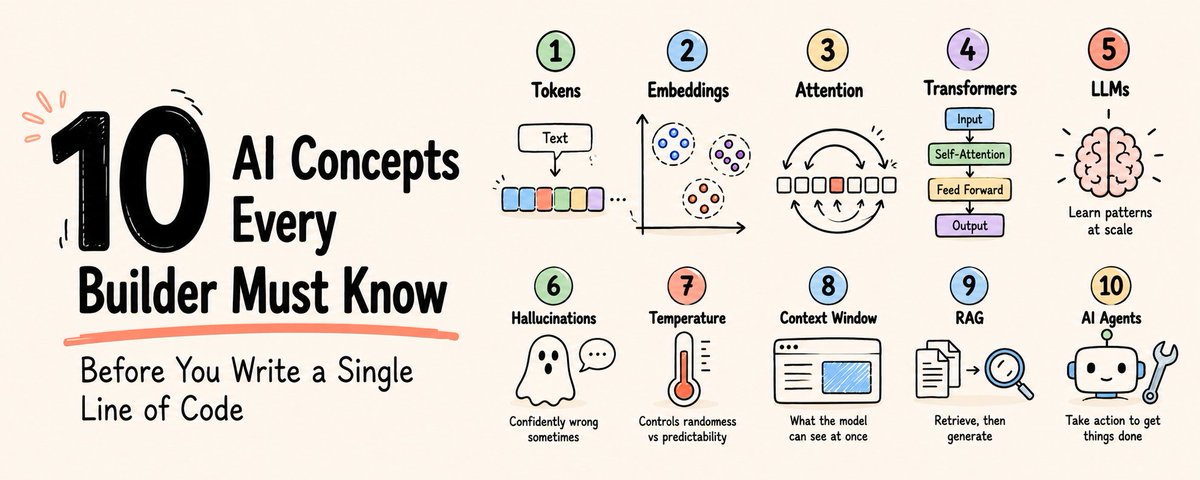
These are the 10 concepts that make the first 1,000 hours count ↓
Bookmark this before you start.







Jim Sagar retweeted

Elon Musk just put an expiration date on the medical profession.
And he gave it three years.
The interviewer asked when Optimus would be a better surgeon than the best surgeons on Earth.
Musk didn’t hesitate.
Musk: “Three years. I’d say three years at scale.”
Not a prototype. Not a lab experiment. At scale.
To understand why that timeline is plausible, you have to understand the fundamental problem with human medicine.
Musk: “Takes a super long time to learn to be a good doctor. And even then, the knowledge is constantly evolving. It’s hard to keep up with everything.”
Musk: “Doctors have limited time. They make mistakes. How many great surgeons are there? Not that many.”
That is the brutal reality of the greatest healthcare system humanity has ever built.
It runs on exhausted humans with biological limits, trained over decades, who can only operate on one patient at a time.
Optimus has none of those constraints.
It doesn’t get tired.
It doesn’t forget a study published last week.
It doesn’t have an off day. It doesn’t have a caseload limit.
And once you train one, you can manufacture ten thousand more with identical precision.
Musk: “At that point, there will probably be more Optimus robots that are great surgeons than there are on Earth.”
Think about what that actually means.
The scarcity of elite surgical skill has been one of the defining limits of human healthcare since the beginning of medicine.
Geography determined your odds of survival.
Zip code determined your access to expertise.
That bottleneck disappears overnight.
Because you can’t train human surgeons fast enough to meet global demand.
But you can manufacture infinite robots running identical perfect code.
The most valuable skill in the world is about to become software.
Infinitely replicable. Infinitely scalable. Available to every human being on Earth regardless of where they were born.
Medical scarcity doesn’t fade gradually under that reality.
It ends.
And whoever controls that code controls healthcare access for billions.
For all of human history, the leading cause of preventable death wasn’t disease.
It was the shortage of great people to fight it.
That problem has a solution now.
And it ships in three years.
Jim Sagar retweeted

I found a way to sell AI infrastructure to companies doing $2M-$50M/year.
ALL with no sales team, enterprise connections or cold calls.
Businesses are desperate for Ai implementation right now and anyone can do this.
But most people get it wrong and that's why they fail.
They lead with tools, ex) "we build automations" or "we integrate AI."
That means nothing to a CEO managing 40 people and $5M in revenue.
They pitch features instead of showing the cost of doing nothing.
And they price hourly, so the buyer treats them like a freelancer instead of a partner.
Mid-market and enterprise companies are bleeding $100K-$500K/year on broken processes, bloated SaaS stacks, and manual work they don't even realize they're paying for.
They WANT to buy AI infrastructure, they just don't trust most people selling it.
Because most people selling it sound like every other agency.
I created a guide breaking down exactly:
→ How to position AI infrastructure so executives actually listen
→ The discovery framework that turns a 30-min call into a $25K-$100K project
→ How to calculate ROI so the price sells itself
→ The 3-pillar strategy process that closes 60%+ of qualified prospects
→ Why "sell the map before you sell the build" changes everything
RT + reply "INFRA" and I'll send you the FULL guide (must follow so I can DM)


