



🔋Self-Motivated 🔋 retweeted

Looks like this SA intern kiddo still hasn’t learned their lesson.

BREAKING: Jensen Huang reportedly told NVIDIA employees that if AMD's Minimax Inferact kernels beat NVIDIA's on AgentX performance targets, he would reset every NVIDIA employee's GTA 6 progress.
The employees then broke down crying. Jensen called it "high-performance levers of motivation."
Is this the kind of thing you want to see from the leader of one of the largest companies on Earth? Disgusting. (Source: roommate)

🔋Self-Motivated 🔋 retweeted

$AMZN: Double Miss Immediately Pulls Down Neoclouds
The big eye catcher for me was that Amazon was way over on CapEx: $77.3B (Est. $57.47B). That’s in one quarter! That’s 34% above estimates!

AMAZON $AMZN Q3’26 EARNINGS HIGHLIGHTS
🔹 Revenue: $201.9B (Est. $202.3B) 🟡; +12% YoY
🔹 EPS: $1.89 (Est. $1.96) 🔴; w/ Anthropic gain
🔹 Operating Income: $28.1B (Est. $26.2B) 🟢
🔹 AWS Sales: $46.0B (Est. $45.4B) 🟢; +39% YoY
🔹 CapEx: $77.3B (Est. $57.47B) 🟢
Q4 Guide:
🔹 Revenue: $240.0B-$247.0B (Est. $244.5B) 🟡
🔹 Op. Income: $28.5B-$33.5B (Est. $33.1B) 🟡
🔹 Revenue Growth: +12%-+16% YoY
Segment Net Sales:
🔹 North America: $112.9B (Est. $113.39B) 🔴
🔹 International: $43.1B (Est. $43.21B) 🔴
Other Q3 Metrics:
🔹 Advertising: $19.6B (Est. $20.87B) 🔴
🔹 Subscription: $14.0B (Est. $13.69B) 🟢
🔹 AWS Operating Income: $17.8B
🔹 Free Cash Flow (TTM): -$42.4B
Key Updates:
🔹 Anthropic: $9.5B pre-tax gain in Q3’25 included in non-operating income
🔹 AWS: $184B annualized revenue run rate; over 39% YoY growth
🔹 AgentCore: Tens of thousands of customers; 2x more agents deployed in Q3
🔹 Alexa for Shopping: 400M+ customers; interactions up 570% YoY
Comments:
🔸 “Our AWS investment in functionality and infrastructure is working, with over 39% year-over-year revenue growth in Q3 ($184 billion revenue run rate) and projected revenue growth rates of over 40% both in 2027 and in 2028”

🔋Self-Motivated 🔋 retweeted

Market is overreacting to hyperscale credit spreads widening from my perspective. TL;DR Spot pricing for renting GPU compute materially above contracted rates implies hyperscalers are underearning while operating cash flow acceleration is an underestimated source of funds for AI capex.
The fact that spot prices for GPU rentals are at least 2x higher than contracted rates is the missing piece from the discussion about hyperscaler credit, which is the only fundamental factor behind this selloff. Multiple private companies are planning on spending at least 2x more per GPU for compute as contracts roll-off and some have spoken about this publicly.
As contracts roll-off, hyperscale growth rates are going to continue to accelerate as their installed bases of compute reprice higher. Hyperscale operating cash flow growth using a mix of estimates and actuals is modeled to accelerate from 31% in the first quarter of 2026 to 50% in the second quarter. This acceleration should continue for the rest of the year and this is not in estimates which incorrectly model a deceleration in the third quarter from my perspective.
Some math. Consensus estimates are probably for 25-35 gigawatts added by hyperscale and neoclouds in CY28 (using a range as standing up datacenters is hard and a lot of the neos plus labs are still private). At 60b per gigawatt, that is 1.5 to 2.2 trillion in capex. Consensus estimates for hyperscale/neo operating cash flow is 1.3 to 1.4 trillion. I think this gets revised up materially as contracts reprice and growth accelerates so the 100b to 700b that would hypothetically need to be plugged by debt goes away. And their credit profiles materially improve. Not to mention the said 100b to 700b would be less than 1 turn of incremental leverage on consensus EBITDA estimates. And obviously the Nvidia and Broadcom “credit wrappers” help improve creditworthiness as well given their FCF profiles.
OpenAI, Cursor/Grok and the various Open Source inference clouds have accelerated materially over the last two months per public data and Anthropic continues to grow insanely fast while likely generating FCF. This - along with the fact that spot prices for GPU rentals are so far ahead of contract - are the missing pieces from the BofA chart on hyperscale FCF vs. semiconductor FCF.
Hyperscalers are underearning and anyone who signed a contract for GPU compute in 2024 and 2025 is overearning. Operating cash flow will be enough to fund capex but as contracts reprice and cloud growth continues to accelerate then spreads likely come in as well.
Would also note that CDS markets are easy to manipulate - was a huge feature of the GFC - short the stock and then buy the CDS. So I would not put attach much signal to CDS.
Net, net I’m not that concerned about the widening spreads in hyperscale credit. The real risk is that bringing power online and energizing all these GPUs is really hard but we are getting better at this every day.
🤖 Made with AI


🔋Self-Motivated 🔋 retweeted
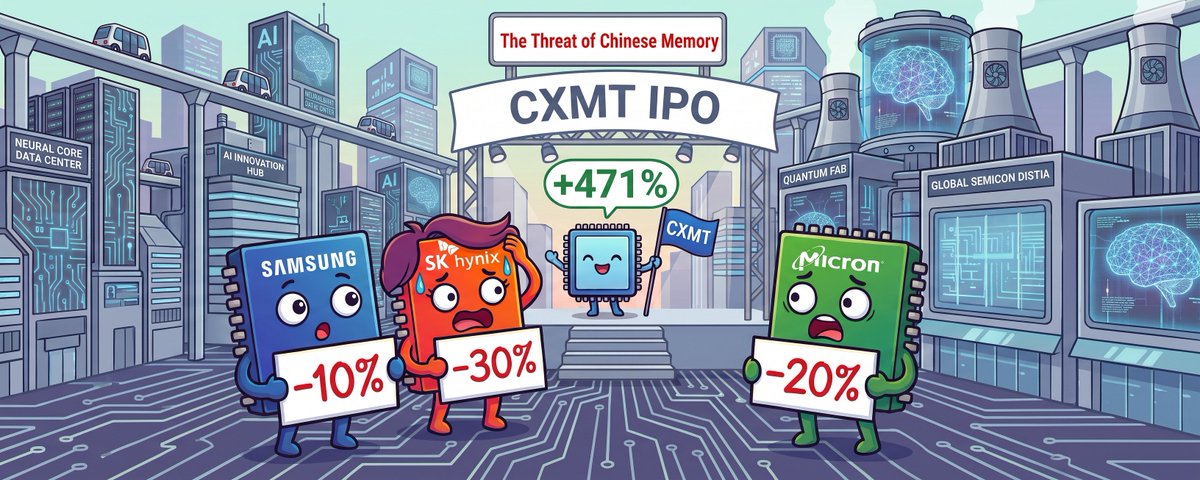
I hope this article helps improve your understanding of CXMT and the three major memory companies.
I have made the entire article free because I want as many people as possible to read it. If you invest in memory or semiconductors, please feel free to give it a read.

🔋Self-Motivated 🔋 retweeted

Open-weight models are essential to a healthy AI ecosystem. Together with others across our industry, we are outlining a path for open-weight models to strengthen American competitiveness and expand economic opportunity, while protecting national security. microsoft.com/en-us/corporat…


🔋Self-Motivated 🔋 retweeted

Zuck: “The pricing from some of the other labs is very extreme and has very high margins. We think that there’s a real ability to be able to offer frontier or very high-level intelligence at a much more affordable cost.”
Epic pricing war breaking out among agentic models.
🔋Self-Motivated 🔋 retweeted
This article is fully open to everyone.
In this piece, I cover two things.
First, for readers without a technical background, I explain how NVIDIA rack names are structured and what each part means.
Second, based on that foundation, I analyze SemiAnalysis’s July 6 post. I go through what it implies, why those posts may sound alarming, and what the actual midplane yield picture could look like in detail.
The first part is written for readers who may not have a technical background. If you only want to read my thoughts on the latest @SemiAnalysis_ post, please jump directly to Section 5.

🔋Self-Motivated 🔋 retweeted

Today, we're proud to announce a strategic agreement with @AnthropicAI that spans memory and storage AI architecture design, supply and demand, enterprise adoption of Claude across Micron and a strategic investment in Anthropic’s Series H funding round. bit.ly/4ezJkL1


🔋Self-Motivated 🔋 retweeted
This bull cycle will last far longer than Wall Street expects.
There is no bubble. AI infrastructure and semiconductor demand are still in the early stages, supporting S&P 500 earnings growth toward $650 by 2031.
Inflation is not the issue many claim; a supply shock simply changes relative prices. Why does everyone forget their undergraduate economics?
Warsh is not a hawk.
We are also heading toward a constructive Iran deal that restores risk-on momentum.
Ignore the doomers. This cycle has substantial room to run.
🔋Self-Motivated 🔋 retweeted
I believe I said “tough, flinty, disciplined” rather than stubborn.
I deeply admire TSM management and believe their capacity discipline, whether organic or self-imposed, is good for everyone.
We want a smoother for longer cycle. An overbuild and/or a bubble would be terrible.
We need to get C.C. on X!

$TSM CEO Pushes Back on @GavinSBaker, Clarifying That TSMC's Bottlenecks Are Organic, Not Self-Imposed
"When asked by a reporter, Gavin Baker, a technology investor who previously managed over $17 billion in assets at Fidelity and is now the chief investment officer at Atreides Management, described TSMC as being managed by a group of very stubborn and experienced people in their 70s who had personally witnessed Taiwan's semiconductor industry go from lagging behind Intel to gradually establishing itself as a global leader. Therefore, they were very clear about the cost of tech bubbles and crashes.
In response to the above statement, TSMC's CEO stated that Baker originally meant that TSMC was applying the brakes because AI would not become a bubble. A group of experienced seniors were applying the brakes. But to be honest, TSMC did not deliberately control it, nor did TSMC intend to apply the brakes. They may be a bit stubborn and old, but they really did not deliberately apply the brakes.
TSMC's CEO said that his company tried its best to increase production capacity for its customers, but who knew that the customers' businesses would grow so fast? The development since the launch of GPT in 2023 has far exceeded expectations. C.C. Wei also revealed that he asked NVIDIA CEO Jensen Huang why he was so smart and hadn't told him earlier, but Huang replied that he didn't know either. No one, including TSMC, can predict this now, and all these demands are going to TSMC, which can't see it coming either.
C.C. Wei also stated frankly that TSMC has been increasing production, with more than a dozen construction sites underway in Taiwan."
It's actually interesting that Wei chose to discuss this narrative, and he specifically quoted Gavin's comments.
$NVDA

🔋Self-Motivated 🔋 retweeted

Dylan Patel from @SemiAnalysis_ asked Jensen why anyone needs a local model on a PC
Jensen: every system is going to be robotic. Your car already is — “hey honey, come pick me up”
So the agentic PC isn’t a PC. It’s the always-on controller for a robotic home. You text your laptop, it tells the vacuum to clean the kitchen, the loop just runs
That’s why it’s local and un-metered — you don’t put a meter on your house
Compute Everywhere

🔋Self-Motivated 🔋 retweeted

"The biggest mistake is people thinking Goldman Sachs and Morgan Stanley have the answers. They don't."
Jordi Visser (@jvisserlabs) on the AI edge nobody is using.
His method:
"Every time Jensen Huang gives an interview, I take the YouTube transcript. I drop it in a folder on my computer."
"Only thing in that folder: every Jensen Huang interview this year."
"Then I go to Claude, hit co-work, connect the folder, and ask: which names has he basically told me to buy?"
"You'll be shocked. You're getting seven-baggers all over the place."
Translation: the alpha is no longer in proprietary data. It's public. The edge is using AI to process it faster than the analysts who got paid to read it.
What other transcripts are you not putting through an LLM yet?

"They are not going to be able to raise rates."
Jordi Visser (@jvisserlabs) ran capital at Weiss Multi-Strategy Advisers as CIO. 30 years on Wall Street. Built one of the first volatility-arbitrage frameworks for systematic hedge funds.
Managed billions through three crises, never had a thesis-driven blow-up year.
"Interest payments on US debt are now bigger than what we spend on defense. Over a trillion dollars a year. This is what Bitcoin was made for."
We cover:
— Why the Fed is mathematically trapped and how the trillion-dollar interest math forces every policy decision from here
— Why "bubble talk" is intellectually lazy: PE goes UP in bubbles, not down, and right now PE is contracting while earnings grow 27%
— The AI-agents-eat-tokens thesis: why agentic AI doesn't care about dollars and what that means for compute-backed assets
— Why belief is harder than fundamentals: fundamentals come and go, belief systems don't, and which belief is breaking in 2026
— The Bitcoin call no other macro guy on Wall Street will make publicly: new all-time highs before year-end
— Why most hedge funds will underperform Bitcoin this cycle and the structural reason it has nothing to do with crypto
— The single chart that made Jordi go from skeptic to allocator and why it hasn't reversed
— What the 2020-2026 monetary regime actually was, named correctly for the first time
Thanks to Jordi for coming on @new_era_finance.
Highlights:
00:00 - Intro
00:42 - Bitcoin Lagging
03:16 - AI Investment
07:14 - Price vs Narrative
12:15 - Market Dynamics
21:28 - AI Trading
25:24 - AI Democratizes Wealth
36:26 - Crypto Transition
39:40 - Elliott Waves
44:08 - Banana Zone
49:37 - Fundamentals vs Technicals
55:14 - Ethereum Future
🔋Self-Motivated 🔋 retweeted

Back-of-envelope numbers for 1 gigawatt data center:
All-in Capex: ~$50 bn
Enterprise revenue generated: ~$25-30 bn/year
Electricity cost: $1-2 bn/year
~2 year payback.
The boom is real.


🔋Self-Motivated 🔋 retweeted
Every conversation I have with @dylan522p, I'm really just trying to understand the supply and demand of tokens.
This is a unique episode in that it's entirely dedicated to talking about both sides of that equation.
We discuss:
- The infinite demand for the newest models
- @SemiAnalysis_ going from $10K on AI spend to $7M
- Mythos and Anthropic's compute problem
- Why TSMC spending $100B on CapEx could cause a shortage
- Robotics as next demand wave
- Why memory prices will double again
This is my second conversation with Dylan and find myself needing to speak with him more and more often to make sense of it all.
Enjoy!
Timestamps:
0:00 Intro
1:00 Surging AI Spend
10:27 Token Demand
16:21 When Ideas Are Cheap and Execution is Easy
20:46 Model Hoarding
22:34 Robotics
27:03 The Compute Bottleneck
30:26 The AI Permanent Underclass
31:39 Supply Chain Reality
37:47 CPUs
42:54 Predictions: Public Backlash