

25+ yrs trading experience | Quantitative System Designer | Mechanical strategies designed for consistent risk-adjusted returns | https://teapawt.net/t.co/pVoNpToWV5
USA
Joined July 2007
- Tweets8K
- Following1.3K
- Followers1.7K
- Likes427







Trading Time Machine retweeted

PRIORITY FEES HAVE SMASHED THEIR ALL-TIME RECORD, GENERATING $510K IN A SINGLE DAY.

Trading Time Machine retweeted
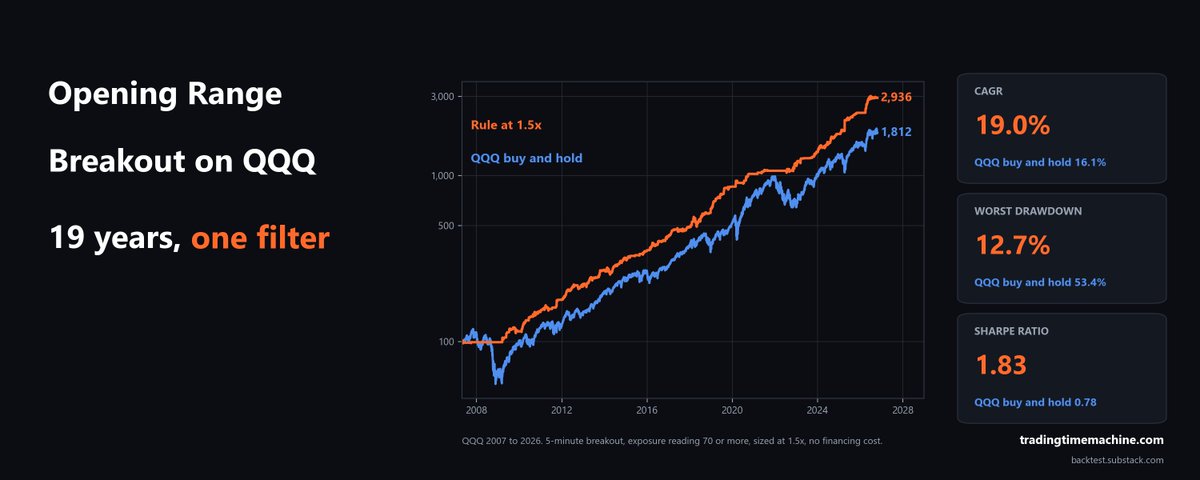
Toby Crabel's rule, 19 years of $QQQ, and the nightly exposure reading that sorts the winning mornings from the losing ones. Sized at 1.5x it made 19.0% a year against 16.1% for buy and hold.
Trading Time Machine retweeted

The dot-com bust crushed the Nasdaq in 2000, but my KJ Custom strategy kept advancing.
And this isn't survivorship-biased data. I'm using historical index constituents, not today's winners retroactively.
A good reminder of why realistic backtesting matters.
#WealthLab #AlgoTrading

Trading Time Machine retweeted

Effective Immediately, all organizations using PHP for their systems are advised to be prepared for an update addressing two critical vulnerabilities. PHP is widely used for web applications. These vulnerabilities often provide a direct path to the server's file system or database. If an immediate update is not feasible, it is recommend that organizations take the system offline until it can be fully mitigated. NSA will follow up shortly with more specific guidance.
Trading Time Machine retweeted

Trading Time Machine retweeted
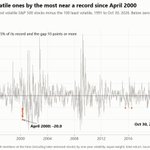
SPY has had 203 days with a move of 3% or more since 1993.
They don't show up at random. 41 came in 2008. 26 in 2020. Twelve full years had none at all.
After a calm day, the chance of a 3% day sometime in the next week is 4%.
After a 3% day, it's 57%.
Direction is a different story. After a 3% drop, SPY was up the next day 60% of the time. You can't call which way it goes. You can call how hard it moves.
That's why position size should come from recent volatility, not from a fixed number of shares. A system holding the same size in March 2020 that it held in a calm 2017 is taking several times the risk without knowing it.
Forecast the size of the move. Leave the direction to the system.

Trading Time Machine retweeted
Here’s an odd one.
Uranium stocks $URA are down 15% in a month. Rare earth stocks $REMX sit 37% below their 200-day average.
Both crashing at once has happened 17 times since 2011. Two weeks later $SPY was higher in all 17, up 4.3% on average. A normal two weeks is +0.6%.
It didn’t need a selloff. With SPY near its high, it was still 8 for 8, up 3.1% on average.
Each one alone was followed by a gain about 70% of the time. Together, 17 for 17. The latest started October 14.

Trading Time Machine retweeted
Larry Williams has a story in his old trading letters. A bank robber is in the middle of a job, cleaning out the vault, and his lookout tells him the cops are coming.
"A bank robber would split, he'd change his plans. That's the difference between traders and bank robbers... traders would stay in the bank hoping the cop alert was a false signal!"
A few lines later he wrote, "Hope does not work in this business."
Every trader has stayed in the bank. The work says get out and you hold anyway, because you still want the original signal to be right. #trading $SPY $QQQ $NKTR

Trading Time Machine retweeted

Nasdaq 100 has closed lower or below its opening price for 9 straight days, only 10th such streak in history. $NDX was higher 5 days later in all 9 prior cases.
In 8 days, NDX is down 6% from ATH. Remember, good and bad days often cluster together. Don't fall for the bear trap.

ALT Bluekurtic Market Insights chart showing the S&P 500 and McClellan Oscillator since 1999, highlighting historical instances when the oscillator crossed above +60 while the S&P 500 was within 5% of its all-time high. Forward performance table shows the S&P 500 was higher one month later in 84.6% of prior cases, with an average gain of 2.2%.
Trading Time Machine retweeted

NEW ATTACK REPORTED AT RIYADH AIRPORT, FLIGHTS DISRUPTED
A fresh attack hit Riyadh’s King Khalid International Airport, prompting evacuations and flight disruptions. Reuters quoted witnesses as saying several people were wounded. The airport has faced repeated attacks blamed on Iran-backed Houthis this week.
Trading Time Machine retweeted

$SPY Seasonality (Since 1928)
1) January: +1.1% — Often strong from the “January Effect” as capital gets redeployed, though variability is high.
2) February: +0.3% — Moderately positive, but typically softer than January.
3) March: +0.8% — Generally constructive as Q1 wraps up.
4) April: +1.4% — One of the strongest months, supported by optimism and tax-related flows.
5) May: -0.1% — Marks the “Sell in May” period; returns tend to flatten with higher volatility.
6) June: -0.2% — Historically weaker with lower volumes and early summer slowdown.
7) July: +1.3% — Strong, often driven by earnings season tailwinds.
8) August: -0.1% — Volatile and inconsistent, with frequent drawdowns.
9) September: -0.7% — Statistically the weakest month, with rising caution post-summer.
10) October: +0.8% — Known for volatility, but positive on average and often a rebound month.
11) November: +1.3% — Seasonally strong, supported by holiday demand and sentiment.
12) December: +1.0% — “Santa Claus Rally” effect, with year-end optimism lifting markets.
-data source from refinitiv

Trading Time Machine retweeted

Honus Wagner looking for the perfect bat. One of my all-time favourite pictures

Trading Time Machine retweeted

The crazy thing about this is 200ish of those lows are fixed income (bond) closed end funds + pfd stocks, so the rip higher in rates is distorting the new lows data to some degree.


Trading Time Machine retweeted

Excited to have my first paper up on SSRN - "Which Trend Signal? Price versus Slope on Diversified Asset-Class Baskets"
papers.ssrn.com/sol3/papers.…
Thanks to @MebFaber for the inspiration - and any comments/critiques welcome.
Trading Time Machine retweeted
Been testing out different breadth signals (everyone is writing about how thin breadth is) to see if they give you any edge. My read is no - better off just watching the 200d MA. When the index makes a high on thin breadth, the forward 12m return is +14% droskill.github.io/market-st…

Trading Time Machine retweeted

Investing Quote of the Day: "Investors long for steady waters, but paradoxically, the opportunities are richest when markets turn turbulent." - Roger Lowenstein (@RogerLowenstein)

Trading Time Machine retweeted

Learn more: github.com/Limex-com/ziplime


Trading Time Machine retweeted
WealthLab 9 is here.
We've taken systematic trading into the AI era.
AI can generate ideas. WealthLab helps you find out if they actually work.
Try WealthLab 9: tinyurl.com/3t3zx25y
