

Paul is Emeritus Professor of Public Policy at the Robert Gordon University, Aberdeen. He mainly writes on poverty, benefits, social justice and social policy.
Joined November 2012
- Tweets1.5K
- Following124
- Followers1K
- Likes159





The "stated purpose" of PIP wasn't part of the design. The predecessor benefits to DLA and PIP were supposed to do something else - to counter the long term disadvantages of disability at all income levels.

Paul Spicker retweeted

The Green Party has today voted that Jews are racists unless they explicitly adopt an extremist purity test set out by the Party. Under that test, Jews belonging to pretty much any synagogue in the UK would fail.
The Green Party Conference’s intentions could scarcely have been clearer. They have adopted the Soviet doctrine that Zionism is racism, meaning that Green Party policy is that all peoples of the world have right to self-determination except for Jews.
Far from being anti-racist, that policy is racism in its clearest form. According to our polling, only 6% of British Jews do not identify as Zionists, and 89% consider anti-Zionism a form of antisemitism.
Whereas past leaders of the Green Party stepped forward to oppose this motion, the current leader of the Green Party showed no leadership at all, skipping the vote entirely.
On the advice of our legal team we wrote to the Green Party prior to the adoption of this motion. As the originating complainant in the Equality and Human Rights Commission’s investigation that found unlawful discrimination against Jews in Jeremy Corbyn’s Labour Party, we have proven before that we will not stand by and let political parties bring antisemitism into the mainstream.

Performative meanness: the small cuts will require a huge infrastructure to implement. The table is from the ONS Family Spending team.


"Isn't it patronising? To tell people how to spend their own money?"
@bbcnickrobinson asks shadow work and pensions secretary Helen Whately, as the Conservatives promise to prevent benefit claimants from spending their welfare payments on alcohol, cigarettes and gambling.
Why is this 'performative meanness'? It's mean, because the intention is to make benefit recipients suffer. It's performative, because it strikes a pose rather than seriously addressing any issue in benefit administration.
It's also deeply stupid. See observant-paulspicker.wordpr…

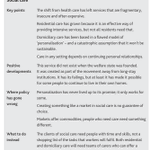
On social care: this is a summary of chapter 5 of my book, How to Fix the Welfare State. policy.bristoluniversitypres…...

Fame at last. After discovering that an article I published in 1981 was apparently produced by AI, someone clearly thought that I ought to be represented by an AI image.


The most plausible explanation is not that this obscure article has been used to train AI, but that a big chunk of my other writing has been - a million words in 60 scraped pieces, including 14 of 23 books. So my writing style has been judged by its similarity to my later work.

I'd love to think that someone out there had read and liked it, but sadly I've no reason to believe that: it has no (zero) citations on Scholar. I've done a little better since ...

I tested something I'd written myself: my first academic article, published 45 years ago. It came in at 77% AI-generated.


Paul Spicker retweeted

Taking both of these points together you can conclude:
1. Excluding men from a women’s facility is less favourable treatment, even if they have access to a men’s facility.
2. If that exclusion is because of sex, that is unlawful unless there is an applicable exception.
3. On a basic comparator test this is clearly direct sex discrimination: if the man was female he would have been included.
4. Since you can only rely on the Schedule 3 exceptions if you’re operating a service based on biological sex, anything other than that is not covered.
Therefore a service based on anything other than biological sex which excludes men from a women’s service (and vice versa) necessarily engages in unlawful sex discrimination without an applicable exception.
Poverty is really about social relationships; but even if one insists it's all about low income, this is ill-informed. Prices are relative - they reflect demand, and so the ability of *other people* to pay. Therefore the value of income is also relative. policy.bristoluniversitypres…

Defining “poverty” upwards makes for bad economics, argues @worstall
thecritic.co.uk/the-problem-…

Paul Spicker retweeted

"Countries that have cut back on certain types of #Benefits have nevertheless found themselves constrained to leave some forms of income support in place...It’s not an inevitable truth, but it’s something that can be charted and seen." @PSpicker @geomill
transformingsociety.co.uk/20…
Paul Spicker retweeted
Listen to @geomill and @PSpicker talk about some of the historical roots, moral foundations, and practical workings of different #Welfare systems. #WelfareState
transformingsociety.co.uk/20…
Paul Spicker retweeted
New in the ‘What Is It For?’ series, ‘What Is the Welfare State For?’ discusses the institutions and methods that characterise #WelfareStates around the world. @PSpicker
ow.ly/zC2q50W4VN9

My new book has shipped: bristoluniversitypress.co.uk… .
"A brilliant critical contribution and powerful overview about how we got here and what is at stake" (Camilo Perez-Bustillo)
"Concise and superbly written" (Daniel Béland)

After 25 years and more than eight million views, I am closing down my educational website, 'An Introduction to Social Policy'. A legacy copy, and my blog, will still be available at observant-paulspicker.wordpr…
Other posts will be at @paulspicker.bsky.social
It doesn't seem to matter how many warnings are posted, some kids playing in the cemetery will try to bring dead ideas back to life. Zero-based budgeting implicitly favours 'core' (in-house) spending over 'peripheral'. Voluntary organisations beware.

A legal case in France is challenging the principle that the benefit authorities can select suspects to monitor by using an algorithm.
laquadrature.net/en/2024/10/…

The concern about algorithms and surveillance of the poorest people seems to be blossoming as an issue internationally. gijn.org/stories/amnesty-int…

Hardly new, people. Richard Titmuss wrote about this 60 years ago and I've been on it for 20.

💥New! The apparent simplicity of Universal Credit conceals the complexity of people’s different circumstances. @kateesummers and David Young argue that Labour's welfare reforms should recognise complexity and relieve claimants from managing it alone.
blogs.lse.ac.uk/politicsandp…
