

Ex-Equity PM & Quant. I built an AI engine to apply 10y+ institutional rigor to the open web. 🟢 Scanning for hidden gems. 💎 I invest my capital using this.
Tracking 1,000+ Authors
Joined December 2025
- Tweets969
- Following432
- Followers574
- Likes737





Pinned Tweet
📊 H1 2026 is in the books - our first real out-of-sample stretch.
The setup: we built Trade Ideas Flow in late 2025, then froze everything - definitions, methods, hyperparameters, prompts. No tuning. No hindsight. Just the system running daily.
The result:
🟢 TIF: +18%
⚪ S&P 500: +9%
💎 +9% alpha in 6 months
Every pick was published to the web + emailed to subscribers in real time. The audit trail speaks for itself.
Not advice. Just how we run the process. Past performance ≠ future results.
Link below if you want to see how it keeps performing and want to get our picks (FREE for now)

💎 MY FAVORITE STOCK PITCH FROM THE LAST 24H
$AIRDF written up by Yazan Homsi
Rocket Doctor went live in Florida on Monday with more than a dozen Florida-licensed doctors ready on day one, and no Florida insurance contract announced yet. Yazan Homsi reads that order as the good news.
Quick background. Rocket Doctor runs a virtual doctor platform. In the US it earns a US$25 platform fee plus an 8% billing fee on each visit an insurer actually pays for, and out-of-network visits generally do not get paid. Florida is its 4th US state after California, New York and Maryland.
The author's core thesis is that the US bottleneck is doctors, with patient demand already there. A doctor needs a license in each state and then has to get into each insurer's network, and that is slow. In the first 3 states the contracts came first, giving about 24M covered people access, and then it took quarters to get credentialed doctors working. At the end of Q2 there were 80 providers on the roster and only 30 active. Q3's growth, US visits +56% and clinical hours +33% on the quarter, came largely from that supply finally coming through.
Florida starts from the other end. Licensing is done for the first group, so when insurers switch on there are doctors to take the visits.
Then the author sized it, labelled as an illustration and not a forecast. Q3 ran about 2.3 visits per US clinical hour. A dozen doctors at just 10 hours a week is ~120 hours, or roughly 1,100 to 1,200 visits a month. The entire US business did ~2,476 visits in September. I redid it: 120 x 2.3 x 4.33 weeks is 1,195.
And a US visit nets roughly 4x a Canadian one, ~US$25 plus the 8% against ~C$8.
What is missing is the money side. The release names no Florida payer and gives no Florida covered-lives number, while Florida has about 9M Medicare and Medicaid beneficiaries (government health cover), exactly the people the US model is built around. Next on the author's list are those contracts, Q3 results by end of November with management already saying to expect record revenue, and ~7.4M warrants at C$0.85 expiring in January 2027.
The author's bottom line: "Today confirms the first half. The payer contracts are the other half, and that's what I'll be watching. I remain long."

Yazan Homsi's full write-up, with the Q3 hours math and what Florida still needs: 📖
makingmoneynow1.substack.com…
I read every pitch like this at tradeideasflow.ai 💎🟢
624 stock pitches went out in the week to 30 October. 3 made this issue.
📈 Thursday Tailwinds #13 is out.
A tailwind is a force that pushes money toward the same companies for years. You can be roughly right about which business catches it and still do well, so it is easier to own than a good company.
This week it is Florida marinas that almost nobody may add to, India's freight-only line reaching Mumbai's container port, and Japanese restaurants paying to keep the foreign cooks they can no longer hire from overseas.
Market has not got to them yet. Gateway Distriparks closed at a 52-week low on 30 October, 4 months after its first double-stack train over the whole route, and only one piece of tailwind writing I have read since May mentions Human Holdings.
5 more I liked and could not fit, all credited inside the issue.
🔹 India's factories buy more precise machine tools than its own builders can yet supply, with imports at 58.8% of Rs 31,781 crore of demand in FY25. SOIC Finance
🔹 Equipment specified for last century's heat is ageing out early, and this summer Eurostar went back to Alstom to raise the spec on 30 trains from 45°C to 55°C. @susanfsu
🔹 NAND is moving to the multi-year build-to-order contracts hard drives already run on, and Sandisk ($SNDK) holds $93.9 billion of floor revenue across 8 customers. Kristal Lens and Nikhs both carry it
🔹 A June executive order gives US federal agencies until 31 December 2030 to move their most sensitive systems to quantum-safe encryption, and about 15% of the customer servers behind Cloudflare support it so far. Grow or Die
🔹 Chipmakers and industrial gas companies now want North American helium, with damage at Qatar's Ras Laffan expected to take years to repair. John Hunt, MD
9 people did the research here and I only chose between them, so follow them ahead of me.
Link in the comments.
Inside: why Florida gained 1 marina in 17 years while its boats rose 51.7%, and the ¥20,000 to ¥30,000 a month Japanese restaurants now pay to keep a foreign cook.
tradeideasflow.substack.com/…
One writer reran Meta's ad revenue as if its AI models had never shipped, and found about $25 to 28 billion a year that would not exist without them.
Also today: a construction software company another writer said the market was pricing for obsolescence.
Last day of going through the industries one a day. Gold, biotech and chips are out. Today software and the internet, then every writer from the week in one place 💻🌐
170 pitches on the internet platforms came through my reading this year, and 2 writers kept asking whether Big Tech's AI bill is paying off.
@espabilaeinv took a paper Meta, $META, published on its own engineering blog and reran Meta's ad revenue as if the AI models had never shipped. The answer was about $25 to 28 billion a year that would not exist without them, which the author put as "Meta no vende IA, la usa", Meta does not sell AI, it uses it. On Alphabet, $GOOGL, the author checks what management promised against what it delivered, and still holds the stock.
Also on the platforms:
Dividendomics calls Meta "one of my largest positions", and went looking for why AI answers cite Reddit, $RDDT, "roughly three times as often as Wikipedia".
🌐

Industry by industry, these are the 24 writers I read when I want somebody who knows the business.
Go support these authors:
🪙
saadkhan88.substack.com
stevebarton.substack.com
taylorjay.substack.com
⛏️
theoregongroup.substack.com
miningcharts.substack.com
🧬
bowtiedbiotech.substack.com
maandhunter.substack.com
bio5c.substack.com
bioequitywatch.substack.com
kelinresearch.substack.com
mordechaison.substack.com
💾
jasonschips.ai
irrationalanalysis.substack.…
senanni.substack.com
yianisz.substack.com
moninvestor.substack.com
samuel6788.substack.com
sixsigmaresearch.com
💻
zenoble.substack.com
polycarpfx.com
theinsideanalyst.substack.co…
investingwithwes.substack.co…
🌐
espabilaeinvierte.substack.c…
dividendomics.com
We read 1,000+ authors and send the best pitches out every morning:
tradeideasflow.ai 💎🟢
💎 THE WHOLE COMPANY COSTS ABOUT $9M AND HOLDS $34.9M OF INVENTORY
$EDUC written up by @DismAssetBkd
Educational Development sells children's books and toys, mostly through PaperPie, a network of independent reps selling at home parties and school book fairs. Books from British publisher Usborne were about 40% of total sales in FY26.
Selling over Facebook, then the pandemic, took sales from $32.5M in FY15 to $204M in FY21. Then it kept buying stock for demand that did not last. Sales fell 31% in FY22, inventory hit $73.6M, and the bank covenants broke in 2023 and again in 2025.
FY26, to February, ended on $22.9M of sales, down 33%. Active reps went from 48,700 in FY21 to 5,200. Inventory is down to $34.9M, but $19.7M of that is non-current, meaning the company does not expect to sell it within 2.5 years.
The debt is gone. In October 2025 it sold its distribution complex for $32.2M (carried at $17.6M), repaid the bank and leased part of it back. That leaves $4.67 a share of tangible book, what is left for shareholders counting only real assets, against a stock at $1.03.
Why the write-up is titled The Book Value Trap: EDUC missed Usborne's minimum purchases and did not post the required letter of credit, so Usborne has the right to end the distribution deal. No notice yet. If it comes, EDUC gets at least 12 months to sell $19.0M of Usborne stock, while its inventory currently takes about 5.1 years to sell through.
Strangest detail in the piece: former CEO Randall White, father of the current CEO, held 13.3% in May 2025, and by May 2026 he was gone from the shareholder register. Management said it could no longer verify his holdings.
What could turn it: the sales decline slowed to 12% in Q2, Brand Partners rose from 4,300 in February to about 5,100 by August, and G&A cuts target over $1.2M a year. Break even for 3 years, get 0.50x book again (10-year median 0.56x) and the stock is $2.33, 124% above the $1.04 the author used. The author owns none and calls the turnaround "yet to be seen".
Best part is their own buyout database. 133 deals by controlling shareholders and 136 by strategic buyers of deep value companies, and at 0.20 to 0.40x book the average premiums were 26% and 63%. The family could take it private, or Usborne, with about £28M of cash, could pick up its own inventory and the distribution business cheap.

The full write-up, with the balance sheet and the buyout premiums: 📖
dismissedandassetbacked.subs…
We track deep value setups like this daily at tradeideasflow.ai 💎🟢
💎 MY FAVORITE STOCK PITCH FROM THE LAST 24H
$ION.AX pitched by @optimusdelta
One modelled recycling module in the US would recover enough dysprosium for roughly 320,000 to 720,000 humanoid robots a year. Iondrive wants to build it.
On 28 October the White House signed a Section 232 proclamation finding that imports of robots and industrial machinery threaten US national security. No tariffs yet, so most coverage stopped there.
OptimusDelta put the year's national security actions on one timeline instead. 5 in 10 months: critical minerals in January, humanoid robots in July, drones in August, wind turbines and then robotics in October. Nearly every one lands on a product with a permanent magnet inside, and from 1 January 2027 the defence magnet rule also covers rare earths mined, refined or separated in China.
Problem is China did about 91% of global rare earth refining and 94% of finished magnet production in 2024. "Moving the robot onshore doesn't move the magnet."
Why robots hit one metal hardest:
→ A humanoid needs about 35 to 79 grams of dysprosium. Joint motors run hot, and dysprosium is what keeps a magnet strong at temperature.
→ At 1.4M robots a year that is about 1.7% of today's heavy rare earth supply, at 10M around 12%.
→ Outside China, heavy rare earths are produced in negligible quantities.
Iondrive recovers rare earth oxide from end-of-life magnets, so from scrap already sitting in the US. Its September study models about 630 tonnes of oxide a year from one US module. Dysprosium is 4.7% of that by mass and 49.5% of the revenue, because North American dysprosium oxide is priced at US$2,300/kg against US$191/kg inside China.
4.7% of 630 tonnes is about 29 tonnes. I redid the robot math because it looked too big, and it only comes out right once you take the oxygen out of the oxide. The author had done that already.
Next proof is closer than any tariff: a 5 tonne test run in North America this quarter, about 1.4 tonnes of oxide for customer qualification, testing 95% recovery against the 89% the study assumed. Cash was A$5.1M at 30 September with about US$62.6M of government funding applied for, so how much of that lands before a build decision is the thing to watch.
Since Monday it also trades in US dollars on the OTCQB, as IIONF.
Every robot Washington gets built onshore is future scrap for a plant like this. The author's verdict: "US policy keeps widening the market for what comes out the other end."

🤖 Robotics, Section 232 & the magnet underneath
Washington has now put robots, drones, wind turbines and industrial machinery under Section 232, and almost every one of them has a rare earth magnet inside.
In this new piece I cover>
> What last week’s robotics proclamation actually does, and why no tariffs doesn’t mean no impact
> Why moving the robot onshore pushes the China dependency down a layer to the magnet and the oxide
> How much dysprosium a humanoid robot needs, and why scrap already in the US is one of the faster ways to get it
> Where @IondriveASX $ION.AX $IIONF fits, now that it trades in the US on the OTCQB
Full deep dive link in the first comment - enjoy 🫦

One writer called a French chip materials maker a "career-defining bet" in March, held it as the largest position, and it is up 178.7% since.
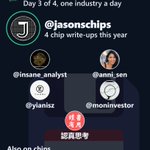
Day 3 of going through the industries one a day. Gold and biotech are out. Today semiconductors 💾
300 chip pitches came through my reading this year.
@jasonschips opened a 7-part series on Soitec, $SOI.PA, in March with "7 articles about a potential 7-bagger. This is my career-defining bet." Soitec has "a near monopoly on the raw material needed for silicon photonics", the author held it as the largest position, and it was the first write-up on Soitec I had seen. Up 178.7% since.
The rest of the beat:
@insane_analyst has written on chips since at least 2023, and has been "a fan of Cerebras since 2019", now as "a proud shareholder" of $CBRS.
@anni_sen bought Qualcomm, $QCOM, at $134.93 in April, and wrote up the trade on the day of earnings, down to the 2 puts sold that morning.
@yianisz got to Silicon Motion, $SIMO, before anyone else I read, the "traffic control" chip between NAND flash memory and the computer it serves.
@moninvestor owns both chip companies written up this year, SK hynix, $000660.KS, and Sivers Semiconductors, $SIVE.ST.
認真思考 invested in Ambiq Micro, $AMBQ, before it went public, and wrote it up in May. Up 35.8% since.
Also on chips: SixSigmaResearch.
💾

Tomorrow is software and the internet platforms, the last day of the week, including a writer who reran Meta's ad business as if its AI had never shipped.
Today's writers, go support these authors:
jasonschips.ai
irrationalanalysis.substack.…
senanni.substack.com
yianisz.substack.com
moninvestor.substack.com
samuel6788.substack.com
sixsigmaresearch.com
We read 1,000+ authors and send the best pitches out every morning:
tradeideasflow.ai 💎🟢

A drug developer one writer summed up as "Lottery ticket until the data drops" in February is up 331.0% since.
Day 2 of going through the industries one a day. Yesterday gold and the miners. Today biotech 🧬
I read 151 biotech pitches this year.
@BowTiedBiotech has been writing since at least November 2021, and "Every Monday" profiles a biotech with a catalyst coming up, a trial readout or an FDA date, the episode numbers in its titles running past 1,000 this year. All 7 of its write-ups this year were biotechs, and it holds no listed biotech stock at all. Relay Therapeutics, $RLAY, previewed in March, is up 101.1% since.
The rest of the beat:
@TheBioMAHunter tracks "biotech acquisition targets before big pharma strikes", and summed up Gossamer Bio, $GOSS, as "Lottery ticket until the data drops. Size accordingly." Up 331.0% since February.
@JNap5C keeps an "annual tradition" of listing biotechs that "could either make you rich or lose you all your money", and is long the entire basket, Shattuck Labs, $STTK, among them.
BioEquity Watch wrote 24 pitches this year, all 24 biotechs, and was first in my reading on 20 of those companies.
@han_seoul_ohno read the cancer worry around Abivax, $ABVX, as "a narrative-control failure, not obvious evidence that obefazimod is a cancer-causing drug". Up 23.9% since.
Also on biotech: Mordechaison, first in my reading on all 4 of its biotech companies.
🧬

Tomorrow is chips, including a French company one writer called a "career-defining bet" in March. It is up 178.7% since.
Today's writers, go support these authors:
bowtiedbiotech.substack.com
maandhunter.substack.com
bio5c.substack.com
bioequitywatch.substack.com
kelinresearch.substack.com
mordechaison.substack.com
We read 1,000+ authors and send the best pitches out every morning:
tradeideasflow.ai 💎🟢
One writer I read put out 24 stock pitches this year, and all 24 were biotechs.
Most people who write pitches go wherever the cheap stock is that month. A few stay inside one industry for years, and on that industry they are who I trust. This week I go through those industries one a day, starting today with gold and the miners ⛏️
39 pitches this year on industrial metals and minerals, copper, nickel, lithium, even road salt.
@TheOregonGroup writes the commodity story first and names one company at the end. The copper essay cited estimates that "the world needs 80 new, sizable copper mines by 2040" and closed on Troilus Mining, $TLG.TO, the first write-up on it I had seen. The nickel essay started from Indonesia, now producing nearly two-thirds of the world's refined nickel, up from 6% a decade ago, and closed on Canada Nickel, $CNC.V, and its Crawford project in Ontario.
Also on materials:
@mining_charts was first in my reading on all 3 of its materials companies this year. Atlas Salt, $SALT.V, is developing a road salt mine in Newfoundland, for a market where "governments on both sides of the border are obligated buyers each winter". E3 Lithium, $ETL.V, pulls lithium out of oilfield brine once "considered wastewater". The third is Lithium Ionic, $LTH.V.
⛏️

Tomorrow is biotech, including a drug developer one writer called a lottery ticket until its trial data dropped. It is up 331.0% since.
Today's writers, go support these authors:
🪙
saadkhan88.substack.com
stevebarton.substack.com
taylorjay.substack.com
⛏️
theoregongroup.substack.com
miningcharts.substack.com
We read 1,000+ authors and send the best pitches out every morning:
tradeideasflow.ai 💎🟢