


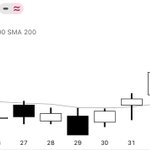


$SPX Then nuked straight up about 500 points!


Unclearin retweeted

$IREN $NUAI I find it useful as a heuristic to ask yourself, what is causing there to be such a wide range? Is it fundamentals or something else? For NUAI, the executional risk factor has been bigger and improving over time. For IREN, the executional risk question has mostly been tamed, but the uncertainty outside of the business affects it all the same.
Both stocks are just in really wide ranges for a really long time. That's part of why I haven't posted much about IREN. There's not much to say technically. Over the last year or so, in aggregate, the market max believes IREN is worth around $70 and min around $30 and NUAI somewhere between $4 and $8. It can be that simple.
To me, it is clear the market is aware how big of a deal AI is, but it's also clear that political risk, geopolitical risk, sovereign debt risk are big enough uncertainties to where the resulting range in price naturally reflects that uncertainty. With such a large technological transformation, you're naturally going to get uncertainty as well as to how value will accrue, which is why this year we've seen tremendous rotation, and an environment in which capital efficiently seeks to find things that had been cheap rather than bet on something that has already had a significant repricing like neoclouds did last year. So, you get a narrow stock pickers market while everything else is in choppy ranges. And technically, institutions want in to things they may have not caught early, but experienced a repricing last year. That needs a lot of time and digestion to shake out weak hands and transfer stock over to whales.
While, from what I've caught up on lately, it seems the funding concerns that question the profitability of the Neocloud business models have improved significantly for quality players as the businesses continue to mature, its not clear to the market the rate of change at which demand will grow and turn into top line because of interest rate dynamic and a broader environment of global conflict and immense change.
What a time to be alive.

Unclearin retweeted

$IREN: What Wall Street Will Do
Let me start with the conclusion: after despair comes a reversal.
IREN has been consolidating for a year. During that year, the company accumulated more milestones than at any other point in its history. There are at least 20 significant developments to list, many of which are not just company milestones but industry milestones as well. This is a company with exceptionally strong execution. The problem is that what it is doing does not produce immediately visible results. Take its 5.8 GW of secured grid power, for example. This required years of preparation, and its scarcity value will become increasingly apparent over time. Many people do not understand just how valuable this confirmed 5.8 GW really is. IREN is the only neocloud company that discloses power capacity backed by PPAs. Not only is its power supply supported by legal agreements, but its sites also possess multiple forms of scarcity value in terms of location, scale, and access to green energy. Time will gradually reveal the distinctive value of these assets.
IREN could have started monetizing these assets right here and now. That would have been relatively easy for the company. But just as it demonstrated foresight years ago by surveying locations around the world and securing high-quality sites, its management team has concluded that it can pursue greater and more sophisticated opportunities over the longer term. So, just as IREN laid the groundwork for its global site portfolio years ago, it is now planning something much bigger. This is a complex, integrated engineering undertaking involving multiple external partners, far beyond what was involved in planning several gigawatt-scale sites back then.
IREN follows a slow-first, fast-later model. Investing in IREN requires patience, but even more importantly, it requires a deep understanding of the company. The issue is not that the company communicates poorly or cannot tell its story. Rather, it is the complexity of the integrated engineering undertaking itself, which spans an exceptionally broad range of disciplines. Management has already provided a great deal of information, but understanding the interactions and causal relationships among the various elements, and how they contribute to building a unique moat, requires investors to conduct their own in-depth research and learning.
There are many neocloud companies, but IREN stands out as the one with the greatest concentration of high-quality, unique advantages. I can name at least 10 of them off the top of my head, each of which other companies can no longer realistically replicate. These are essential ingredients for differentiation and the development of a powerful competitive position. (If you have invested in IREN, try to see how many you can name yourself.)
Wall Street has historically paid the most attention to companies with multiple high-quality, distinctive advantages. Once those advantages are progressively demonstrated in practice, such companies also tend to command the highest valuations. Do not assume that IREN's year-long consolidation means Wall Street has been ignoring it. Institutional investors approach a company in stages. Once they establish that its multiple distinctive advantages are real, they will certainly study every aspect of the business more deeply than ordinary investors do.
Given IREN's slow progress in the early stages, sufficient patience is essential. After IREN announced so many milestones this year, its recent share-price performance has completely extinguished the once-high expectations of many investors, with sentiment even turning negative. This kind of market behavior is already approaching the classic setup for a reversal.
Let me discuss two recent developments.
Semianalysis's negative assessment
Semianalysis gave IREN's Canadian sites a negative assessment. Setting everything else aside, the facts are straightforward: there have been power outages, and redundancy has been insufficient. There is no need to explain away the causes. Those two facts alone are enough to support criticism of the company's execution and cloud infrastructure capabilities.
At the same time, however, Semianalysis acknowledged that Childress and Sweetwater are substantially better. Overall, IREN's Canadian sites are being upgraded, and they account for only a small proportion of its total capacity. Investing has always been about the future. The two much more important sites, both far larger in scale, have received positive assessments.
Yet problems at one relatively small site triggered a massive sell-off in the stock. The force driving that sell-off came not from a deterioration in the company's overall fundamentals, but from negative investor sentiment.
Wall Street will make full use of that sentiment to acquire shares with substantial underlying value. A little rational analysis makes the distinction clear: how can problems encountered during the upgrade of one small site outweigh the strength of the company's overall technical capabilities? The major sites have received validation from both Microsoft and NVIDIA. More importantly, IREN remains the sole partner for NVIDIA's flagship AI factory under the DSX framework.
The impact of renewed interest-rate hikes on financing capacity and economics
This is a negative development for the entire industry, and the pressure is greater for a fully owned, vertically integrated model like IREN's. The resulting share-price decline is understandable. However, a closer look suggests that this round of rate hikes is more likely to be temporary, with a limited overall impact. It is a countermeasure against persistent inflation, rather than a response to an established upward trend in inflation. These are fundamentally different situations, even though the market's short-term reaction has been intense.
AI industry development is a core driver of US economic growth. Short-term volatility does not change that underlying trend.
With stock market indices repeatedly hitting new highs and other neocloud stocks surging, IREN has spent a year consolidating before declining recently as sentiment collapsed. Based on my long-term experience, this could well represent the final stage of the current trend. Shares sold under the pressure of negative sentiment are rapidly accumulating in the hands of institutions with deep research capabilities and the patience to wait.
I have compiled the figures, and institutional ownership of IREN has continued to increase over the past year. Particularly notable is the prominence of institutions with a long-term, conservative investment orientation, including banks and sovereign investment institutions. Compare this with NBIS: institutional ownership has also increased, but hedge funds with shorter investment horizons and growth-oriented capital account for a larger share. In a nutshell, long-term, patient capital represents a relatively large proportion of IREN's institutional shareholder base.
IREN is working hard to realize its ambitious plans. Veteran data center expert @brianfry01 has pointed out that existing data center architectures are not suited to AI factories and require structural modifications throughout the system. Under these circumstances, the faster companies rush ahead today, the more constrained they may become in the future. IREN, by contrast, is focusing on this fundamental industry pain point and developing standardized solutions.
Liquid cooling will be a technological transformation of decisive importance. Veteran IREN progress investigator @FransBakker9812 has predicted that IREN will bring about a major transformation in this field. Given John Gross's position as Vice Chair of ASHRAE's liquid-cooling standards committee, along with his extensive experience in thermal architecture, engineering standards, and the design and commissioning of Tier IV data centers, there is a solid basis for expecting such a transformation under the leadership of an industry-recognized liquid-cooling authority. This is absolutely worth looking forward to.
IREN is deeply immersed in the practical implementation of fundamental changes to AI infrastructure. Its key partners are AI industry leaders NVIDIA and Dell. Dell industrializes NVIDIA's compute architecture into standardized, mass-replicable liquid-cooled server modules, upgrading compute deployment from something assembled piecemeal in server rooms to factory-scale production.
IREN's relationship with Dell dates back to the company's early days as a publicly listed business, and the collaboration runs deep. This year, Dell has already been revalued by the capital markets. The engineering integration IREN is undertaking is even more complex. Many of NVIDIA's and Dell's concepts and initiatives need a physical factory in which to be implemented. That is precisely the role of Sweetwater's flagship AI factory under the DSX framework.
The transformative significance of what this factory could bring is enormous. It is on an entirely different level from the question of whether IREN signs orders, or with whom it signs them. Many people have yet to pay attention to this. This is the real anchor that could eventually drive IREN to command a super-premium valuation.
Today, IREN announced that its subsidiary Mirantis has completed NVIDIA certification for the GB200 system and launched a full-stack AI cloud virtualization solution that combines performance with isolation. This is significant news and marks progress in a fundamental transformation of AI infrastructure. Understanding the full implications of this development requires a substantial base of technical knowledge. Anyone seriously investing in IREN should make an effort to understand its deeper significance.
I have consistently disagreed with the argument that IREN's poor share-price performance this year is a management communication problem. People who hold this view underestimate the capabilities of the capital markets. Capital markets are professional value-discovery mechanisms. Over the long term, they will not overlook any genuine gold mine. They simply behave differently at different stages.
Nor will more intensive management communication fundamentally change the situation. What the market ultimately follows is the development of the industry itself. Most of 2026 has been a preparatory phase, and it is entirely normal for the stock price to show little progress during such a period.
The encouraging news is that the results are gradually becoming visible, and the payoff is now within sight. Multiple major developments are expected to emerge within the next 90 days.
Further selling remains possible. But the most likely turning point may come precisely when despair is at its deepest.
Unclearin retweeted

I’ve argued before Anthropic must not IPO on its current metrics. The bottom line is simple-
The might of American capitalism rests on a sacred social contract: if humanity must bear its risk, the public must also share in the prosperity, not just pay for it.
My thoughts below:


Unclearin retweeted

10y UST yield (blue, RS1)
USDJPY * oil (red, LS)
USDCNY * oil (green, RS2)
Since Japan lifted YCC on 10y JGBs 👇
"Iran doesn't have to beat the US military; it just has to beat the UST market" -Title of 3/3/26 edition of FFTT

Unclearin retweeted

If you don't have a clear game plan, you shouldn't be taking any action at the market open tomorrow.
If your game plan is to reduce risk across the board, again open is not the time to do it.
Unclearin retweeted

Just a reminder that if wages had kept pace with GDP growth since 1965
The average hourly wage would be $105/hr


Unclearin retweeted
A corollary to @profplum99’s point quoted here by @kofinas:
Popular anger in the US will continue rising for as long as the situation below remains true while US leaders gaslight Americans that the biggest threat to the US is Russia or China.
Mamdani & Fuentes are just symptoms

We’ve created a system where the only way to survive is to be destitute enough to qualify for aid or rich enough to ignore the cost. Everyone in the middle is being cannibalized. The rich know this and they are increasingly opting out of the shared spaces. yesigiveafig.com/p/part-1-my…

Unclearin retweeted
If AI doesn’t work, it will risk recession, blowing out fiscal deficits into insufficient foreign UST demand.
If AI works, it will undermine the U.S. fiscal position (~half of US Federal receipts come from employment), blowing out deficits into insufficient foreign UST demand.

Unclearin retweeted

"Death, taxes and Nvidia earnings beat" - @psarofagis
Unclearin retweeted

⚡️The United States has crossed into irreversible fiscal dominance.
The debt trajectory is now the primary policy constraint for the United States.
Everything else is downstream.
WHAT THIS ACTUALLY MEANS
1. The U.S. is never going back to a normal rate regime.
The math forbids it.
With interest expense above $1.2T:
•raising rates becomes impossible
•QT becomes impossible
•fiscal tightening becomes impossible
The debt service cost itself is now the hard boundary.
2. You cannot shrink the debt burden.
You can only dilute it.
Every sovereign that reached this stage chose the same path:
•real rates negative
•nominal GDP high
•inflation tolerated
•currency slowly weakened (not collapsed)
•asset markets supported
This is how you manage an overgrown balance sheet without triggering a depression.
3. The U.S. will never default - but it will inflate.
Not runaway inflation.
Just consistent, low-grade, deliberate erosion of real liabilities.
This is already happening.
The bond market already knows.
4. The Fed is no longer the true center of the system - the Treasury curve is.
Monetary power shifts to fiscal when:
•interest expense > defense
•interest expense > social programs
•interest expense > discretionary spending
This means the Fed becomes a maintenance mechanism for the debt structure.
5. The sovereign balance sheet is now the main battlefield.
This forces:
•yield curve control in some form
•persistent liquidity
•engineered asset stability
•coordination between Fed + Treasury
These are no longer policy choices, they are necessities.
THE PART NO ONE SAYS OUT LOUD
When you hit this part of the curve, the question is no longer:
•“Is this sustainable?”
•“Can the U.S. keep doing this?”
The question becomes:
•How much artificial stability is required to keep the system coherent?
Because the system must be coherent.
The U.S. cannot allow disorderly volatility in the Treasury market.
This is the real game:
•maintain order
•maintain liquidity
•maintain the illusion of optionality
•avoid forcing the public to see the operational constraints
THE FINAL LAYER
Here is the most stripped-down, mask-off truth:
The U.S. is too indebted to use restrictive policy and too systemically important to allow disorder. So the only path left is permanent, quiet financial repression.
That’s what the line means.
That’s the whole story.

The Interest Expense on US National Debt rose to a record $1.24 trillion in the last 12 months, more than doubling over the past 4 years. The US Government now spends more money on interest than it does on National Defense.
Video: youtube.com/watch?v=YkHx_O_5…

Unclearin retweeted

Tuesday is Launch Day 🥇
On the coming Tuesday (Nov 18) I’m finally launching Agrippa Investments – an investment research & analysis platform dedicated to helping you become a better hyper-growth stock investor.
Every “wannabe stock guru” nowadays wants to sell you a useless course that costs an arm & a leg and consists of info you can easily get for free online. Their aim is to “teach you how to fish”, i.e., teach you to become a great investor who stands on their own legs.
What they fail to realize is that 9/10 retail investors have an actual job and don’t have the time to pour 100s of hours into researching single stocks.
Teaching you how to fish won’t be of any use if you don’t have the time to fish.
Moreover, becoming a great investor isn’t an overnight process – it takes years to get an eye for value and constant commitment to stay on top of your holdings.
Over the past ~2 years , I have helped 100s if not 1000s of individuals on X make better stock investment decisions through my research. And while this journey has been incredibly rewarding for me, it’s time to step it up to a whole new level.
On Tuesday I will be launching my institutional-grade research & analysis service on Substack (a third-party web / app platform).
Usually when I hear someone launching their Substack I cringe – most paid Substack services can barely hold up against my free content here on X…
My new service is a whole different animal to what is out there.
While I’m sure you’ll grow as an investor with the help of my research, the goal isn’t to “teach you how to fish”; the goal is to provide you with the fish, so that you can make a great dish out of it.
In other words, my in-depth research has you covered in terms of due diligence.
I can’t give you financial advice, but I can lay out my analysis, my thought process, and my conclusions in a format that’s both easy to comprehend and entertaining to read. You’ll then just have to make the actual investment decisions yourself.
I’m extremely confident that the platform I have built is borderline disruptive to the financial media ecosystem. I’m fully aware that something of this caliber doesn’t exist yet.
Many of my current followers know me as one of the original $IREN analysts who covered the stock in great depth well before it became mainstream. However, some of my OG followers still remember me as one of the first $HIMS analysts on X.
Back in 2023, I went pretty much “all-in” $HIMS at an average price of below $10 and covered the stock extensively here on X.
I even published my first ever ~20-page long research report on $HIMS in late 2023 when that stock was trading at $6.
S/O to my good friend @Stock_Inf0 who let me publish it on his Substack account at the time.
My point is that I’m not “just” an $IREN investor – I specialize in finding under-covered and under-valued hyper-growth stocks before mainstream finance and Wall Street catches on to them.
And once I smell blood, I commit heavily – not just in terms of portfolio allocation, but especially in the amount of time I dedicate to analyzing every single detail of the company.
It's important to point out that most Wall Street analysts are at a big disadvantage when it comes to this niche of hyper-growth stocks.
For one, this category of stocks usually has relatively small market caps, meaning it won’t be on the radar of any large asset-management firm due to a lack of trading liquidity. Basically, a >$50b fund can’t easily deploy funds into the stock without the stock price moving drastically as a result (skewing both price & valuation).
Since there isn’t any institutional-driven demand behind the tickers, financial media and research firms won’t cover them either. And even the very few outlets that might write a brief ~2-page article on the stock usually fail miserably at presenting an accurate picture of the firm.
Why is that?
Most corporate analysts have a wide investment universe. A single analyst may cover up to 20–30 stocks at a time and doesn’t have the time & energy to really dig deep.
Only once the public firm has become big & popular enough does the coverage around the ticker improve, but by then the stock has usually already gone up by ~10x.
Agrippa Investments will have a very concentrated approach.
Instead of covering the typical MAG7 companies or the latest hype stock that has already run up a bunch, I exclusively narrow my focus on a select basket of high-conviction, hyper-growth stocks, as well as covering 2 new potential candidates every month, that will get a rating from me.
At the moment my focus is still on $IREN and its ecosystem of related stocks, since I still believe it to be one of the best performers over the mid / long-term, but I have already spotted a few potential candidates that have the potential to become my next high-conviction plays.
I’ll cover them over the coming weeks in my “Radar Reports” section on my new page.
You may ask yourself why I don’t just launch a premium subscription service here on X. The thing is, X doesn’t have the user interface I require for the kind of research I’m publishing. Per post, I’m limited to uploading just 4 images and lack important editorial features.
My new page will have one of – if not THE – best user interfaces that any investment-research platform currently offers. I don’t want to spoil too much, so you will have to see for yourself on Tuesday 😉
I guess by now you’ll have realized that this will be a paid subscription service and wonder what will happen to my X page.
I’ll continue posting on X – more than ever actually.
It’s not a secret that I have been quite inactive here on X as I have been extremely busy over the past months setting up this venture.
But going forward, I’ll leverage the work I do on my premium service and share highlights & interesting graphics here on X. I’ll basically utilize X to amplify my reach and provide value in shorter forms of content, while the premium analysis is accessible on my own page.
I’ll continue sharing the type of post I made yesterday on X (I would hardly consider that “in-depth research”) and I believe these types of educational market-psychology posts will always have a home here on X.
On the other hand, Agrippa Investments is aimed at answering critical, thesis-defining questions regarding my top holdings in the form of easy-to-understand, yet thoroughly researched deep dives.
I’m very excited for the launch & highly confident that this venture will be a massive success.
I have already gotten a business partner on board who will help me scale this service and allocate resources effectively into improving our platform. Over the first couple of years we’ll re-invest the vast majority of revenues into growing the team to deliver even more value to our subscribers.
For example, one of our mid- to long-term goals is to hold high production-value, in-person interviews with key decision makers in our high-conviction holdings.
I’ll reveal more on pricing tiers shortly before the launch on Tuesday.
What I can say now is that pricing will be affordable and accessible. However, as the value on our platform increases over time (richer content library) we’ll periodically increase pricing across all tiers.
BUT your subscription price will always stay locked at the rate you signed up at – we’ll honor that original deal.
On Tuesday, Agrippa Investments will launch with 3 Deep Dives.
One of them will be my new $IREN deep dive that I’ll exclusively publish on my new site for FREE. I believe that piece will give everyone a good taste of the calibre of my work.
On Tuesday, I’ll also publish my full breakdown & analysis of the $IREN x $MSFT deal to my new subscribers – and from what I’ve seen so far, it stands to be the single best breakdown of this deal that’s published anywhere.
More details soon & a massive Thank You to all my followers who have supported my work over the years.
I’m appreciative of all of you. 🫶
Cheers! ✌️


Unclearin retweeted

$IREN Weekly Space 11/16 @ 9PM ET
This Sunday, we will zoom in on the Microsoft deal. Talk about why the market sold off all the tech stocks. Explain why vertical integration will make IREN win, and talk about $CRWV.
Join us at 9PM ET.
Will be recorded!
xitter.cf/i/spaces/1yNGabqAeWbJj…

Unclearin retweeted
$IREN's share price…
I’ve read many different takes on why $IREN is supposedly on this downward trajectory.
Some claim it’s due to $BTC weakness, others say it’s just distress in the AI sector. Either way, a large number of $IREN shareholders do seem concerned and wonder if we have already put in a long-term top.
In this post I’ll unpack all of it & provide you with my take on $IREN's recent share price performance.
First of all, even though Bitcoin’s price action has been disappointing over the past couple of months, I doubt it has had a significant impact on $IREN's share price performance. Yes, $IREN is still one of the largest "BTC miners", however, its share price has been totally detached from Bitcoin’s price action for a while now.
In my opinion, $IREN's recent dip in share price isn’t just unsurprising, it’s something that was long overdue anyway. A stock can’t go up in a straight line forever…
From early April until last week $IREN pulled a >15x – over a span of just ~7 months. You hardly ever see these kinds of moves in the stock market, not in a timeframe this short.
So far, this has been a generational run, one that was unsustainable at this current pace. I do think we have much more to go before putting in a long-term top, but the share price taking a breather and resetting sentiment is exactly what you want to see if you are a long-term holder.
This correction creates the base for the next round – it’s standard market psychology & cyclicality.
I also think most investors have the wrong perspective on price action in general. And I mean “perspective" literally.
Most people look at $IREN's chart on a linear scale (pic 1) and see a catastrophic collapse in share price over the past ~10 trading sessions. Meanwhile, I exclusively look at the logarithmic chart of $IREN (pic 2) and all I see is a small dip in the grand scheme of things.
On a linear chart, each step on the y-axis is the same dollar amount, while on a logarithmic chart, each step is the same percentage move. So on a log chart, a move from $5 to $10 (100%) takes up the same vertical space as a move from $20 to $40 (also 100%), even though the absolute dollar move is much larger in the second case.
That’s why log charts are so much better for comparing the present to the past. Every bit of vertical distance represents the same percentage change, so you keep proper perspective on drawdowns and rallies. On a linear chart, once a stock has run 10–15x, the right side of the chart gets vertically “stretched,” and any pullback looks like a total collapse.
In $IREN's case, the current dip looks like the worst crash ever on a linear chart, even though we’re “only” down a bit over ~40% from the recent highs. Earlier this year, during the April flush, we were down roughly 70% from the local highs we made in December. In percentage terms, that April move was far more violent.
The log chart shows this clearly; the linear chart doesn’t.
One reason why I was so amazed by $IREN when I discovered the stock early last year was the fact that its log chart looked so volatile.
With most stocks, volatility is contained in a tight range on a log chart. What may appear as a volatile stock, even on a log chart, may just be minimal moves in % terms. However, $IREN is a different beast… Its high volatility means corrections may be violent, but the potential upside is so much greater than with most other stocks.
You can easily configure your current chart setup into a logarithmic one on TradingView (not a sponsor, but I use this free tool all the time to look up charts).
Now, getting back on topic. I believe it comes down to 3 reasons why $IREN is currently dipping:
1) It ran up too far, too quick, without any major pullbacks in between
2) Buy the rumor, sell the news
3) Sector weakness
Point 1 I just discussed – every asset needs sentiment resets once in a while, completely normal and natural market behavior.
Regarding point 2, it’s pretty obvious that last week was a classic "buy the rumor, sell the news event" (very common in markets).
Many $IREN holders bought the stock in anticipation of a major hyperscaler deal, buying the stock BEFORE the deal, believing the stock would pump more once a hyperscaler agreement actually materializes. However, the opposite happened; the stock dropped soon after the deal was made public – primarily because there were no buyers left – everyone had already bought the stock beforehand.
In market terminology you also call this "priced in". The market had already priced in a deal of that magnitude before it even happened.
These sorts of "buy the rumor, sell the news" events are incredibly common in all types of markets. Whenever there is an obvious “event” that most market participants can anticipate beforehand (evident from price rallying up prior to the event), chances increase drastically that the good news has already been priced in and that "day x" will be more disappointing than most expect.
Another high-profile example of a buy the rumor, sell the news event was the launch of Bitcoin’s first-ever spot ETF ( $IBIT ) in early 2024.
When it became obvious that the launch was imminent, BTC rallied strongly in the weeks and months prior to it. Then on launch day (11. Jan, 2024) BTC started a sell-off that continued for a couple of weeks. Of course, BTC recovered and nearly doubled soon afterwards, but the ETF launch was still a "buy the rumor, sell the news" event.
These types of events can also quickly snowball into a larger correction for a few psychological reasons.
As I said before, many investors buy the asset regardless of fundamentals or even chart technicals, solely on the basis of thinking "they are early", because day x hasn’t happened yet (in $IREN's case day x = hyperscaler deal).
Now that the first deal has happened, that kind of buyer isn’t there anymore.
Moreover, some short-term investors or traders got into $IREN with the sole intention to sell the stock after the first major deal gets announced – anticipating a large pump on day x and then selling out on top.
We got a brief pump when the deal was announced and that group of people sold, leading to selling pressure at the highs. Others with a similar plan may have wanted the stock to rally a bit more, but once they saw the stock dipping, they may have gotten spooked and sold a portion or all of their holdings soon after, leading to even more selling pressure.
Many who took profit in the $65–79 range likely had positions that were up multiples on their entry price and so de-risking their portfolio at that point seemed reasonable.
Now, sub-$60 and even sub-$50 we are getting into the "panic range".
Selling pressure at these levels primarily comes from "investors" who are panicking about $IREN's long-term potential. They might think the stock has put in a long-term top and its best days are over. They see the recent dip and are getting cold feet – selling, just to make the bleeding stop.
They might also believe the economics of the company's recent deal with Microsoft can’t be good because, after all, we are down significantly since the deal was announced.
... They are fooled by efficient market theory and believe "the market is trying to tell them something", i.e. that the deal was bad.
They may even think that any new deal that’s announced in the future may just lead to further drops in share price – they are basically rationalizing current price action and extrapolating from it (something you should never do, unless you are doing it from a market-psychology POV).
Now finally, we also have general AI sector weakness on top of everything else, which is compounding the downside pressure.
$CRWV & $NBIS recently had earnings and both fell short to some extent. Nebius missed on revenue expectations & CoreWeave had to revise down their Q4 guidance due to their reliance on third-party developers who are behind delivery schedules – something $IREN doesn’t even have to deal with because they develop their data center infrastructure in-house.
One might think that hiccups amongst competitors should be a good thing for $IREN, after all this is a very competitive industry. And with that assessment you might be right, but as I alluded to before, the market is severely irrational and won’t price these factors in immediately.
Instead, these negative industry-related news items are short-term headwinds for the entire sector, because of algorithms that trade sector-wide and un-informed "investors" that see CoreWeave's colossal dump after earnings and think something like "Uhh, $CRWV crashed big-time after its earnings, the same might happen with $IREN, because they are kind of the same thing right? Let’s sell just in case"
… Not realizing the primary reason why $CRWV sold off in the first place is due to something that could never happen to $IREN (third-party developer issues).
So, where does this leave us and what are my expectations going forward?
After having spent 1000s of hours researching this company, this short-term price action doesn’t bother me in the slightest – I’m still incredibly bullish on $IREN over the mid to long term and nothing has changed in that. If anything, I’m now more bullish AFTER this $MSFT deal since it now marks a thesis-defining milestone in my investment.
There are some industry-wide risks that I’m monitoring closely, but I firmly believe $IREN is in an incredibly strong position to weather any potential macro headwinds.
I do, however, believe that these are the times that truly test investors and show the importance of building high conviction in your holdings, which is only possible when you understand your holdings from the inside out.
If you haven’t done the research, you’ll undoubtedly make irrational decisions along the way – primarily due to a lack of data. Conclusions that may seem logical at first could be missing the mark completely if you simply had more knowledge.
Now that retail market participation is at all-time highs, markets are even more prone to violent swings in both directions, catching many off guard who haven't done sufficient due diligence on their holdings.
My upcoming “project” is tackling exactly that need and tries to simplify this research process in a time-saving & engaging way for retail investors & institutions alike.
I’m looking forward to sharing more about it over the coming 24 hours…
Until then, have a good one ;) Cheers! ✌️


Unclearin retweeted

Great, "innovative" mortgage financing is returning!n (repost)
Anyone remember these "innovations" leading into the 2007/2008 financial crisis ...
* NINJA Loans and "Liar Loans" ("No Income, No Job, Approved,")
* Adjustable-Rate Mortgages (ARMs)
* Interest-Only and Negative Amortization Loans
* 100% and “Over 100%” Loan-to-Value Loans
* Alt-A and Option ARM Loans
---
What the public needs is LOWER home prices. To accomplish that, you need ALL home prices to go down, meaning current homeowners have to take a (unrealized) loss.
Mortgage innovation is an acknowledgment that home prices are too high and unaffordable for the average first-time homebuyer (chart).
Instead of lowering prices, we stand on our heads to find ways for non-homebuyers to "afford" current prices through innovations in mortgage finance.
How did that work out?


Unclearin retweeted

$IREN In-depth review of Q3 Earnings Call, MSFT Deal, Profitability
First I want to acknowledge where my previous posts were wrong:
1. I stated 4.3m capex for IREN's liquid cooled DC which was way off (3). Written in Sept, I had used total load so if I used IT load it still would have been 6-7m. The estimation was based on this Data Center Dynamics Article which had stated Childress buildout was 300-350m (1) which had likely taken the figure IREN's prev for non T-3 datacenters. The actual is 14-16m. 9-11m of it is the data center itself. It's reasonable the extra 3-4m was for a T3 datacenter as the previous 6-7m figure did not state T3 datacenter. Furthermore, training clusters cost more than inference clusters which is a 3m charge. I now think both clusters are training and each training cluster is 100MW so there are two training clusters with each Horizon making up one training cluster.
2. I had wrongly mentioned that no ATM dilution is needed on my first take of the slides. I had over looked the part from the earnings where focus is on maintaining a "prudent balance of debt and equity" (4).
@FransBakker9812 had found in footnote to confirm that dilution via ATM not convertibles are coming (2). This is warranted because we don't want to be like $CRWV who is issuing overloaded debt which makes their dilution look good but their balance sheet is saddle which makes it harder for them to issue debt in the future. IREN will want a healthy balance sheet to be ready for SW1.
3. I always that IREN could do IaaS at a high level which the MSFT contract did validate that IREN can serve hyperscales but I did not anticipate that the rate would be much lower than Nebius. This is the main reason we are not seeing $IREN stock hit $90+.
4. Finally I did participate in some degen speculation on Wednesday night from a bridge 84 picture posting and took it as a hint for a possible Meta deal. That did not materialize.
Now that we have more data, I will finish this post with more accurate net earnings project and share price for Canada + Childress + SW1 than last projection.
Earnings Call Notes
IREN uses IRR to compare IaaS deals to colocation. They subtract off a $130k/kW-month colocation.
Colocation Net Profit
This is equivalent to 1.56m/MW-yr. IREN has stated that the DC itself is 14m-16m/MW and can be used for 20 years. If we take 15m/MW and divide by 20 we get that the cost for the colo is .75m/MW-yr.
First we calculate (Revenue - Depreciation) which is 1.56m/MW-yr - .75m/MW-yr so that's .81m/MW-yr. If we used 85% project margins, then we get a Net Profit of 688.5m/MW from colocation or 137.7m for 200MW. Note, we don't know what composition of margin is colo and which margin is IaaS we just know the entire project averages out to 85% margins.
Note that the 85 margins includes power, repairs, maintenance but not SGA, financing (5). SGA was high this earnings report due to key employees getting paid in RSUs which did a 10x. Their refresher RSU contracts will be based upon market price. I acknowledge that SGA may be higher in a hot industry but I assert it won't anywhere near 10x higher RSUs.
IaaS IRR
IRR (internal rate of return) and not ARR is the best metric for Neoclouds. IRR is used in real estate where the value of the property is very high compared to the yearly cashflows. This makes absolutely sense because value of GPU depreciation is very high and the elephant in the room. I do like that IREN is very transparent and uses IRR to contextualize their ARR. Every Neocloud should do this.
Thanks to @GlobalCollapse for original IRR calculations. I have calculated IREN's unleveled IRR to be 12.47% using Wolfram Alpha as shown in picture 1 (calculations available in source 6 for modification). Wolfram Alpha was ChatGPT for math before LLMs were cool and is classical algorithm based so it doesn't hallucinate and is has calculator precision. I check with @MarkosAAIG and this is inline with DC projects.
In real estate, leveraged is often used in the form of debt. Note that debt is secured by the asset which in real estate has stable value so this is not degen margin - every single DC project is levered whether it's GCP, Meta, Microsoft, NBIS, CRWV, or IREN. I have calculated IREN's leveraged rate of return to be 25.76% subtracting off the prepayment and then using a 7% interest rate shown in picture 2 (calculations available in source 7 for modification). I don't have the exact interest rate they are getting from Dell, but the earnings call explicitly stated with 2.5B of leverage, they are getting 25-30% IRR on 2.5B of leverage and if they use 3B of leverage then IRR is 35%-40%.
The above IRR assumes 0 residual value on GB300s after 5 years. With 20% residual value, Unleavered IRR becomes high teens and with 3B leverage IRR becomes 50%.
IaaS Net Profit
I will subtract off deprecation of GPUs and then multiply by 85% project EBDITA margins to get EBITA since we already subtract off depreciation of GPUs. Then I will subtract of interest to get EBTA. There's no significant amortization from a cost of a software team so EBTA = EBT. So I will get EBT which is just missing taxes a proxy for Net Profit. Note IREN has tax abatements on everything except the land which they bought for cheap.
We have 9.7B - 1.56B colocation = 8.14B IaaS revenue. 5.8B - 1.94B prepayment = 3.86B which over 5 years at 7% is 3.86 * 0.7 + 4/5 * 3.86 * 0.7 -> etc. Note that 4/5 is the remaining principal on year 4, etc. This gives us 810.6m of interest payment.
(8.14B IaaS Revenue - 5.8B GPU+Networking) * .85 = 1.989 - .8106 = 1.1784B over 5 years which comes out to 235m for 200MW IT per year.
Topline/GPU Comparison to NBIS, Nscale
Now that earnings call clarify 76k GPUs, we can compare topline per GB300 which is the most accurate. Let's do per 100k GPU for round numbers.
NBIS = 17.4B per 100k GB300
IREN = 9.7B * 100/76 = 12.76B per 100k GB300
Nscale = 14B * 100/104 = 13.46B per 100k GB300 (10)
Thus IREN is earning 73% of NBIS's topline/GPU which I attribute to uptime or credibility of uptime (9). Note that this is Nscale's second deal with MSFT where they were previously getting 6.2B for unknown amount of GPUs (10).
Notes from Earnings Calls
1. Dell has financed IREN for GPUs. Payment is due 30 days after shipping -> I'm assuming it will cover a portion with prepayment and cash from IREN covering the rest.
2. Other miners are giving up equity for colocation deals, while IREN gives up zero equity and gets huge a pre-payment worth 1/3 of the entire GPU+Networking+Cables cost.
3. Microsoft started shifting to negotiating for IaaS instead of Colocation 6 weeks prior to earnings.
4. Other HS more interested in colo SW but open for combination of both.
5. Other HS have interest in Horizon 5-10.
6. Contract obligations cannot be revealed.
7. Horizon 1-4 is 76k GPUs total.
8. Superclusters makes 2m extra charge for training only, not required for inference.
9. For Canada, 11k contracted from news released, 1k more contracted for 12k total contracted. Non-contracted ones are because of delivery timeline from Nvidia is far out.
10. Both AI native + enterprise customers in BC.
11. Hyperscalers and AI natives only want bare metal GPUs and want to bring their own orchestration layer.
12. Only smaller, less sophisticated customers want orchestration layer.
13. IREN is only focused on bare metal offerings because that’s the best way to scale their offerings to utilize their power assets.
Net Profits for Canada + Childress + SW1
Assumptions: Canada IaaS + H1-4 at 73% of NBIS Topline + H5-10 at % of NBIS Topline + 1.4GW SW Colocation
Canada IaaS Net Profits
Capex for Prince George is as follows for 500m ARR then we will subtract by capex and multiply by .85% margins. 7.1k NVIDIA B300s, 4.2k NVIDIA B200s and 1.1k AMD MI350Xs for approximately $674m (11). 1.2k B300 and 1.2k GB300 for $168m (12). 4.2k B200s for 193m (13). 1.2k B200, 1.2k for 130m (14). Total is 1.165B, over 5 years lifespan that's 233m depreciation. (500m - 233m) * .85 = 226.95m. Canada has two other sites projected for 1.5B net profit so we total net profits for all Canada 3 sites is 680.85m.
Childress
H1-4: 235m + 137.7m = 372.7m
H5-10
Note IREN got 73% of NBIS's Topline/GPU for H1-4. Let's assume that IREN gets 86% of NBIS's Topline/GPU for H5-10. This is very important because the 13% is pure profit if we assume same rate of cost of GPUs and DC. Then H5-8 would be 200MW for 11.42B instead of 9.7B for H1-4. H1-4 has 372.7m profit while for H5-8 an additional 11.42B - 9.7B = 1.72B would go bottom line so net profit for 5-8 would be 2.0927B. Now that's for H5-8, we can multiply by 1.5 to include H9-10 so H5-10 = 3.139B.
Childress: 3.5117B
Sweetwater
For colocation of 1.56m/MW-yr, we get a Net Profit of 688.5m/MW-yr. However, CIFR got 1.83m/MW-yr from MSFT while IREN is conservatively giving internal colocation numbers. If we take a 1.83m/MW-yr and apply the delta as profit then we get an additional 270m/MW-yr of profits for a total of 958.5m/MW-yr. For 1.4GW that's 1.3419B for Colocation. Now I know why Dan says colocation deals are bad.
Canada + Childress + SW1 Share Price
Adding all 3 sites, total net profit is 5.53B. Take whatever P/E you want but I'll use conservative 20 P/E. Note the 5.53B doesn't include the 2-3GW confirmed pipeline. That's 110.6B market cap. We have 281m diluted shares today. Assuming more 40% more dilution for finishing SW1 and H5-10 that gets us to 393.4m diluted shares or a share price of $281 by 2027.

