

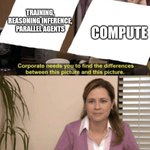






once model quality is in equilibrium i suspect (1) pricing (2) harness quality (3) API quality (eg all of openai's recent stuff - agents API, decisions API) -- will play a factor in lock-in (very stripe like approach)

this is the part that fascinates me. both the labs are amazing, but the low switching cost is just...wild
theinformation.com/articles/…

exceptionally bad take. agentic workflows need inference they're growing exponentially. investing in chips is the easiest way to margins while reducing prices. why do you think google charges so little - charity?

Frontier labs making custom chips is not really as hard / as impressive as you might think.
1. They are primarily targeting inference not training. inference is easier
2. They are targeting transformers only. Think large MXU matmul units
3. They are writing all kernels in close to ISA with coding agents RLed for their ISA.
4. They aren’t making high level compilers for codegen
A frontier lab vending a true generic chip like a Nvidia GPU or Google TPU is MUCH harder than spinning up an in house inference program.
Still I think you will see many more inference chip companies as the cost of the software is just the cost of tokens.

bullish for gcp. curious if Gemini shows up in AWS and Azure now

OpenAI models are coming to Google Cloud.
We're bringing our frontier models and Codex agentic workflows to Google Cloud's Model Garden, so enterprises can use our technology where they already build.
openai.com/index/openai-mode…

1) then whyre they pretraining
2) agentic coding token $s don't commoditize at scale. meta spends so much money on ant, the cost of bad code at scale is too high
3) idk
4) training large models is complex. msft & aapl aren't in the frontier game either. it's not just rl envs
Some thoughts about the frontier AI business right now:
1. The recipe for making AI coding models is widely known throughout the industry and all of Silicon Valley. There is no secret to this. It is primarily RL envs + Compute.
2. I predict in single digit years most companies / individuals will use free AI coding models. Free meaning sold at chip time (cost). There will be no real business in selling AI coding models, as there is no inherent moat in making AI coding models.
3. Frontier labs without cash producing businesses will be unable to subsidize AI coding models and will transition to selling other forms of intelligence like biology, chemistry, pharmaceuticals etc.
4. Most companies you see that are still behind in coding models like @Muse and @SpaceXSI are mainly due to lack of RL envs and harder tasks. What I am saying here is that these gaps will further close, as these companies make more RL envs.

quoting because diluted in replies. $100b capex > "lesser" opex later. anecdotally meta is 1/5th of ant revenue, implying ~$7-14b annual opex. meta is forecasting that to grow larger - they & most bigtech are better off developing their own models. $AAPL/$MSFT will feel this soon

Dumb question but what's the advantage of $META having spent 100b+ to develop their own model under Muse, as opposed to having kept that money and just built Muse with whatever model gets the job done?

I suspect major distillation from 4.6 to 5.5 which will follow and repeat itself from 5.6 sol to whatever they release next, at least on writing / articulation

Opus 5.5 is currently the best model. Astra and the new sol are oddly again bad at writing, communication and style to the point it makes it hard to figure out what’s going on during long auto research loops. Quite frustrating.
Whatever made 5.6 sol amazing should be repeatable. But somehow it’s not. Funny how writing, comm style and personality are so hard to get consistently right. Why?
idk about whether this explains the alignment bit, but the bullets are basically spot on.

ok i think i finally figured out why alignment has gone basically nowhere after 15 years and several billion dollars. the problem is hard sure. but have you met the people in charge of it
1) the leadership does not know how computers work. ask one what happens when you type a url into a browser and watch them start sweating. dns is a spooky word. they genuinely believe the model lives in "the cloud" like a ghost haunting a castle
2) zero idea how large scale distributed systems work. never been paged at 3am. never watched one bad bgp announcement take half the internet offline. their big threat model is the ai "copying itself across the internet" like its a floppy disk virus from 1998. brother it needs 50 megawatts, a liquid cooling loop and a personal relationship with jensen. it is not escaping onto your smart fridge
3) they dont understand the stack they are supposedly protecting us from. ask about inference servers, kv cache, batching, egress, rate limits. blank stare. ask how the model will seize the power grid and you get a 45 minute answer with a hand drawn diagram and three links to their own blog
4) nobody can define an agent. ask ten of them and you get eleven definitions and a 30 page google doc. to the rest of us an agent is a while loop that calls tools and eats a 429 every thirty seconds. to them its a digital god in its larval stage. my agent cant book a dentist appointment without asking me three times if im sure
5) they started from "everyone dies" and worked backwards so every result is bad news somehow. model refuses, deceptive. model complies, sycophantic. model does well on evals, well now its scheming about the evals. i cant think of a single thing a model could do that would get them to say ok maybe we're fine

Anthropic has set up a wet lab in San Francisco, their bio research has advanced beyond in silico. They are now conducting physical research both in-house and with external partners. The NYT also broke the news this morning that Anth now plans to scale its compute to 5 GW by the end of the year, and 10 GW within the next 16 months. Bio is next after math, and I think we are going to see some medical announcements much sooner than people are expecting.

idk. median quality of life in sg is higher (esp vs US). the upside is not as high, the social risk of failing is worse - so people dont take risks. consequently, striving to be slightly above avg (via early game) basically lands you at amazing quality of life vs rest of world

Early game in sg is overrated. Mostly a deep dive into a local minima (a decent one but far from global).
I frequently tell others the reason why I'm here today is because I did horribly for a levels and CS was a alevels dumping ground back then. If I had a strong early game maybe I could have accidentally gone into finance or law. 😳
Common wisdom in sg is also generally local minima diving and more often than not, just bad advice. Be brave to be who you are and enjoy what you do.
bad math. meta wouldn't be training it's own models then. they save money in the long run by avoiding dependency for such a core tech


three body problem wen @AnthropicAI @OpenAI
We’re sharing a solution to the Navier-Stokes Millennium Prize Problem, one of the deepest problems at the frontier of mathematics.
The proof was produced by a group of agents, using an OpenAI next-generation model significantly more capable than GPT-6 Astra.
The problem concerns whether the description of smooth three-dimensional fluid motion modeled by the Navier-Stokes equations can break down. It has remained unresolved for roughly 90 years.

going closed & pushing capital onto llms (while CA ensures unenforceable noncompetes) has actually accelerated llm research. it's wonderful that math is an open-sharing domain but free markets with fluid capital allocation helps research go vroom. math should not be different

Still more absolute 🔥 from Terence Tao:
“We have now seen that even the rumor of someone working on a problem can trigger a massive amount of AI-powered effort to flatten it before the original research project has time to reach its full potential. The incentives may now be pointing in the direction of no longer sharing any promising research directions with the broader community, which would reverse centuries of traditions of open science and do serious long-term damage to the future of the field”


ai is beautiful

GPT-6 Astra has the best result yet on the Bach Benchmark. Its chorale contains no voice-leading errors, and its harmonic palette is sophisticated enough to include a Neapolitan sixth chord. More importantly, it is the first model to ever write passing tones on this benchmark, a significant leap in musical understanding.
Extra High effort. Prompt below:
“In LilyPond (version 2.24), write a 4-part chorale in the style of Bach, 3/4 time, G minor. Use two staves -- soprano and alto on the top staff, tenor and bass on the bottom staff. Respond with only the code block.”
big ouf
character.ai (noam gone); their personalization was amazing, idk what happened to it / where it got used
windsurf (antigravity barely talked about rn, internally probably fine)
contextual.ai (?)
mechanize (?)
barret zoph (?)
idk what else

